A teacher watching a child have a seizure has an awkward problem. Helping the child and going to fetch help are two different jobs, and they have only one body. In a testimonial published by CENTEGIX, a Texas high-school teacher describes using a wearable badge to summon assistance while staying with the student. The administration handled the response. The teacher stayed where she was needed.
This is a quieter story than the one usually attached to school security. There is no cinematic control room. There is a person, a button, and the distance between a classroom and somebody who can help. CENTEGIX has built its business around shrinking that distance. The button is the part you can hold. The harder part is arranging everything that happens after you press it.
- The job: wearable emergency alerts connected to location maps and response workflows.
- The surprise: CENTEGIX classifies 99% of school alert usage as everyday incidents in its 2025-26 report.
- The customers: school districts, healthcare organizations and other workplaces with people spread across buildings.
- The catch: installation, training and a working response team matter as much as the badge.
The emergency that happens on a Tuesday
School safety is often discussed through the rarest, most frightening event imaginable. CENTEGIX's own usage figures tell a more ordinary story. Its 2026 school report records more than 346,000 activations, including drills and testing, and describes a 99-to-1 split between everyday incidents and extreme campus-wide emergencies. Behavioral incidents dominate its everyday category; medical incidents also feature.
Everyday incidents
Company-reported classification
That changes the buying question. An emergency tool can earn its place through an ordinary medical crisis or a request for help with a physical altercation. It need not spend its entire working life waiting for catastrophe. For a district administrator, the useful question becomes: can the employee nearest the problem reach the appropriate people without abandoning the scene?
CENTEGIX started in 2017. Its current leadership page identifies Daniel Dooley as founder and Brent Cobb as CEO. The company's stated mission is to innovate safety solutions that empower and protect people. Its values are empowerment, innovation and advocacy. A customer advisory board contributes to product direction and customer experience. Those aspirations become interesting only when reduced to a practical question: who is allowed to ask for help, and how cumbersome is the asking?
One button, two different requests
CrisisAlert is a wearable panic badge. It sends an alert with the user's identity and location to designated responders. CENTEGIX describes room- and floor-level accuracy and a private managed network that lets the badge operate without relying on campus Wi-Fi. Campus-wide alerts can activate colored strobes, computer-screen takeovers and intercom messages. The employee supplies the signal; the platform distributes it.
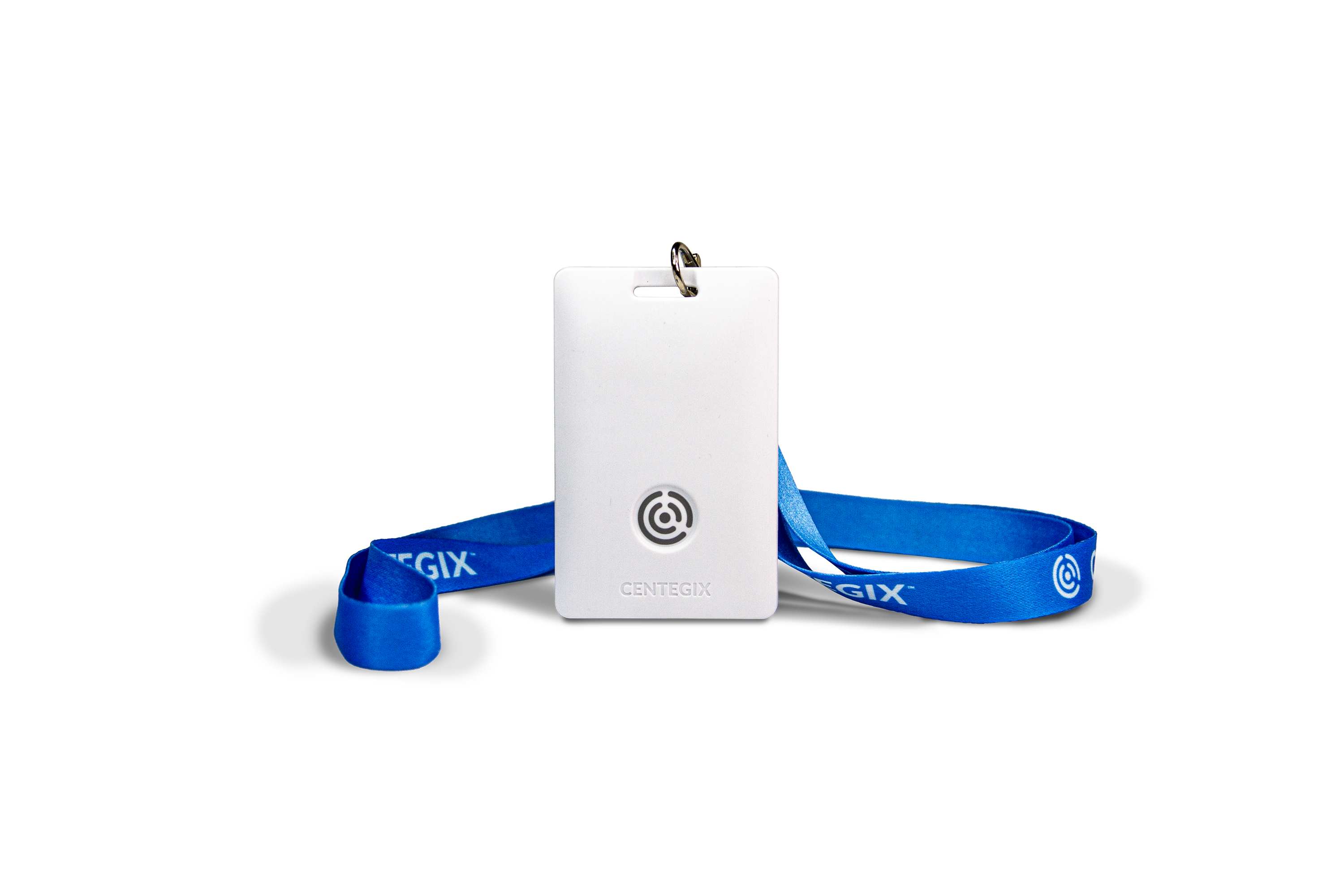
The company's 2023 quick-start guide makes an important distinction. Three clicks request individual assistance and produce a short vibration. Continuing to eight or more clicks, until a prolonged vibration, triggers the campus-wide lockdown protocol. A staff alert does not announce the incident to the entire site. A campus alert does. Buyers should train against their deployed configuration, but the distinction explains the design: a medical emergency and a building-wide threat need different audiences.
presses badge
identity + location
follow the protocol
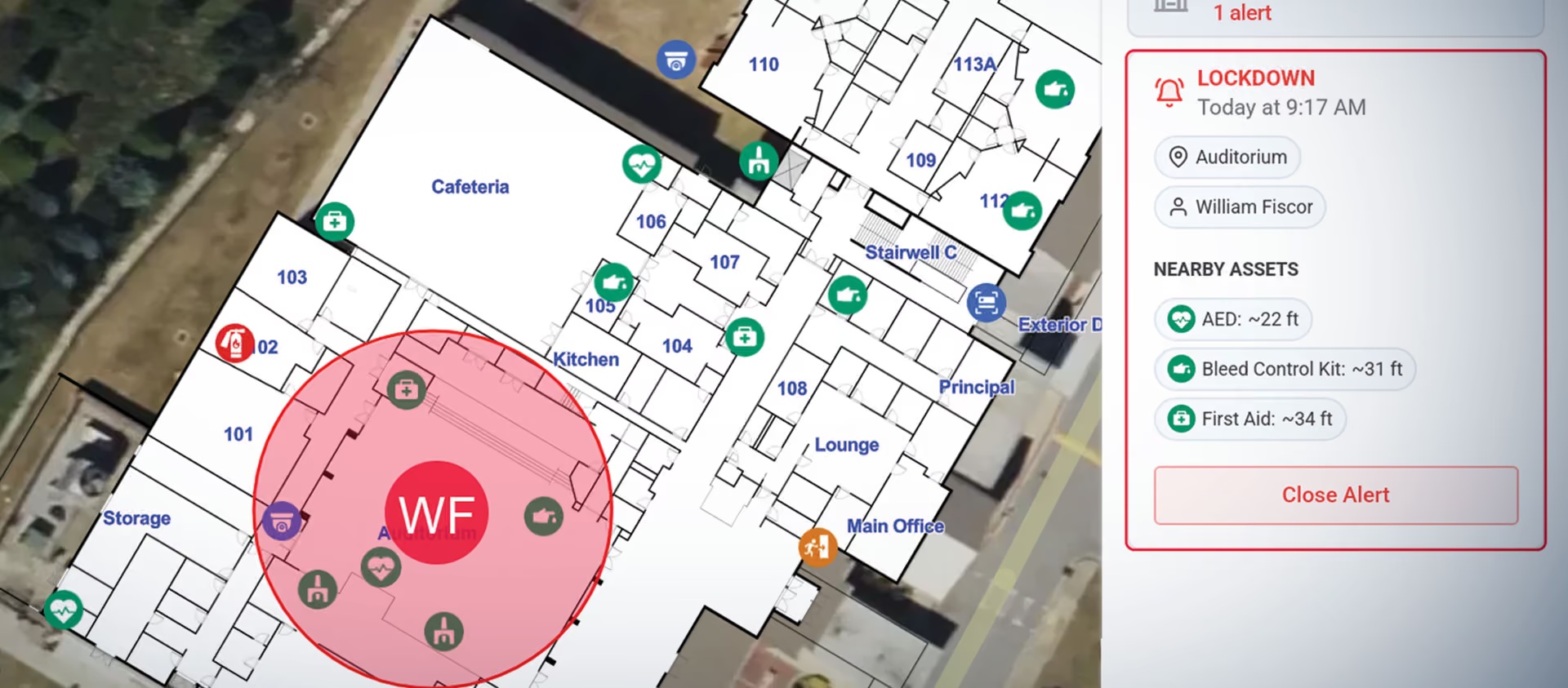
Safety Blueprint adds the map. It locates incidents and safety assets, including equipment responders might need nearby. A map is useful because people under pressure should not have to remember which corridor contains an AED. Its usefulness depends, in turn, on somebody keeping the underlying building and asset information accurate. An exquisite map of yesterday's building is an oddly expensive way to get lost.
Charlotte supplied an expensive rehearsal
The early record contains a serious counterexample. In January 2020, the Charlotte Observer reported that Charlotte-Mecklenburg Schools had agreed to buy $1.75 million in CENTEGIX equipment and paid about $1.13 million, despite staff warnings about performance. An internal email described a teacher's June 2019 alarm activation failing to summon help. The reporting also questioned the district's use of purchase orders and its procurement oversight.
The district terminated the relationship in February 2020. Superintendent Earnest Winston said problems included badges and beacons failing to work properly, particularly in multi-story buildings. What failed first, in the reported chronology, was the operational promise: pressing the badge did not reliably produce the expected notification. Confidence and the commercial relationship followed.
By October, a settlement returned $475,000 to CMS. WFAE reported that the district remained out at least $655,000, before undisclosed legal and removal expenses. CENTEGIX had disputed the district's account and maintained that it met the agreed criteria. Neither party admitted fault in the settlement. This was a contested deployment failure, and it deserves to remain part of the company story.
It also supplies a lesson any buyer can copy: agree on measurable acceptance criteria before expanding a pilot. Test the difficult locations, the alert recipients and the full journey from activation to response. A successful demonstration in one room cannot answer for every stairwell. The point of a pilot is to discover inconvenient things while the inconvenience is still affordable.
What a button costs when it comes with a system
CENTEGIX sells an institutional subscription with equipment and implementation services. A public Transylvania County Schools proposal dated July 2025 lists eight sites over five years, with CrisisAlert platform pricing of $8,000 per site annually. Its full quoted term total is $432,690, including additional services and implementation charges. That is a proposal for a particular scope, rather than a universal price or proof of payment.
Annual platform price per site
Eight-site, five-year scope. Full quoted total: $432,690.
A newer customer record shows a different route to confidence. Fontana Unified announced a $418,000 county-supported investment in March 2026 to expand CrisisAlert after a year-long pilot at four schools. The district described more precise communication and improved coordination among staff, school police and first responders. Fontana has 44 schools across more than 50 square miles. Its announcement explains why it expanded: experience with the pilot, followed by funding to broaden access.
The conditions are practical. Staff must wear and understand their badges. Response teams must be available. Location information must be maintained. The public Transylvania implementation document assigns the customer responsibilities for new-user training, semester test drills and reporting floor-plan changes. Schools buying the platform are also buying themselves a continuing job. A badge left in a drawer has the response time of a drawer.
The badge wants the rest of the school day
CENTEGIX has expanded beyond the initial request for help. In February 2023 it announced the acquisition of Ident-A-Kid, whose visitor-management product served more than 7,000 schools. The combination added visitor and volunteer workflows, plus an enhanced offering with real-time visitor locating. Checking somebody in and knowing where they are answer different security questions.
In April 2026, CENTEGIX acquired Pikmykid, adding dismissal management, student movement and reunification capabilities. The announcement said integration would begin immediately. It is an expansion of ambition: connect the predictable choreography of pickups and classroom transitions with the unpredictable work of emergency response. That ambition should be assessed product by product, rather than assuming an acquisition instantly makes every workflow seamless.
Outside the building, RapidSOS connects configured emergency alerts with dispatch. A July 2025 enhancement added real-time reclassification: responders can update an incident as they learn more, and dispatch receives the changed context. Inside the building, a July 2026 Rhombus partnership connects badge activations to relevant camera feeds in the Rhombus Console. Both tackle the same nuisance: an alert is only the beginning of understanding what is happening.

“Our response time has been in the seconds, not in the minutes.”
James Perry / Chief of Police, West Georgia Technical College
Customer testimonial published by CENTEGIX
The competition has buttons, too
This is a crowded market with converging products. Raptor Technologies launched Raptor Badge Alert in March 2025 within its emergency-management suite. Alertus offers hardwired, wireless, USB and software panic buttons, including a Wi-Fi wearable option and an app-paired personal duress badge. CENTEGIX's argument rests on its particular combination of a managed badge network, precise location, mapping and integrations. The presence of a button alone settles very little.
Charlesbank made an undisclosed growth investment in August 2025, joining a business previously backed by Gauge Capital in 2021. Charlesbank described plans for product development and expansion across education, healthcare, government and commercial settings. CENTEGIX reported more than 18,000 locations and 18 million people across all 50 states in its July 2026 Rhombus announcement. Those are company-reported reach figures, not a count of lives saved.
The useful buying comparison is wonderfully unglamorous: which system works in your buildings, reaches your responders and remains usable when your people are frightened? CENTEGIX has turned that question into a national business. Its prospects depend on answering it repeatedly, in the rooms customers actually occupy. Somewhere, a teacher still needs to stay with a child. The rest of the system has to come to them.
See the button at work
Explore the CENTEGIX website and CrisisAlert, or watch the product in action.