Michael Martin’s father fell from a roof while removing snow. His cellphone would not connect him to 911. With a shattered hip and a broken wrist, he waited in the cold until Martin’s mother returned and called from a landline. The device in his pocket belonged to the mobile age. The route to help still depended on the telephone in the house.
That incident helped inspire RapidSOS. The company’s story turns on a deceptively ordinary problem: information can exist, be accurate, and still be useless because it never reaches the person who needs it. A dispatcher has to send an ambulance somewhere. A location trapped in a phone does not answer the question.
- The job: connect phone, vehicle, camera, and sensor data with emergency responders.
- The turn: move from a consumer app to the software and devices people already use.
- The economics: free core access for agencies; paid modules and commercial integrations.
- The lesson: study the receiving end of your product as carefully as the sending end.
01 / A good idea takes the wrong door
Martin’s co-founder, Nicholas Horelik, brought an unusual résumé to emergency software. He was a nuclear engineer at MIT, writing reactor simulations. Earlier, at Tufts, he had volunteered on a suicide prevention hotline, where the difficulty of locating a caller had stayed with him. The two arrived at the same problem by different roads.
The first product was a smartphone app called Haven. It let people send emergency information and location, and offered family safety features. It was an understandable starting point: put a better emergency button on the thing people carried everywhere. But the company’s own origin account records a failed Kickstarter campaign and a subsequent pivot away from the consumer application.
The founders drove more than 1,500 miles visiting agencies in Martin’s father’s Prius. They discovered that delivering emergency information meant fitting into existing operational systems. An early technology-company pilot helped them work through the product. The receiving end of the connection was becoming the center of the business.
“We were a company seed-funded by competitions.”
Nicholas Horelik · MIT News, 2015
02 / The phone already knew
In June 2018, Apple announced that iOS 12 would use RapidSOS’s data pipeline to share emergency location with US 911 centers. Apple calculated location using its own technology; RapidSOS delivered it into existing emergency software. In September, Google announced the US expansion of Android’s Emergency Location Service with RapidSOS among its partners.
Google’s announcement made the distinction plain. Android could combine GPS, Wi-Fi, mobile networks, and sensors to estimate location. The missing step was getting that estimate to the emergency center. Users did not need a separate app. In US testing, Google reported that the average location uncertainty radius fell from 159 meters to 37 meters.
These integrations gave RapidSOS access to a distribution channel a consumer app would have had to build one download at a time. Its useful work could happen during an ordinary emergency call, without asking a frightened person to remember another product’s name.
03 / One emergency, fewer windows
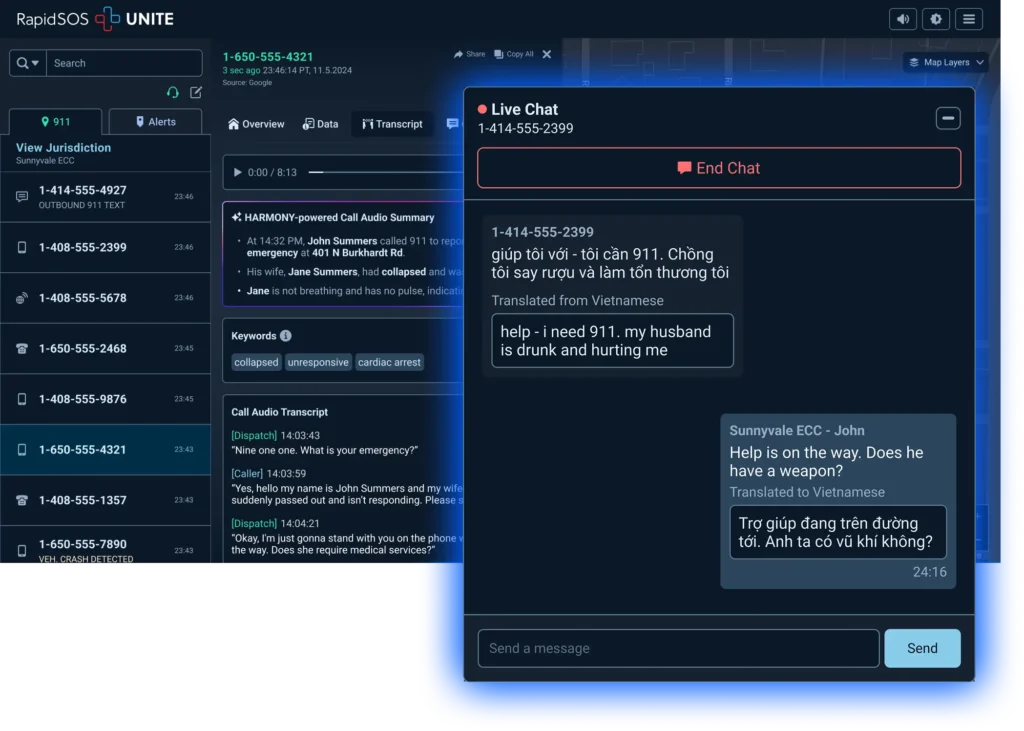
RapidSOS now sells a broader set of tools. Unite, introduced in May 2024, evolved the earlier Portal and Premium offerings into one platform. Location, medical profiles, crash information, alarms, text, and video can appear within an incident workflow. Modules extend the information to field responders or add mapping and analytics.
Harmony is the AI component: live transcription, translation, incident summaries, and natural-language queries. It also handles tasks on non-emergency telephone lines and can send requests for service into agency workflows. RapidSOS presents it as assistance for public safety professionals. Automating a routine request and deciding how to respond to a person in danger are different jobs.
The company reports a network of more than 723 million connected devices, over 23,500 first responder agencies, and more than 250 enterprise partners. Those are different populations. A connected device is a potential source of information; an agency is a recipient. Neither count tells you which paid modules an individual center has installed.
04 / Free is a door, not the whole building
RapidSOS has customers on both sides of the connection. Public safety agencies use the information and response tools. Technology companies, fleet operators, security providers, and other businesses connect products or services to that network. The Emergency API Suite offers routes for profile information, incident data, and alerts.
Core Unite access is available at no cost to public safety agencies. Premium modules cost extra. Commercial integrations are priced according to a business’s requirements and scale. The arrangement lowers the barrier for agencies to receive data while creating paid opportunities around richer workflows and connected services. A free core does not make the entire deployment costless.
Building that network has required substantial capital. RapidSOS closed a $150 million financing round in March 2024, including an additional $75 million announced at closing. In November 2025, a $100 million round led by Apax Digital brought reported total capital raised above $450 million.
Its market position is worth being precise about. A Miami-Dade procurement review identified RapidSOS and Intrado as alternatives offering functionality similar to Carbyne’s video-to-911 platform. RapidSOS’s broader distinction is the combination of device-data distribution and agency software. For a buyer, integration with existing systems matters alongside the feature list.
05 / Ten minutes is a very long hold
At El Cajon Police Department in California, the problem was language. In a RapidSOS case study, communications manager Craig Groll described waits exceeding ten minutes for a voice translator. The department adopted Unite’s Communicator features in stages. Translated text let a dispatcher begin understanding an emergency while the voice translator was still being connected.
Supervisors also gained live transcripts and AI summaries. The installation required new hardware to process call data, with oversight and technical setup. That detail deserves space beside the feature list: a product can work with existing operations and still require local installation work.
“Every shop is different, and all the backroom equipment is different.”
Craig Groll · El Cajon Police Department
The practical condition is clear. The agency needs an enabled workflow, working equipment, and staff who understand how to use it. Translated text also needs a caller able to participate. The example illustrates a useful intervention; it does not establish a universal reduction in response time.
06 / Let the context travel
The next problem begins when a call goes somewhere else. An outage or surge can send it to a neighboring jurisdiction. In January 2026, RapidSOS introduced Real-Time Interoperability to share live transcripts, summaries, and interagency communication across those boundaries.
In April, the company announced Harmony availability through AT&T ESInet, the managed IP network carrying emergency calls. North Carolina’s work after Hurricane Helene supplied a concrete motivation: rerouting keeps a call alive, but neighboring centers also need its context. The receiving agency should not have to reconstruct everything by telephone.

In August 2026, RapidSOS announced emergency live video in Brazil through Unite. Participating dispatchers can request video or stored media from eligible iPhones; the caller controls sharing. The launch specifies iPhone 14 or later with iOS 18 or later. A video feature requires the right device, a participating center, and a usable connection.
07 / Copy the fieldwork
The transferable lesson is in those early agency visits. Watch the person who receives your output. Learn which screen they use, which information they trust, and which extra step they cannot afford. RapidSOS’s pivot suggests that fitting the workflow can be as consequential as improving the technology.
Its careers page names “Purpose over Pride” through employee testimony and describes flexible work, learning stipends, and two annual Recharge Weeks. Those are company statements. The origin story offers a more observable example of changing direction: the founders let an appealing consumer product give way to the integration work their users needed.

For an ordinary reader, RapidSOS’s citizen guidance suggests preparing emergency medical information on supported phones or through EmergencyProfile.org. Agencies can explore the core platform and evaluate paid modules. Businesses can investigate the APIs. Each path depends on compatible systems and local availability.
By November 2025, RapidSOS reported supporting more than one billion emergencies. That is a usage milestone, not a count of lives saved. The company’s contribution is easier to understand at human scale: a dispatcher receives information that would otherwise have required another question, another call, or another search. Sometimes the difficult part of knowing is getting the answer onto the right screen.
See the tools, meet the people, or follow the next rollout.