The OS Engineer Who Saw the Next Computer - in Your Frames
Cayden Pierce built his first smart glasses in a dorm room. He was solving a real problem - helping people with hearing difficulties read captions in real time. What he discovered was something much bigger: nobody had built the software to make smart glasses actually useful.
Seven years of obsession later, he leads Mentra, a San Francisco startup whose flagship product - MentraOS - is described by Pierce himself as "the Android for smart glasses." Write one app, deploy it on any pair of smart glasses. No reinventing the wheel for every new hardware device. No fragmentation. Just a developer-first OS built for continuous wear, real-time AI, and cloud-native applications.
The people writing him checks include Rich Miner, co-founder of Android; Jawed Karim, co-founder of YouTube; and Eric Migicovsky, who built Pebble - three people who each backed the defining software infrastructure of their era. Pierce's $8 million seed round, announced in July 2025, also drew Paul Graham, Amazon's Alexa Fund, Toyota Ventures, and 40 additional investors. The thesis is simple: smart glasses need an operating system the way smartphones needed Android.
"The hardware is finally ready, the AI is here - but there's still no OS."
- Cayden Pierce, CEO, MentraPierce didn't arrive at this insight from a conference talk or a market report. He got there the old way: by actually building it. His first pair of smart glasses were scrapped together from hardware components in a MIT dorm room around 2018. That early project - captioning glasses for the deaf and hard-of-hearing - pulled him into the world of wearable computing, where he found a community of scattered builders working in parallel with zero shared infrastructure.
That scattered-ness was the problem. And Cayden Pierce decided to fix it.
Before Y Combinator, before the $8 million, before the San Francisco office - Cayden Pierce converted a 40-year-old RV into a mobile hacker lab and criss-crossed North America building and demonstrating open-source wearables. He met co-founder Alexander Israelov on Reddit in 2022. Within a year they were on the CES 2023 floor showing off the OpenSourceSmartGlasses project to anyone who would look. The playbook: build in public, move constantly, ship first.
The lineage behind Pierce is not accidental. He spent formative time at the University of Toronto working alongside Steve Mann - widely credited as one of the inventors of wearable computing and smart glasses. Then he joined the MIT Media Lab under Professor Pattie Maes, where his research focused on proactive AI wearable agents - systems that understand what you're doing and step in when needed, rather than waiting to be asked.
The research question at MIT translated directly into the product question at Mentra: how do you build an operating system layer that lets AI apps run persistently on glasses, observe context, and act intelligently? MentraOS is, in many ways, Pierce's academic work turned into infrastructure anyone can ship on.
He left MIT in 2024 without finishing his degree - joining a short list of founders who gambled that the company mattered more than the credential. He says the timing was right: hardware had finally caught up with the software vision. The smart glasses that consumers could actually wear all day - devices from companies like Even Realities, Vuzix, and others - had arrived. What they lacked was a common software layer.
"Just as cell phones needed their own operating system, smart glasses need their own OS." - Cayden Pierce & Alexander Israelov, at CES 2023
Mentra's MentraOS borrows the logic of Android: an open platform where device manufacturers plug in and developers build once. The app store component means discovery, distribution, and monetization live in one place. Developers use a single SDK that abstracts away device-specific hardware differences. The result, in theory, is a Cambrian explosion of smart glasses apps - the kind that only happens when there's shared infrastructure underneath.
What MentraOS Actually Does
- Write Once, Deploy Anywhere - one SDK works across multiple smart glasses hardware manufacturers
- Integrated App Store - discovery and distribution for smart glasses apps, built in
- Real-Time AI Layer - persistent, context-aware AI agents that observe and act
- Cloud-Native - designed for continuous wear and always-on computation
- Open Source Core - developer-first philosophy, community-driven development
- Hardware Partnerships - built with supply-chain depth in both San Francisco and Shenzhen
That supply chain depth is not incidental. Pierce and co-founding engineer Nicolo Micheletti learned Mandarin Chinese specifically to negotiate directly with hardware component suppliers in Shenzhen. Most Western startups work through intermediaries. Mentra embedded itself in the manufacturing ecosystem, gaining supply-chain visibility and iteration speed that most hardware startups never achieve. Pierce's Chinese name - 凯登 (Kǎidēng) - appears on his LinkedIn and social profiles, a public signal of how seriously he took that commitment.
The research lineage shows up in unexpected places. Pierce's work at the MIT Media Lab wasn't just theoretical: projects included using the human eye as a camera with brain-computer interfaces, social wearables for autism, and augmented musical experiences with brain stimulation. He describes himself as a transhumanist hacker - someone who believes technology can meaningfully extend human cognitive capacity, not just entertain it.
Before Mentra took its current form, Pierce ran the H2O Smart Glasses Community - a platform connecting end users and manufacturers - and worked on contextual search infrastructure at Emex Labs. Both were reconnaissance: understanding what users actually wanted from the technology before building the infrastructure for it.
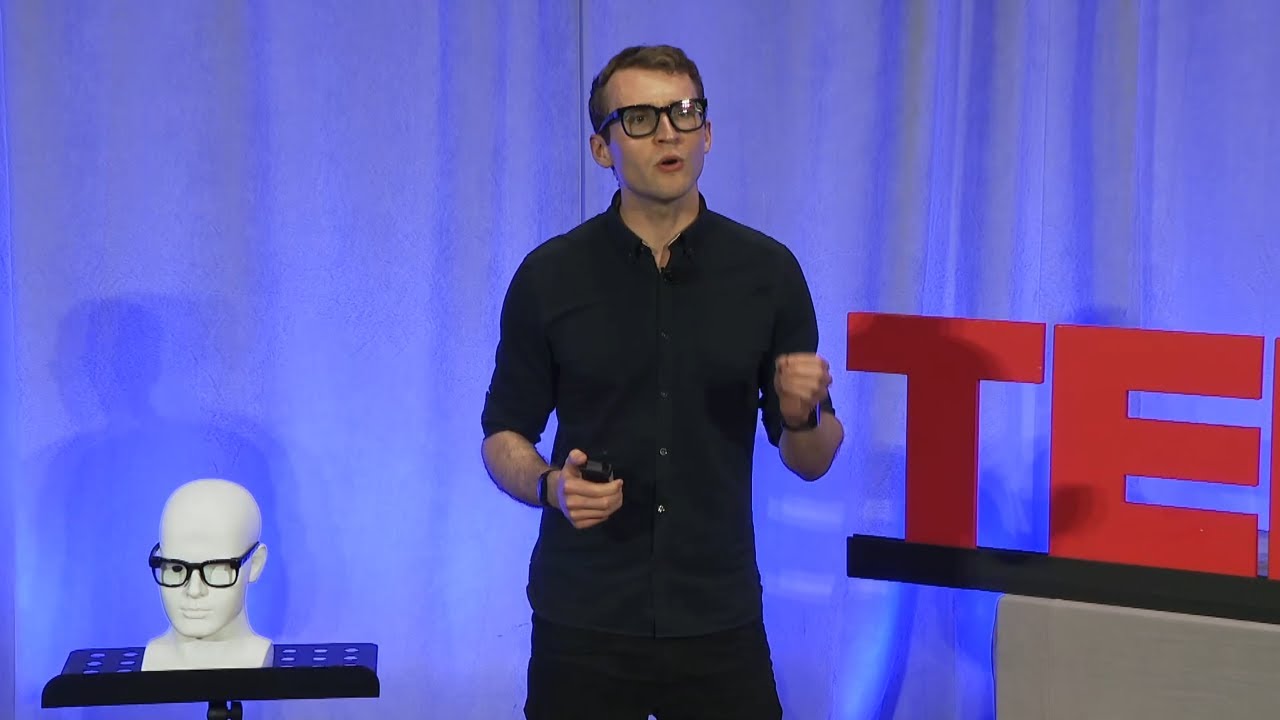
In April 2024, he stood on the TEDxMIT stage and delivered a talk titled "Can Smart Glasses Revolutionize How We Learn Languages?" - a talk that drew on both the accessibility angle from his original captioning glasses and the AI-augmentation research from his Media Lab years. Months later, he dropped out and built Mentra full-time.
The company entered Y Combinator's Winter 2025 batch with Jared Friedman as primary partner. It now has 12 team members drawn from Google, Microsoft, Nike, and other major tech companies, operating across San Francisco and Shenzhen.
The $8 million seed round, announced in July 2025, funded the launch of MentraOS 2.0 - a milestone that marks Mentra's transition from research project to commercial infrastructure. The vision: smart glasses become the next personal computer, and MentraOS becomes the software layer that makes it possible for everyone from solo developers to Fortune 500 companies to build on top of it.
Pierce's early bet - made in a dorm room with DIY hardware and no institutional backing - is starting to look less like stubbornness and more like prescience. The founders of three defining technology platforms thought so too.