Carrie Shaw's first consequential act in technology was to ignore a line in a job description. Microsoft said its internship was for engineering and computer-science students. Shaw was studying English and computer science at the University of Waterloo, a pairing that made perfect sense to her and less sense to conventional recruiting. She applied anyway. The interviewer happened to be a philosopher by training, someone comfortable with people who crossed categories. The door opened.
It is tempting to treat that moment as pluck rewarded by luck. It was both. But it was also the first clean example of the operating pattern Shaw would repeat for three decades: move toward the intersection, learn the machinery, then explain why it matters to a person. At Microsoft, she helped build and launch consumer software including Encarta, Microsoft Money and MSN services for early mobile devices. Later came startups, corporate incubation, financial data, customer-relationship software and AI for insurance. The industries changed. The work of translation did not.
The hyperlink was the clue
Long before growth teams talked about funnels in every meeting, Shaw wrote an undergraduate thesis on the anatomy of a hyperlink. Netscape was a familiar browser. The web still carried the thrilling awkwardness of a new room whose furniture had not been arranged. She ran usability tests on where links sat, what color they were and how people moved from one page to another.
That subject now sounds almost quaint. The instinct behind it does not. A link is code presented as a human invitation. It asks someone to trust that a click will take them somewhere worthwhile. Shaw was studying the seam between a technical system and a reader's behavior. English supplied attention to language and meaning. Computer science supplied attention to structure. Product management turned the pair into a job.
She stayed in product for about a decade. The discipline taught her that software cannot be designed in a sealed room, tossed across a wall and forgotten. A product manager stays for the compromises, the testing, the ship date, the maintenance and the customer reaction. Shaw later described empathy as one of product management's essential lessons because users are not copies of the people building for them. To make useful software, she had to step outside her own biases.
“In this business, you're nothing if you're not thinking about your customers.”Carrie Shaw, on the product lesson she carried into leadership
Her graduate work at Rensselaer Polytechnic Institute pushed farther into computer-mediated communication. She published on instant messaging and asynchronous video collaboration in the early 2000s, when remote work was still a technology question rather than a default calendar condition. The academic chapter did not pull her away from operating. It sharpened the same old curiosity: what changes when people meet through software?
Learning to sell without leaving the product
After Microsoft came consulting and senior product roles, including Blueprint Software Systems and Thoora. Then Shaw moved more fully into marketing at Rogers. At OutRank, an emerging business inside the telecom company's incubation group, she helped build from zero. A former colleague later credited her with an integral role in scaling the operation to $20 million and more than 175 employees. The internal awards on her profile have a distinctly operator-ish flavor, including a Golden Sledgehammer for the team's MVP. Less velvet rope, more get the work done.
Consumer product management
Startup incubation and marketing
Marketing alternative financial data
CMO, then CEO
Growth stories for technical products
Quandl presented a different translation problem. The Toronto company gathered financial and alternative data for institutions, a category that had to be explained while it was still taking shape. Shaw joined as CMO in 2016. She also carried product responsibility in public appearances, describing how the company reworked its marketplace so customers could incorporate alternative data. Nasdaq acquired Quandl in 2018. The deal gave the company a place inside market infrastructure and gave Shaw a close view of how a technical category becomes legible to a much larger buyer.
Her next move began with the best possible marketing research: she had already bought the product. Quandl had once needed a CRM. Shaw had managed a complex Salesforce installation elsewhere and remembered the administrators, custom code and effort required to make it behave. Her team tried Copper, then called ProsperWorks. Salespeople liked that it lived close to Gmail. The company used it for four years without conducting another replacement drama.
So when a recruiter called about a San Francisco CRM company and assumed Shaw had never heard of it, the pitch collapsed in a useful way. She knew Copper. She liked Copper. In 2020 she joined as CMO, responsible for global positioning, demand generation, product marketing and communications. Conviction came preinstalled.
The work leaves the keyboard
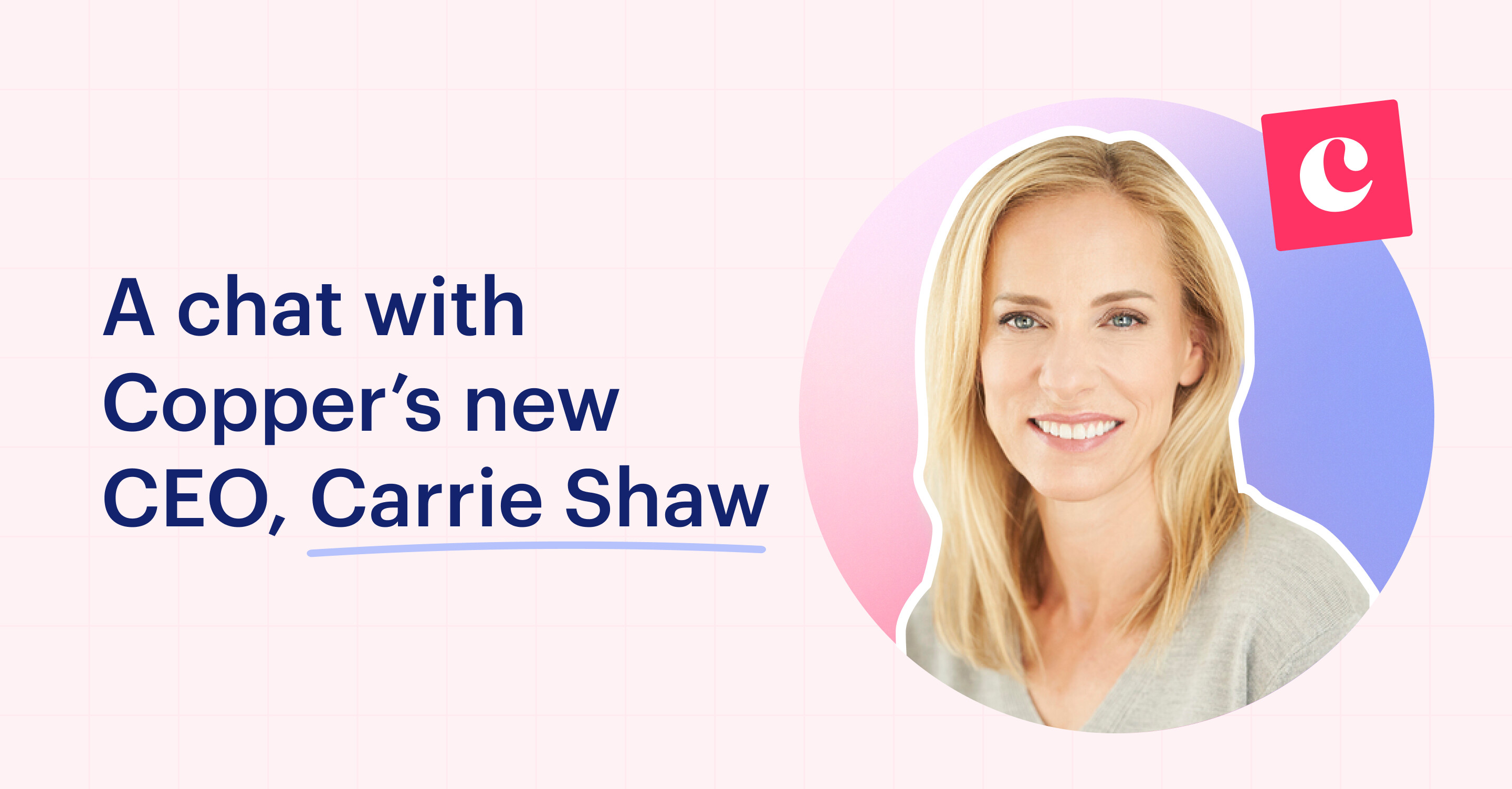
Early in 2023, Copper promoted Shaw to CEO. She nearly turned the offer down. The scope changed faster than her core habits did. She still needed a point of view, strong people, clear communication and close attention to customer experience. But decisions became tougher, more frequent and less complete. Silicon Valley Bank failed during her first quarter. No tidy playbook covered the possibility that the company's banking strategy might disappear over a weekend.
Shaw explained the new job with an observation that deserves to be pinned above a lot of desks: some days she had to step away from the computer to do the work. Planning and strategy did not always look like output. She played chess games in her head, considering her move and the responses it might provoke. A CMO might shape a creative brief. A CEO had to shape how conversations unfolded so that a group could reach the right outcome.
Asked what CRM feature she would be, Shaw chose a filter on a list view. The answer was funny because it was specific. It was revealing because it described her actual job. An executive is inundated by matters that may or may not deserve attention. Shaw's preferred move is to pick apart the list, winnow it down and act on what remains. Ruthless prioritization is how she names it. The humanity is in what the filter preserves: time for the consequential customer, colleague or decision.
AI, with the nouns removed
Shaw was skeptical of empty AI labels before they became unavoidable. In 2023, she noticed competitors hurrying to call experiments AI-enabled. The useful Copper application, in her view, was more concrete: synthesize the emails, transcripts, texts and chats that make up a business relationship, then help someone understand it without combing through every input. The value was not the label. The value was the saved comprehension.
That standard travels well to her recent work with Quandri, a Vancouver company applying automation and machine learning to personal-lines insurance renewals. The business began by automating repetitive work, then narrowed its focus to the renewal process, where policy data hides across brokerage systems and documents. Its platform checks policies, surfaces gaps, supports requoting and helps agencies contact clients before a renewal becomes a fire drill. Quandri announced a US$12 million round in July 2025 after reporting a fifteenfold revenue increase since its previous financing.
Shaw's recent public posts describe Quandri as a client and show her working closely with its marketing team. The supplied company record gives her title as chief marketing officer. Whatever the contract language, the match is recognizable. Complex technical machinery sits behind an ordinary human promise: help an insurance agent notice what matters before a customer is disappointed. It is the hyperlink problem again, only the click now opens a renewal workflow.
There is a playful resistance to formula in Shaw's public voice. She celebrated a deliberately low-budget Quandri announcement because it was funny. She promoted a hiring role by praising a team that uses AI while avoiding bland machine-made copy. During her CEO interview, she imagined her younger self reacting with disbelief: she was supposed to become a writer and did not even know she could code.
The writer is still present. So is the coder, even if she no longer spends the day coding. They appear together whenever Shaw strips a technical system down to a sentence a customer can use. She has said she still plans to write a book one day, adding a cautious “maybe” that makes the aspiration sound more credible, not less.
Her advice to her daughter was to stay open, explore without judgment and take reasonable chances. It also reads like the logic of her own career. She did not choose one side of the English-computer-science divide. She kept moving through it, from products to stories to company decisions and back toward the work of building. The useful part is not that every opportunity must be accepted. It is that a label should not become a locked door.
The most interesting thing about Shaw's career is not the sequence of titles. It is the same question surviving inside each one: what will make this useful to a person?
Technology has acquired larger models, faster interfaces and more ambitious claims since Shaw tested blue links in a browser. Trust still forms in small moments. A product behaves as promised. A marketer resists an inflated word. A leader leaves the keyboard long enough to think. Then someone filters the long list, finds the few things that matter and acts.