Before the agency, before the mobile-phone consultancy, there was the matter of the business card. Carme Miró recalled preparing Catalan mayors to meet Japanese executives: offer the card with both hands, add a small bow, take the introduction seriously. Some officials thought it sounded comical. For the visitors, she explained, the conversation depended on getting that beginning right.
A great deal of business language has been invented to describe understanding your audience. Here was an economical demonstration. Two hands. A card. A little less certainty that everybody else conducts a meeting the way you do.
Miró was working to attract foreign investment to Catalonia. She would go on to help build a consultancy around mobile telecommunications, then co-found a communications agency. Across those different jobs, the introduction keeps returning: how do you make an unfamiliar proposition intelligible to the person whose attention you need?
Her career has crossed enough borders, geographical and professional, to make that a practical question. Today she leads APPLE TREE from Barcelona. The economist who once watched businesses work out where to invest now watches brands work out how to be understood.
When the telephone became a business plan
Miró studied economics at the University of Barcelona. Her later MBA took her to MIT, supported by a la Caixa scholarship. She has remembered the pleasure of being taught by economists whose names she already knew from her textbooks. There is something cheering about discovering that the people behind the required reading actually exist.
Her early career included Monitor, the strategy consultancy associated with Michael Porter. International work put her in rooms where women were scarce. Her recollection of those years is also a recollection of movement: between countries, clients and ways of doing business.
In 1993, she and colleagues founded Cluster Consulting, specialising in telecommunications and new technologies. They saw a business opportunity in mobile phones. The useful question for a consultant was what that opportunity meant for companies trying to enter markets and build businesses around it.
Cluster’s eventual transaction with Diamond Technology Partners gives that chapter a definite endpoint. On November 28, 2000, Diamond acquired Cluster, forming DiamondCluster. A venture built around an emerging market had become part of an international consulting company.
That might have supplied a comfortable conclusion to an entrepreneurial biography. It supplied Miró with experience she could carry elsewhere. Strategy consulting trains a person to ask how an organisation works and what it wants to achieve. Those questions travel well into communication, where a beautifully executed idea still needs a reason to exist.
Three women at the same table
APPLE TREE brought together three founders with different professional equipment. Miró supplied the business and strategy background. Kirsty Brown was a British journalist. Olivia Walsh was an American creative director. The agency’s current chronology places its founding in 2007.
The combination makes sense before anyone writes a positioning statement. An economist asks what a decision will accomplish. A journalist asks why someone should care. A creative director asks how an idea can take a form worth noticing. A client usually needs answers to all three questions, preferably before the deadline.
The founders called their approach NEW THINKING, joining creativity and innovation with strategic analysis. In Miró’s account, creative work belongs in the business conversation. It should help an organisation deal with a problem, reach people or change its position in the world.
By December 2014 she was explaining the differences between public relations and advertising to university students, using campaigns to explore reputation. Her own career made the distinctions unusually tangible. She had arrived in communications through management consulting, with experience at Monitor and Cluster across several countries.
The classroom visit also placed her in a wider professional network: agency associations and an advisory relationship with MIT. She was building a company while taking part in conversations about the profession around it. For a founder, those are different kinds of work, each capable of improving the other.
“Nuestra cultura es la de explorar, probar, equivocarnos…”
Carme Miró, 2023. Explore, try, make mistakes.
In 2023, Miró spoke about considering acquisitions as another way to bring expertise into the agency. APPLE TREE had grown organically; specialist capabilities could also come through partnerships. Its alliance with influencer agency Keepers illustrated that possibility. An established company still had things to learn, and other people might already know them.
The second B in the hiring brief
Ask Miró about the ingredients of a team and she gives an answer that can sound almost disarmingly domestic: good people. In the agency’s recruitment language, BB stands for buen profesional and buena persona. Professional ability and personal conduct both belong in the assessment.
There is a business argument inside the pleasant wording. Agency work passes between people. A strategy needs a creative expression; a creative expression needs someone who understands the audience; the client needs the whole thing to arrive as a coherent piece of work. A colleague who makes cooperation difficult adds a cost that rarely appears neatly on the brief.
Kindness, in that setting, has tasks to perform. It helps information move. It makes asking a question less expensive. It gives someone a reason to help when the reward will be shared. These are ordinary acts, which is why a company has to repeat them often enough for them to become credible.
Miró pairs this emphasis with demanding expectations. Her public account of leadership allows for ambition, curiosity and the willingness to attempt unfamiliar work. The pleasant colleague still has to deliver. The accomplished colleague still has to be someone others can work alongside.
Her September 2026 reflections on leadership return to collaboration and the ability to turn the page after a difficult decision. That second skill matters for anyone running a company. A decision can require care without becoming a permanent residence. Eventually, there is work waiting in the next room.
A place on the pitch
One place Miró has chosen to put the agency’s attention is women’s football. APPLE TREE supports women’s clubs, connecting an interest in equality with the practical matter of visibility. A communications business has particular reasons to notice who receives attention and who struggles to obtain it.
During a January 2024 interview, she described sponsorship of young players at CFF Olympia Las Rozas and a campaign concerned with equality and respect. The scale is revealing. Alongside the familiar names that appear on agency client lists, there were children beginning to play.
A sponsorship is a specific choice about resources. It gives a company’s stated priorities an address, a team and something to do. For Miró, the subject belongs beside the broader discussion of women reaching positions of authority. Opportunity depends partly on whether others can picture you occupying the space.
APPLE TREE became a B Corp in 2022. Miró has publicly celebrated membership of that movement as a professional achievement. In a separate discussion of corporate purpose, she argued that purpose must belong to the whole business. That places responsibility across the organisation, including the parts of a company that seldom appear in a campaign.
Her more recent comments about women’s leadership also address the circumstances around a career: family responsibilities and access to professional networks. A company can encourage confidence while recognising that time and connections are unevenly distributed. The point has force coming from a founder whose working life has depended on international relationships.
The next person asking may be a machine
In June 2026, Miró moderated a discussion at Casa CUPRA Raval in Barcelona with technology specialist Pep Martorell and digital-business expert Genís Roca. The subject was AI, leadership and reputation. Telecommunications had given her an early entrepreneurial opportunity. Another technological change was now bringing another set of questions into the room.
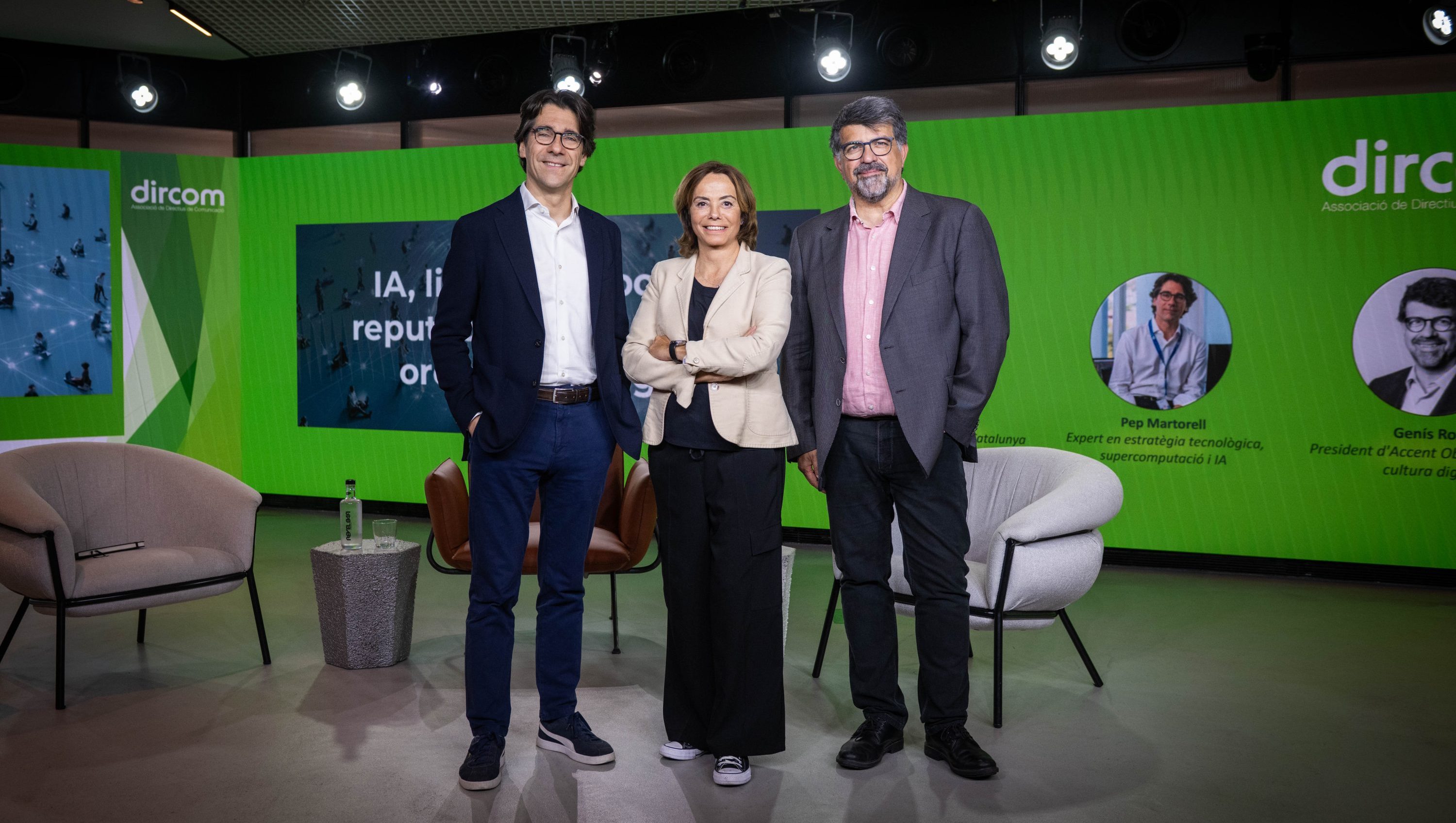
Her agency’s Agentic Relations offering examines how AI systems represent brands. Miró’s July 2026 argument was straightforward: when people use tools such as ChatGPT or Gemini to ask about a business, the answer becomes part of that business’s reputation. Communications teams want to understand what is being said about their clients in that setting.
The commercial proposition deserves the same questions she has brought to other work. What can be measured? What changes for the client? How does an organisation connect its activities with what people hear about it? A new vocabulary gives a communications agency plenty to explain.
There is continuity here with the business card. The setting changes, and people carry expectations into it. A founder who has spent years working across disciplines has reason to be interested when the terms of an introduction change again.
Outside the company story, Miró has described herself as a fan of pop music across the decades, a traveller who enjoys encountering different cultures, and someone who likes setting herself goals. Her metaphor for business is the marathon. It is a comment about persistence, rather than a claim about a finishing time.
That long view suits the career: an economics education, foreign investment, mobile telecommunications, a second venture and now the questions raised by AI. She keeps finding another audience to understand. Somewhere between the analysis and the introduction, the work begins again.