A truck can cross a state line at 2 a.m. A bank transfer, faced with the same hour, may prefer to sleep on it. Somewhere between those two facts sits Carlos Medellin's working life: invoices, currencies and the stubborn interval between money being promised and money becoming useful.
Medellin is the co-founder and chief executive of Coba, a fintech company building financial infrastructure between the United States and Latin America. The title is tidy. The problem is not. A business may collect dollars, owe pesos, pay a carrier on one side of the border and answer to a customer on the other. Each handoff can introduce a fee, a cut-off time, another account and the thrilling possibility that everybody spends Friday afternoon refreshing a balance.
His route into this problem began in finance rather than product theater. Medellin studied finance at Tecnologico de Monterrey and earned a master's degree from Copenhagen Business School. He later became chief financial officer at Icalia Labs, a software company working across Mexico and the United States. A CFO learns the less romantic geography of a company: where cash waits, where it leaks, which delay is merely irritating and which delay prevents tomorrow's work.
That experience gave Medellin a founder's advantage that is difficult to photograph and wonderfully easy to underestimate. He had seen the back office. He knew that a financial product is judged twice: once when the interface behaves, and again when the money actually arrives.
01 / A company born on the roadFour hundred miles of friction
Coba traces its beginning to the highway between Austin and Monterrey. Somewhere along the roughly 400-mile run on Interstate 35, Joseph Saliba and Eduardo Lopez De Leon were discussing the trouble foreign nationals encountered when trying to use American banking from outside the United States. There were few options. The accounts that existed often became clumsy the moment their owner went home.
Medellin and Abraham Kuri, longtime colleagues of the pair, joined the founding group. The team's first ideas were about connecting Latin American talent with American companies. Customer conversations sharpened the thesis. Mexican professionals could earn in dollars, yet turning those dollars into ordinary life in pesos was expensive and awkward. Coba's first public product offered dual-currency accounts: receive a paycheck in the United States, save in dollars, transfer pesos locally and spend without conducting a small international summit every payday.
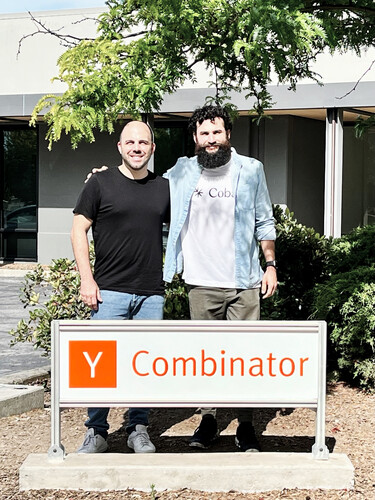
The company entered Y Combinator's Summer 2023 batch with that proposition. Its launch page estimated that an international knowledge worker could lose $1,000 each year to hidden foreign-exchange and transfer costs, while money touched at least three accounts on its journey. The arithmetic had all the charm of a baggage fee. It also made the product legible. One account. Two currencies. Fewer places for a paycheck to become smaller.
From paychecks to payloads
Founders are often told to fall in love with a problem. Coba did something more useful: it kept following the problem as its setting changed. Cross-border friction appeared in remote-worker paychecks, then again in the operations of companies moving goods. The same border, the same dollar-peso choreography, but with trucks, brokers, carriers and suppliers added to the cast.
The freight version is particularly unforgiving. Commerce across the US-Mexico corridor runs through nights and weekends. A carrier cannot always wait for a conventional banking window. A business may need to convert currency, schedule a payment, confirm funds or settle an obligation while the load is still moving. A delay is no longer an abstract inconvenience. It can become idle equipment, a strained supplier relationship or working capital marooned on the wrong side of a ledger.
“At Coba, we eliminate businesses' financial challenges when managing cross-border transactions and navigating costly, complex banking systems.”Carlos Medellin, announcing Coba's Monex USA partnership
Coba now describes itself as a financial layer for the Americas, connecting payment rails and regulated partners so money can move quickly and compliantly. Its own company timeline says the first US-Mexico corridor brought carrier payouts down from 30 days to hours. By 2025, the platform had become multi-rail, combining banking and stablecoin partners behind one orchestration layer. The stablecoin is not the story's hero. The useful part is optionality: select the rail that can move the payment while keeping the rules, records and safeguards intact.
This is where Medellin's CFO past becomes more than biography. Treasury is product design when the user is a business. Timing is product design. FX is product design. The quiet promise beneath all of it is certainty: the amount, the arrival and the record should agree. A pleasing dashboard cannot compensate for a payment that spends the weekend contemplating its purpose.
03 / Build, partner, repeatThe discipline of borrowed history
Coba announced a $2.2 million seed round in early 2024, led by Alaya Capital and Switch VC. Other backers included Topaz and the founding family behind Banco BASE, a Mexican bank with deep foreign-exchange experience. The investor list suggested the sort of company Coba intended to become: software-led, certainly, but attached to institutions that already understood the corridor's regulatory and currency machinery.
In 2025, that instinct became visible in two partnerships. Wallbit worked with Coba to extend access in Mexico to dollar accounts, virtual cards and USD-MXN transfers. Medellin said the aim was to let people in Mexico “hold, spend, and save in USD.” It was a continuation of Coba's original consumer logic, delivered through a partner rather than treated as a reason to build every surface itself.
A month later came Monex USA, an established corporate FX and international-payments provider. The referring partnership gave Coba's business customers a route to multi-currency accounts, global payouts and foreign-exchange tools through Monex. Medellin's public explanation was operational: faster transactions, rapid settlements and simpler global finance. The arrangement also revealed an adult quality in the company's strategy. Decades of institutional trust cannot be downloaded from an app store. Sometimes the intelligent product decision is an interface to someone else's history.
Finance in public
Medellin's public appearances stay close to the work. During Mexico Tech Week in 2025, he joined a panel about American stock ownership for Mexican founders and employees. His listed territory included cross-border transactions, equity holding and asset management. The subjects were technical, but they shared Coba's central question: how does a person or company operate across two financial systems without losing control between them?
Later that year he co-hosted an event for transport leaders around Expo Transporte ANPACT in Guadalajara. The description positioned Coba as a platform made for the cross-border transport and logistics industry. There is a clean progression in those rooms. First understand the financial consequence. Then meet the operators who live with it. A fintech founder can learn more beside a freight conference coffee urn than from another afternoon of admiring fintech.
Coba's stated company values make the same preference explicit: operators first, compliance as a feature, boring rails done well. The wording is company language rather than a private confession from Medellin, but it fits the career on record. The former CFO has built his company around details that spreadsheets taught him to respect. The boring parts become fascinating at the exact moment they fail.
The larger aspiration is continental. Coba says it wants North and South America to operate as one market, with more corridors and products joining the original US-Mexico route. There is romance in that idea if one squints. Medellin's version is more practical. One operating layer. Regulated partners. Money available when the business needs it. The poetry is hiding inside the reconciliation report.
For founders, the stealable lesson is not to copy Coba's product. It is to notice where expertise and irritation overlap. Medellin knew finance, knew a team that had operated across the Americas and knew the nuisance of money moving more slowly than work. The company emerged from that intersection, then grew by listening for the customer whose waiting had a visible cost.
A border will always be a border. It has laws, institutions and two currencies with no obligation to behave conveniently. Coba's bet is that the complexity can move backstage. If it works, the freight company sees a payment, not a maze. The carrier sees available funds, not a chain of correspondents. And sometime after midnight, while the banks appear to be asleep, the money keeps trucking.