A paycheck has a destination. A life has several. For a professional in Mexico working for an American company, those destinations can sit in different currencies, different accounts and different banking systems. The work crosses the border through a laptop. The money requires more introductions. Joseph Saliba helped co-found Coba in the space between those two experiences, where an international salary still had to become an ordinary local purchase.
The company’s beginning includes a conversation between Saliba and Eduardo López on the route linking Austin and Monterrey. López knew the difficulties foreign nationals faced when seeking American banking access. Even an account that worked in the United States could become awkward to use from Mexico. The account had crossed the border less successfully than its owner.
That is a useful place to begin Saliba’s story. His public career contains consulting firms, an engineering degree, a business-school degree, a search fund and a fintech startup. The road conversation gives those credentials something concrete to do. Two people who had worked together were discussing a recurring inconvenience. Other people recognized it. A business began to take shape.
The account that stayed behind
There is a small absurdity in cross-border work. A person can be trusted to produce software for a company abroad, then spend their own time arranging the financial machinery needed to use the proceeds at home. The job has become portable. The surrounding administration still carries luggage.
Coba’s founding premise addressed that mismatch. Its early customers were Mexican knowledge workers earning US dollars while conducting daily life in pesos. They needed somewhere to receive income, somewhere to keep savings and a way to pay locally. Treating each requirement as a separate errand leaves the customer holding the itinerary.
A transfer is only one moment in that itinerary. Receiving money, retaining it and spending it have different purposes. The useful product must follow the person through all three. For Saliba and his colleagues, the opportunity lay in bringing those activities together. The customer should be able to think about the purchase, rather than rehearse the journey their money would take to reach it.
Ownership before invention
Saliba arrived at entrepreneurship with more than one kind of business education. He holds a B.S. in Mechanical Engineering from the University of Notre Dame and an MBA from Harvard Business School. His consulting work included McKinsey & Company and Booz & Company, advising large companies on growth and operations.
Then came Ascent Equity Group, a search fund he co-founded and led. Through Ascent, he helped acquire and grow a business serving the energy industry. That business exited in 2019. His experience of building a company therefore included taking responsibility for an existing operation, with customers and work already underway.
In describing the partnership behind Ascent, Saliba said: “Both my partner and I came from entrepreneurial families.” He brought operations and consulting experience; his partner brought private-equity experience. Both had worked in oil and gas. Their backgrounds fitted the company they purchased.
The distinction between acquisition and invention makes this chapter interesting. Buying a business puts an entrepreneur inside a functioning system. Starting one requires persuading people to make room for a new system. Each approach eventually reaches the same unromantic territory: serving customers, coordinating work and making the economics hold together. A founding announcement is brief. Operating responsibility has considerably more office hours.
“Both my partner and I came from entrepreneurial families.”
Joseph Saliba, on his Ascent partnership
The customer joins the table
Saliba’s connection to Coba’s founding group grew out of a working relationship. He had been an important customer of Icalia Labs, the software company associated with Eduardo López and his colleagues. The future collaborators had already seen one another work before they began considering a company together.
Their initial exploration involved connecting Mexican talent with American employers. Conversations with workers sharpened another problem: earning abroad and spending at home could be expensive and cumbersome. The hiring opportunity came with a financial problem attached. The group followed that problem toward cross-border financial services.
Saliba, López, Carlos Medellín and Abraham Kuri became Coba’s co-founders. Medellín brought experience as Icalia’s CFO. Kuri brought software experience. The relationships supplied a starting point for the venture; the customer conversations supplied a more precise direction.
There is something pleasantly practical about this origin. The team did not have to introduce itself from scratch. Someone who had occupied the customer’s side of a working relationship moved to the building side. The question changed from what work to commission to what business they might create together. Trust had a history before the company had a product.
A salary with two currencies
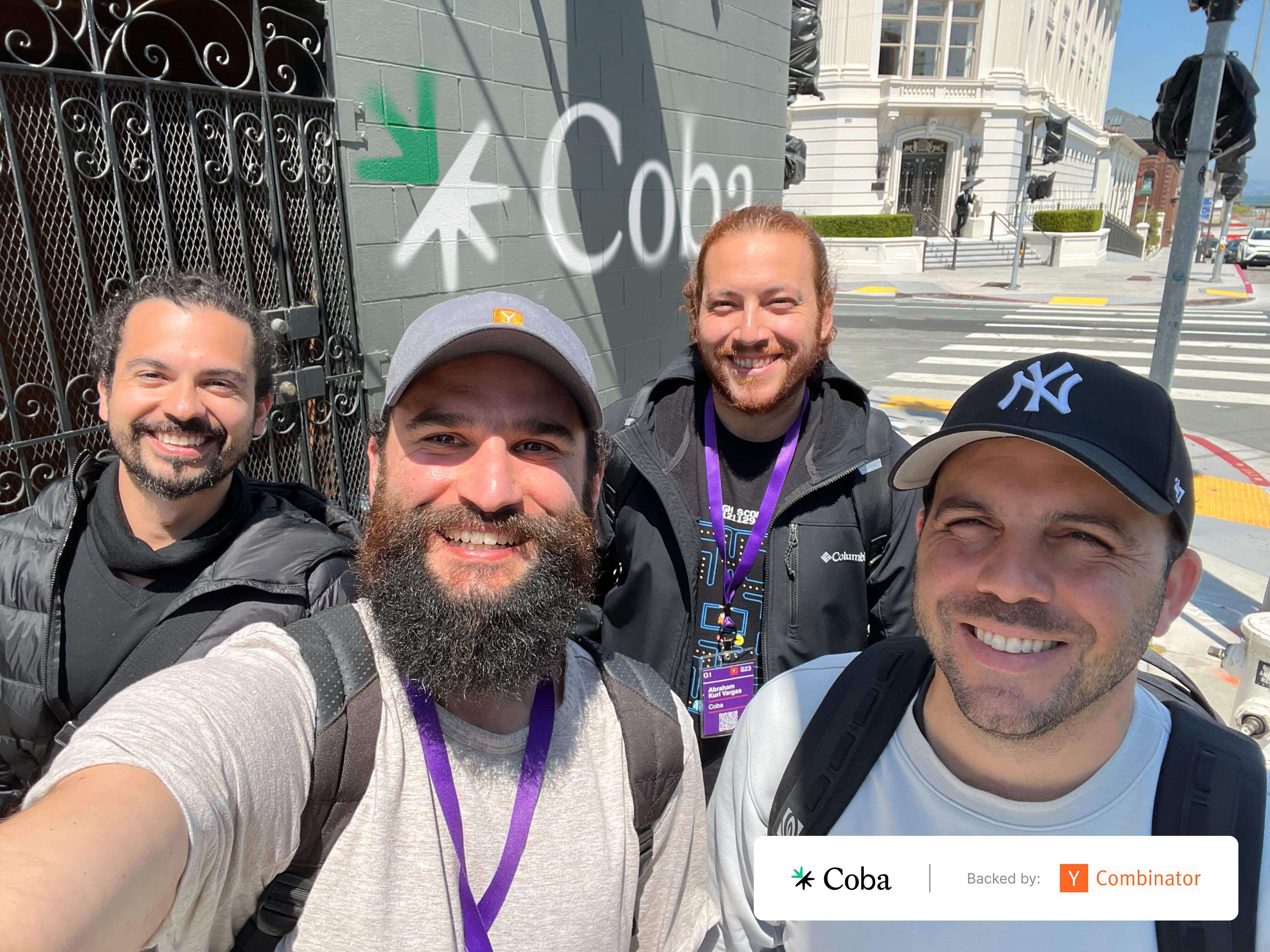
Coba joined Y Combinator’s Summer 2023 batch. Its launch proposition was straightforward: allow people in Mexico to deposit dollar paychecks into US accounts, keep savings in dollars and spend locally in pesos. The early product connected American account access with Mexican transfers and local spending features.
The company estimated that a knowledge worker could lose about $1,000 a year to hidden foreign-exchange and transfer fees. It also described money passing through at least three accounts. Those were Coba’s estimates of the problem it was addressing, rather than a claim about every worker’s circumstances.
The numbers helped translate an awkward process into a cost. More revealing was the sequence of needs behind them. A salary exists to support a life. An account balance may be accurate and still inconvenient. Coba’s pitch asked whether the receiving account and the local purchase could belong to the same usable experience.
For a founder, that is a demanding promise. Customers encounter financial products at the point where small failures matter. A confusing step interrupts something they wanted to do. Convenience has to survive the entire journey, including the ordinary transaction that nobody will photograph for the company’s launch announcement.
Potential hidden FX and transfer costs for a knowledge worker. A company estimate, not a universal fee or a measured saving.
The money follows the work
Coba announced a $2.2 million seed round in early 2024, led by Alaya Capital and Switch VC. Other disclosed backers included Topaz and the founding family behind Banco BASE. The round followed the team’s participation in Y Combinator.
Saliba’s public response was celebratory and specific to the work ahead. He thanked the people behind the round, looked forward to building more features with the team and returned to the familiar pairing of dollar earnings and peso living. Fundraising gave the company resources; the customer’s daily financial experience remained the point of the exercise.
His public networking was equally close to the product. Ahead of Money 20/20 in 2023, he invited conversations about cross-border financial services. For an early company, meeting potential partners is part of making the proposition operational. A financial product must connect with institutions as well as customers.
By April 2025, Coba was announcing a referring partnership with Monex USA for business payments. Clients referred by Coba and onboarded by Monex could access its foreign-exchange and payment platform. The announcement named Carlos Medellín as Coba’s CEO. Saliba’s founding CEO chapter had become part of the company’s history; its current team page lists him as a board member.
The company now presents a broader set of business services, including banking, workforce payments and embedded financial rails. A company paying suppliers has a different routine from a professional buying groceries, but both need money to reach the place where it becomes useful. The transaction acquires a different size and schedule. The practical question travels remarkably well.
- 2023Y Combinator’s Summer batch
- 2024$2.2 million seed announcement
- 2025Monex USA referring partnership
The researcher returns to the customer
Today Saliba is also a partner at Strop Insights, working across quantitative and qualitative consumer research. His current professional life brings together a Coba board seat and a research practice. The roles put him alongside both the businesses making decisions and the customers whose behavior gives those decisions meaning.
Strop describes its approach in terms of operational constraints, competitive responses and the choices a business has to make. Its name comes from the leather tool used to sharpen a razor. The metaphor is almost obligingly editorial: an instrument for making the edge more useful. Nobody needs a customer study that merely looks handsome on a shelf.
The connection to Coba is worth considering as a question, rather than a claim about Saliba’s private motivations. How much of a customer’s inconvenience is visible from inside a business? A company sees its portion of the process. The customer experiences the whole thing, including the gaps between providers.
Saliba’s career offers several positions from which to ask that question: consultant, business owner, fintech co-founder and researcher. The road between Austin and Monterrey supplied one concrete answer. A person could work across a border while their financial life remained divided by it.
Coba began making a product around that division. Saliba’s story is clearest there, in the distance between the account where a salary arrives and the place where someone needs to use it. The distance may appear small on a screen. It can occupy a surprising amount of a person’s day.