Eighteen minutes is an awkward unit of progress. It is too small for a ribbon cutting, too large to dismiss when you are sitting in a truck. In July 2024, cargo handler AGI reported that its “Skip the Front Counter” initiative with CargoSprint at Los Angeles International Airport had reduced driver waiting and front-counter processing time by an average of eighteen minutes. The intervention involved scheduling, information and a paperless pickup process. A counter had become optional.
- The job: connect cargo payments, appointments and pickup.
- The buyers: forwarders, handlers, terminals and trucking operators.
- The catch: the facility, the data and the truck still have to agree.
There is something revealing about that result. International freight invites us to look at enormous things: aircraft, container ships, cranes. Yet a shipment’s next move can depend on a much smaller thing, such as whether someone has checked a document. CargoSprint has built a business around those moments. Its software sits where a financial transaction becomes permission to move something physical.
A receipt is only half the journey
Founded by Joshua Wolf in 2012, CargoSprint began with SprintPay. The premise was practical: help cargo customers pay fees so freight could be released. In 2017 came SprintPass, a vehicle booking system for cargo facilities. Put the two dates together and a pattern appears. Paying was one task. Collecting the cargo required another set of people to be ready.
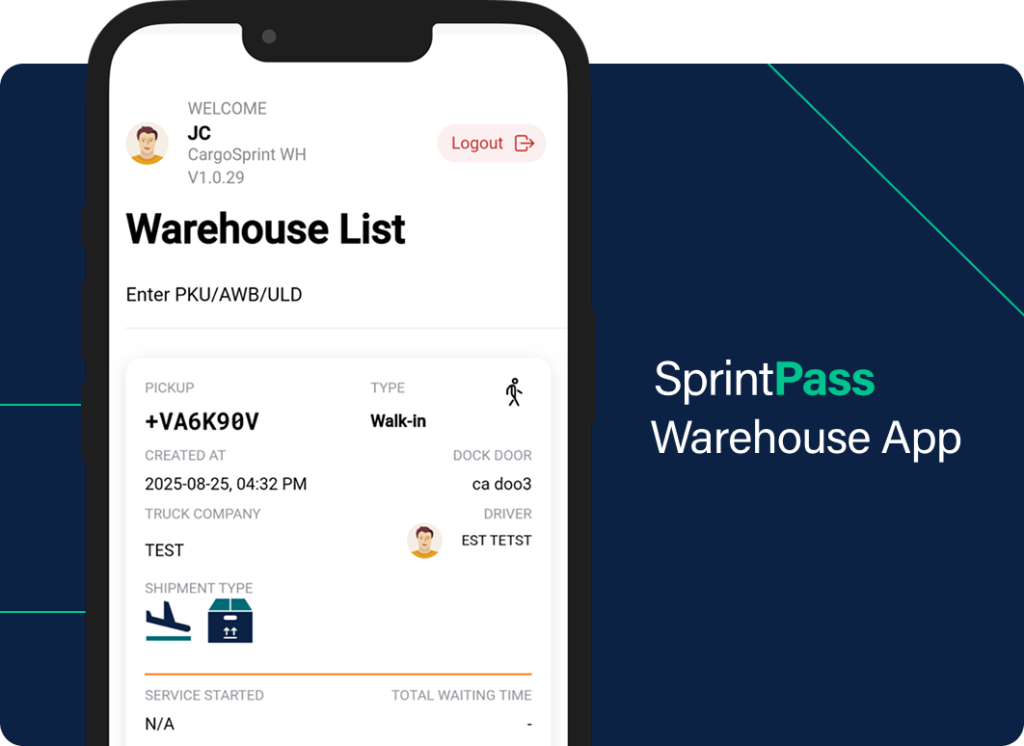
Today, SprintPay gives freight forwarders, customs brokers, truckers and shippers payment records, approval workflows and connections to transportation management systems. SprintPass handles appointments, check-in, identity validation and dock assignments. A driver can send information before arrival and follow a queue on a phone. Warehouse agents can update shipment status and record signatures. Each tool addresses a different reason for standing still.
Illustrative sequence. Actual release requirements vary by facility.
The customers occupy both sides of the handoff. Forwarders want a reliable pickup; facility managers want orderly arrivals and fewer administrative interruptions. United Airlines supplies a named customer testimonial on CargoSprint’s site. AGI supplies the more concrete LAX example. That distinction matters: an endorsement tells you someone likes a system. A measured change tells you where to start asking questions.
The price of getting unstuck
CargoSprint’s published SprintPay payor pricing is unusually tangible: $12 per transaction for a standard account, $17 for a guest, with no annual fee. Business Pro requires a conversation. The commercial engine includes transaction fees, financing and integration services; buying the wider software portfolio involves its own arrangements. A published payment price is a starting point for procurement.
The arithmetic is easy to borrow. At 100 standard transactions, the posted transaction fees total $1,200, before any other applicable charges. An operator can compare that with administrative labor, waiting and storage exposure. The AGI result is useful evidence for one pickup workflow, but it does not establish that every payment saves eighteen minutes or that every facility produces the same return.
Illustration using published transaction pricing. Other applicable charges excluded.
Then there is the timing of the money itself. SprintPay Flex lets approved freight forwarders finance cargo charges on 14-, 30-, 45- or 60-day terms. Financing charges apply, and access depends on underwriting, location and contract. Its attraction is understandable: a forwarder may need to release goods before collecting from its own customer. Borrowing changes that timing. The bill still comes due.
The airport business buys a harbor
The scope widened in 2024. Lone View Capital acquired a majority stake, announced that November. Longtime board advisor Caro Krissman became CEO; Wolf moved into a board advisory role. In December, CargoSprint acquired Advent eModal, whose port community technology brought a maritime and intermodal counterpart to CargoSprint’s air-cargo strength. The combined businesses adopted the CargoSprint name in 2025.

eModal connects terminal operators with carriers and other users through appointments, fee collection and visibility. SprintPort combines interactions across terminal systems; SprintPass Pro automates drayage scheduling and fee settlement. In February 2026, CargoSprint added Dray Dog, software for port drayage operators. The acquisition announcement emphasized aligning scheduled moves with available capacity. The sequence suggests a company following the handoff from counter to gate to dispatcher.
CargoSprint says it now enables four million payments worth more than $2 billion annually and orchestrates nine million appointments. Those are company-reported volumes, not revenue figures. Its position combines freight fintech with operating software. PayCargo is a direct payment alternative; buyers comparing the wider portfolio also have to evaluate terminal systems, integrations and the facilities their trucks actually visit.
A name with a $16 million bill
The history also contains an expensive dispute. In April 2024, the Eleventh Circuit affirmed a judgment favoring PayCargo against CargoSprint and Wolf. The litigation concerned trademark and contract claims involving the earlier PayAirCargo name. PayCargo subsequently reported receiving $16,395,683.90 in satisfaction of the judgment. This is part of CargoSprint’s record alongside its products and acquisitions; it warrants attention without inventing a connection to the later ownership change.
“improve the efficiency of global commerce”
Caro Krissman / December 2024
Move the decision ahead of the truck
The useful operating lesson is to prepare the handoff before arrival. Confirm the fee, documentation, cargo status and appointment capacity while the truck can still be redirected. Measure the intervals between those steps. CargoSprint’s integration services acknowledge the practical work involved: connecting existing systems, configuring rules, testing and supporting rollout. Software needs an operating process to attach to.
Consider the dispatcher choosing tomorrow’s routes. A visible appointment slot is helpful; knowing whether the shipment can actually be collected is more helpful. Bringing those answers together can prevent a wasted trip. This is the practical distinction between displaying information and using it to organize work. It also explains why a buyer should evaluate the entire pickup process, including the people who must act on each update.
A cleared payment cannot remove a cargo hold. An appointment cannot create warehouse capacity. Inaccurate information can send a well-scheduled truck to an unready shipment. The approach depends on participating facilities and dependable data. At LAX, AGI found eighteen minutes in the process. For a driver watching the clock, that is a perfectly respectable place to begin.