The revealing object in the Cambridge GaN Devices story is a small green circuit board. It is an adaptor: a way to fit one semiconductor into a space intended for another. In a business preoccupied with switching speed and electrical losses, this is a pleasingly practical invention. It acknowledges the person at the other end of the sales pitch, looking at an existing design and wondering how much trouble improvement will cause.
- CGD designs GaN power chips for more efficient, compact power conversion.
- Its ICeGaN interface lets engineers use standard gate drivers.
- Evaluation boards and system partners help turn a device into a design.
The little board with a big job
CGD introduced its Application Interface Boards in May 2023. Their job was to map the pins of an ICeGaN device onto a supported alternative footprint. Engineers could solder the assembly into a circuit they already had, then begin evaluating. A new printed circuit board could wait. The first decision became smaller: try the chip.
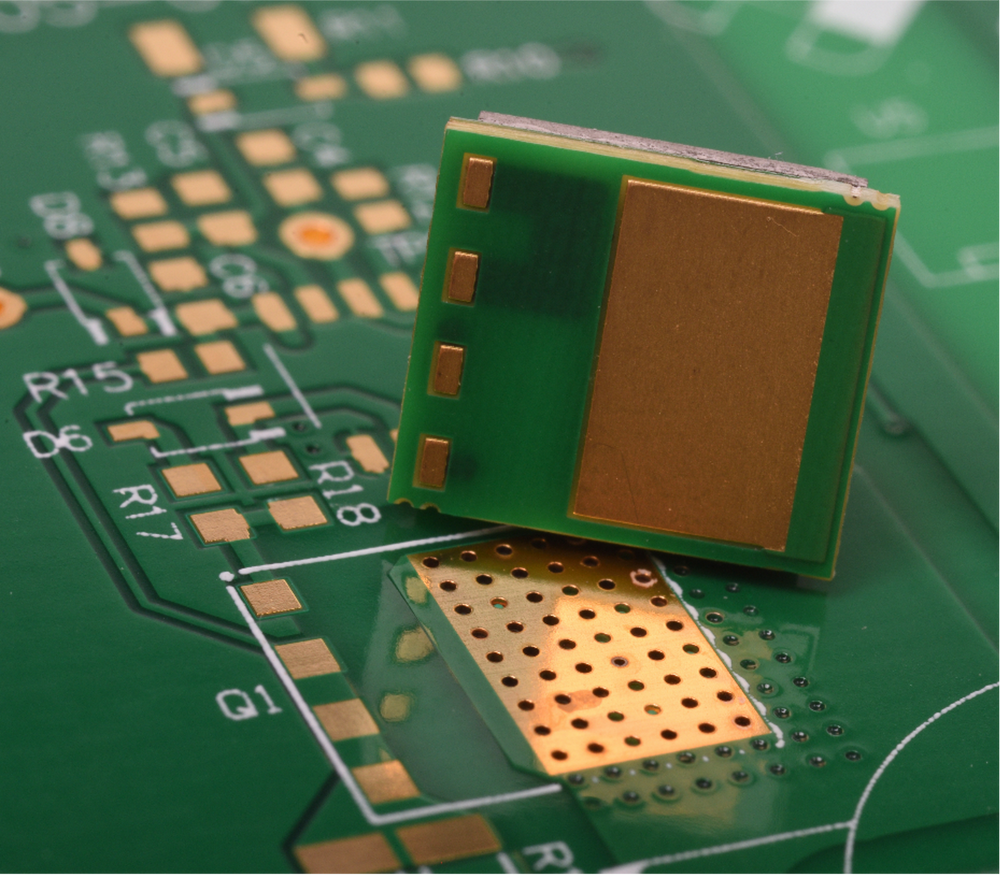
There was a catch, and the company said so. The adaptors were for design and evaluation, with some effect on thermal performance. Peter Comiskey, then director of application engineering, described “some minor impact on thermal performance.” That qualification makes the product more interesting. It was a tool for answering an early question, before committing to a finished layout.
Put the awkward bits inside
Gallium nitride, usually shortened to GaN, is a semiconductor material suited to fast power switching. Power converters use switches to reshape electricity into something a load can use. Lower switching losses mean less wasted energy. Higher operating frequencies can also allow smaller magnetic components. These are useful properties in a server power supply, a motor drive or a charger.
The complication is control. Conventional enhancement-mode GaN devices can be demanding about gate voltage and vulnerable to unintended switching. CGD’s answer is ICeGaN, short for Integrated Circuit Enhancement Mode GaN: a power transistor with interface and protection circuitry on the same die. Engineers gain a wider, more familiar gate-drive interface, including compatibility with standard drivers, within the device’s specifications.
gate driver
Crucially, CGD integrates the interface without insisting that the system controller live beside it. That leaves room for other companies’ control chips. The company sells power devices, supported by evaluation hardware and engineering material, to equipment makers and design teams. It operates a fabless model: design the semiconductor, then work with outside manufacturers to make it.
The catalogue reflects that range of work. H2 devices include current sensing and circuitry aimed at no-load and light-load efficiency. The P2 series targets higher-power duties such as server supplies and industrial drives, with on-resistance down to 25 milliohms. Packaging is part of the offer, too: thermally enhanced packages provide a route for heat to leave the device. The transistor and the surrounding design have to work together.
The price of becoming ordinary
The company began in 2016, when Giorgia Longobardi and Florin Udrea spun it out of the University of Cambridge. Their expertise came from power-device research and reliability work. That year, CGD was a joint winner of Cambridge Enterprise’s Postdoc Business Plan Competition, receiving a £20,000 investment. Its first commercial ICeGaN portfolio arrived at APEC in March 2022.
Between those dates sits the less photogenic part of semiconductor entrepreneurship: financing a product before it becomes something an engineer can order. A $9.5 million Series A in 2021 supported portfolio expansion and plans to double the team. A $19 million Series B followed in November 2022, intended to support mass production. The $32 million Series C, announced in February 2025, backed international expansion.
That is $60.5 million across those three rounds alone. It buys perspective on the timetable. A chip company must develop devices, arrange manufacturing and help customers evaluate them. CGD’s October 2025 GlobalFoundries partnership addressed the manufacturing side, expanding its supply chain. Ease of use has to survive the journey from an ingenious circuit to a dependable supply of components.
A chip needs company
The partnerships show where CGD fits. In 2023, it signed a development agreement with Chicony Power and Cambridge University Technical Services for notebook adapters and data-centre supplies. In 2024, Qorvo joined it on a motor-control reference design. Inventchip demonstrated a 2.5 kW power-factor-correction design using ICeGaN in 2025. Each connected a device to a particular engineering task.
In June 2026, CGD announced a longer-term collaboration with NXP. CGD brings GaN products and device expertise; NXP brings processors, analog products, system knowledge and commercial reach. The intended applications include automotive and data-centre power conversion. These are development relationships, and their announced scope matters more than treating a partner list as a list of finished products.
The adaptor makes the first decision smaller: try the chip.An observation on CGD’s design approach
Competition remains close. Infineon’s CoolGaN devices are another route into GaN, while silicon and silicon carbide remain alternatives for power conversion. Chicony itself announced an Infineon-based adapter design in 2026. A collaboration is no claim on every future socket. CGD’s argument rests on its integrated interface and the work that architecture can remove from a customer’s design.
The next test is the whole system
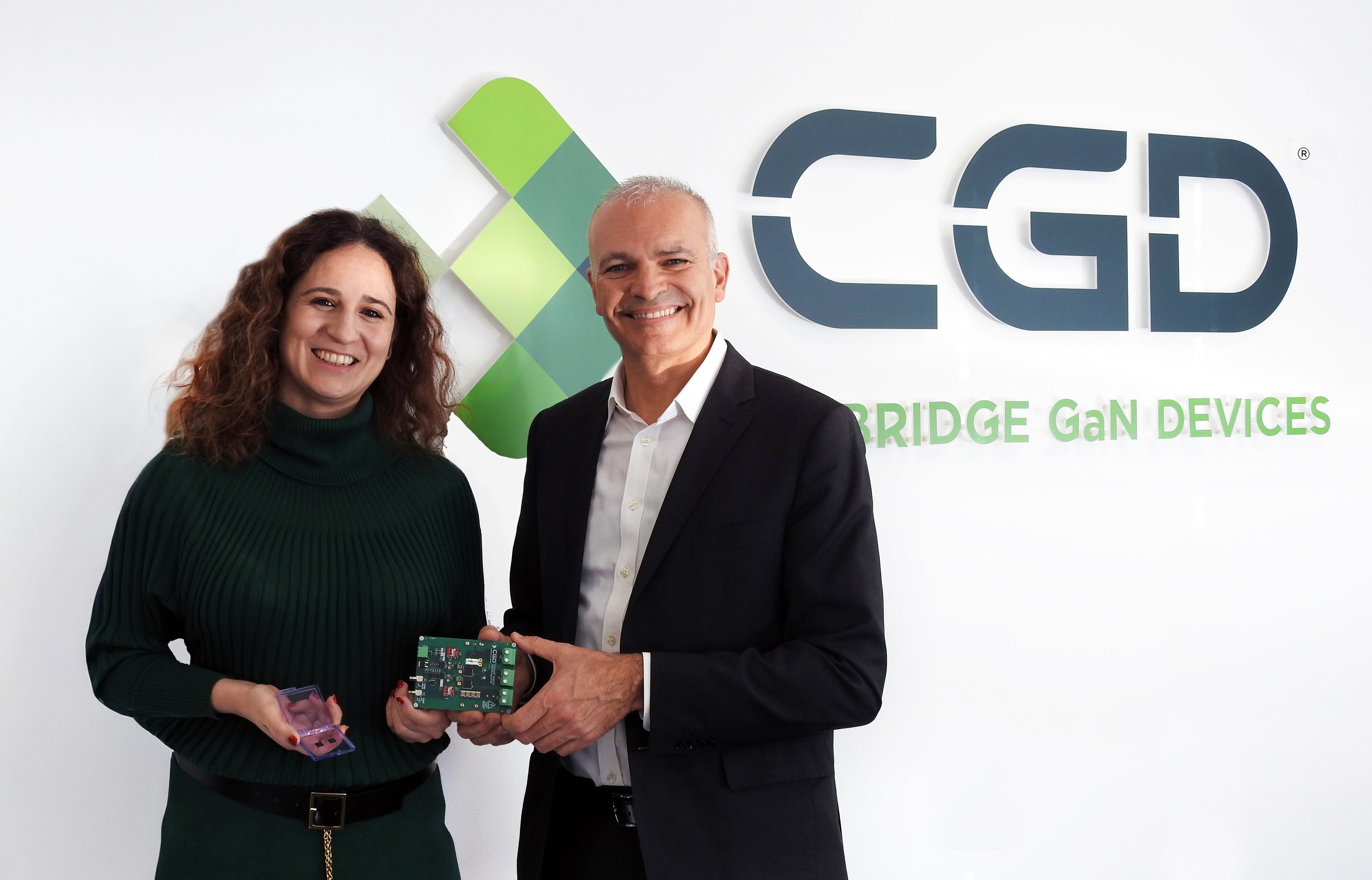
Fabio Necco became CEO in January 2026, arriving from onsemi; Longobardi moved to CMO and remained a director. In June, CGD announced a 650 V automotive prototype with 9 milliohm on-resistance and temperature sensing. It was sampling to interested parties. Hyundai’s earlier innovation-challenge recognition likewise involved a proof-of-concept evaluation. Both are progress; neither announcement establishes a production car deployment.
For engineers, the useful next step is concrete: compare the datasheet with the application, evaluate the switching behaviour, and measure the complete converter. Voltage limits, cooling, electromagnetic interference, qualification and cost still decide the outcome. For other businesses, the lesson is equally practical. Give customers a modest first experiment. Let them keep useful tools. An adaptor board can express a commercial idea with unusual clarity.