Peter Rawlinson took the long way to a simple point. In 2021, he drove a Lucid Air Dream Edition Range from Los Angeles to San Francisco, then across the bay to the company's headquarters, without stopping to charge. Another car made the journey with a motoring journalist at the wheel. There was range left when they arrived. For an electric-car engineer, skipping the charging stop was a fairly agreeable way to make an argument.
The number that followed him into the headlines was 520: the miles of EPA-estimated range awarded to that version of the Air on 19-inch wheels. It was a number customers could understand immediately. Rawlinson's explanation concerned the machinery underneath it: compact drive units, battery management and a high-voltage electrical architecture developed within Lucid. The mileage was the visible result of work most drivers would never see.
That distinction runs through his career. A car has to go somewhere, but the engineering question is how much energy, weight and space it consumes getting there. Rawlinson helped turn that question into two electric sedans, the Tesla Model S and the Lucid Air. Eventually he also became responsible for the rather less tidy question of turning Lucid into a business.
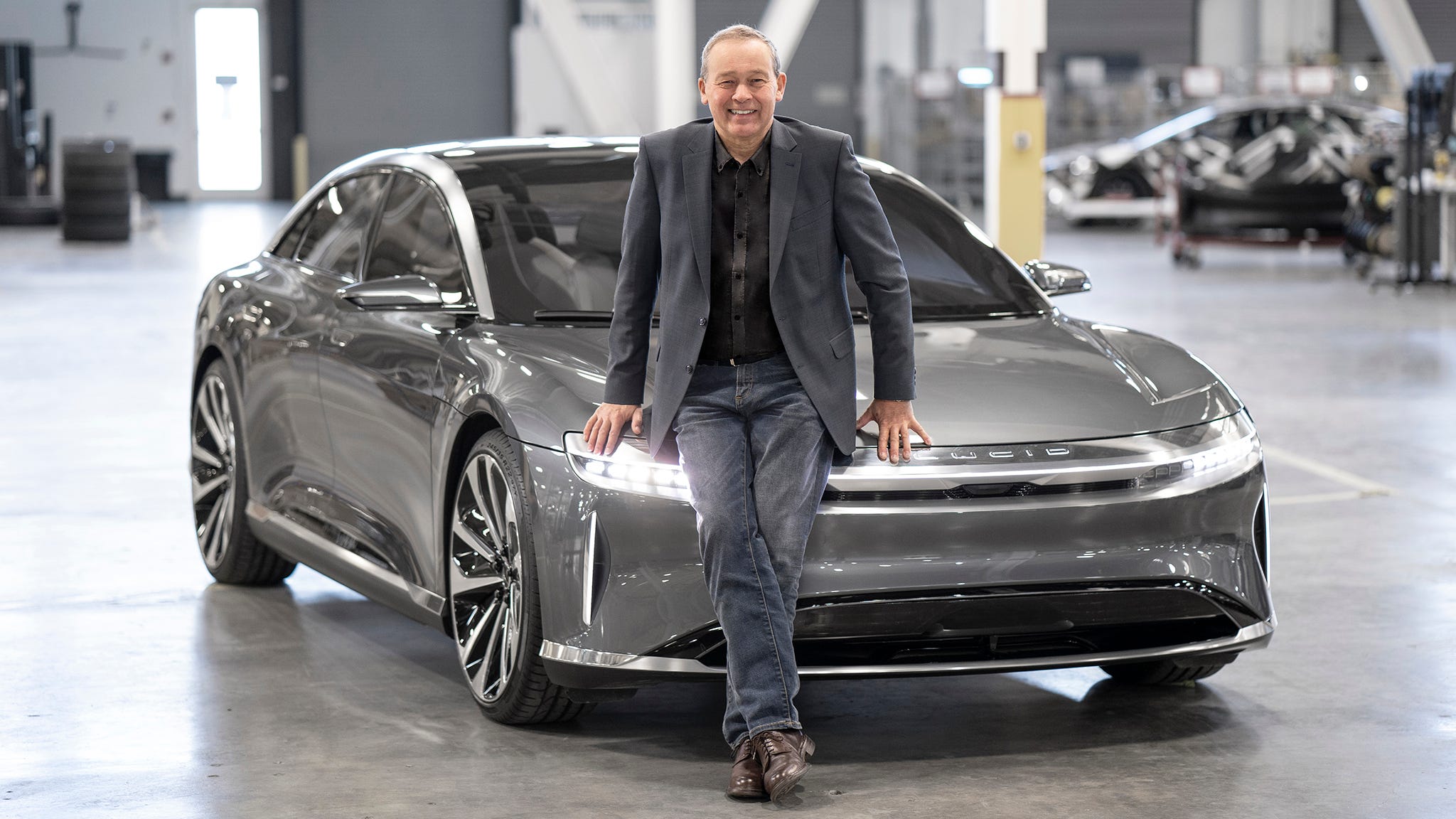
Before the car, the shed
He grew up in Bonvilston, South Wales, and attended Cowbridge Grammar School. Before there were vehicle programmes and board meetings, there were things to make at home. His mother was an artist and potter. In his father's shed, he devised buildings for a toy farm; his father handled the tools. Art school was a serious possibility. Engineering offered another route for someone who wanted to give an idea a physical shape.
He graduated in mechanical engineering from Imperial College London in 1979. Decades later, returning to the university, he described his early ambition in wonderfully ordinary terms: “I wanted to be someone who designed things and made things and created things”. The sentence could describe a child with a toy farm as comfortably as a vehicle engineer.
Rawlinson has also built his own house, cutting stone and learning enough masonry to do the job. There is something useful about that detail. A wall cannot be persuaded to stand up by a persuasive presentation. Materials have opinions, and they tend to express them without tact. His account of engineering keeps coming back to that practical encounter between an idea and what will actually hold together.
“I wanted to be someone who designed things and made things and created things”.
Peter Rawlinson, on choosing engineering
Jaguar learns to pass the file
At Jaguar in the 1980s, Rawlinson worked through a change in how cars were conceived. Drawing boards were giving way to computer-aided design. Engineering teams could use computation to examine stresses and crash performance, then pass digital files between terminals. In his recollection, the team developed a way of sharing work that would now be called an intranet. At the time, they were simply trying to design a car together.
His subsequent positions included chief engineer of advanced engineering at Lotus and head of vehicle engineering at Corus Automotive. The titles describe responsibility; the work describes an education in structures, packaging and the awkward business of making parts agree with one another. An automobile is full of negotiations conducted in millimetres.
His experience was broader than one badge on a bonnet. When Tesla announced his appointment in 2009, it listed engineering projects across British, European and Japanese brands. It also noted that he had designed and constructed a sports car in his spare time. For Rawlinson, making things had survived employment. The house and the sports car suggest a hobbyist whose idea of relaxation still required a structure.
The Model S makes room
Tesla gave that background a different setting. Its September 2009 announcement named Rawlinson vice president and chief vehicle engineer, responsible for the Model S's technical execution and delivery. He brought experience from established carmakers into a company asking customers to place their confidence in an electric family sedan that had yet to reach production.
By January 2011, he was publicly explaining the vehicle's engineering: suspension, aerodynamics and the integration of the battery pack into the body. The pack affected much more than the fuel supply. Its position and relationship to the structure influenced how the car behaved. Electric propulsion offered a chance to rearrange the familiar compromises of a passenger car.
That rearrangement became a continuing interest. If the propulsion system could occupy less room, the people inside could have more. The question joined his original attraction to design with the structural work he had learned in Britain. A beautiful outline still needed an engineering answer underneath it. Working on the Model S gave him a practical education in the possibilities of an electric car, and another set of decisions to revisit when he got the chance.
- 1979Imperial graduate
- 2009Tesla Model S
- 2013Atieva / Lucid
- 2019CEO + CTO
- 2025Technical advisor
A second chance at the sedan
He joined Atieva as chief technology officer in 2013. The company later adopted the Lucid name, and Rawlinson added the chief executive role in April 2019. His next sedan gave him an opportunity to apply what he had learned to a different arrangement of space and machinery.
His conversations about the Air could be disarmingly specific. Asked why it had a conventional boot rather than the Model S's hatch, he pointed to rigidity. A familiar feature on the outside of the car became, in his telling, a decision about the structure beneath it. He had a past project to learn from and enough confidence to reconsider his own choices.
The Air also required more than a clever chassis. Lucid constructed its Arizona factory at Casa Grande, completing the initial facility in less than a year. Production, regulatory requirements and customer deliveries had to meet in the same place. The first Dream Edition customers were invited to take delivery on October 30, 2021. After years of engineering, someone else would finally be driving home with the keys. A prototype can demonstrate an idea; a delivered car gives that idea an owner.
Five miles from one kilowatt-hour
By July 2024, the arithmetic had become particularly clear. Lucid announced that the 2025 Air Pure had an EPA-estimated range of 420 miles from an 84-kilowatt-hour battery pack. Divide one by the other and the result is five miles per kilowatt-hour. The car's headline range was shorter than the Dream Edition's earlier 520-mile figure. The smaller denominator was the point.
The argument matters beyond a luxury sedan. For a given distance, a more efficient car can need less stored energy. In principle, that creates room for a smaller battery and less material. Alternatively, keep the battery capacity and use the efficiency to travel farther. Those are engineering options, rather than promises that every saving will reach the buyer's invoice.
Rawlinson had talked about the wider ambition years earlier: getting electric technology into cars that many more people could afford. In a 2021 interview, he suggested that other manufacturers could use Lucid's efficiency advances in smaller, cheaper battery packs. His proposed route included licensing the technology. Luxury buyers would experience the machinery first, while its usefulness might eventually extend beyond the Lucid badge.
In June 2023, Lucid announced a technology partnership with Aston Martin to supply electric powertrain and battery-system technology. Another carmaker would use work developed inside Lucid. It gave concrete form to the idea of a company selling both cars and engineering. The partner was another luxury brand, so this was a step in the licensing argument, with the affordable-car ambition still farther down the road.
The other set of numbers
Lucid's second vehicle moved the same thinking into an SUV. The Gravity was unveiled in November 2023 with accommodation for up to seven adults. Interior room, exterior dimensions and the space taken by the powertrain again belonged to the same engineering conversation. By the time Rawlinson stepped aside, the company had launched it.
A second vehicle, however, could not settle every question attached to the first. For 2024, Lucid reported production of 9,029 vehicles and deliveries of 10,241. Deliveries rose 71 percent from the previous year. Those figures show progress; they also show the distance between a technically accomplished product and a large car business. A range rating measures a vehicle. Annual production measures an organisation.
The two tests require different kinds of success. A drive unit can be examined, refined and measured. Demand depends on people who are free to spend their money elsewhere. A factory must repeatedly deliver the work of thousands of components and decisions. For an engineer who could explain how to use less battery, the chief executive's job added questions about making and selling more cars.
Rawlinson had expressed a wish to reach a million cars a year by 2030 in an interview published for Imperial's winter 2022-23 magazine. It was an ambition, and should be read as one. Placed beside the 2024 production total, it conveys the scale of what he wanted to build. The gap is part of the story, as much as the mileage figures.
The title changes; the lesson remains
On February 25, 2025, Lucid announced that Rawlinson had stepped aside as CEO and CTO. The change had taken effect on February 21, when he also resigned from the board. He became strategic technical advisor to the chairman. Marc Winterhoff, then the chief operating officer, took over as interim chief executive.
Rawlinson connected the timing to the Gravity launch and credited the team that had built the company with him. Lucid's 2026 annual filing continued to describe him as available in the advisory role through February 21, 2027. His place in the company had changed from running it to advising its chairman.
There is another way to encounter him: in Lucid's Tech Talks, opening a battery module or discussing a motor with powertrain engineer Emad Dlala. The videos give viewers the parts behind the public numbers. Someone interested in the cars can follow the explanation down into the components, where efficiency is accumulated one decision at a time.
The career comes into focus there. Rawlinson began by wanting to make things. He learned to design structures, helped develop the Model S, then led Lucid through the arrival of two vehicles. Along the way, he kept asking how much of the machine could be made smaller, lighter or more useful. The cars provide answers you can drive. The company's scale remains a separate test, and a reminder that even a sound calculation has to survive the world outside the workshop.
Keep the bonnet open
Watch Rawlinson explain the parts, then follow the conversations and milestones behind this story.