520 miles of EPA range - still the record2022 MotorTrend Car of the YearUber orders 35,000+ Lucid robotaxis2025 revenue up 68% to $1.35B687-mile hypermiling run on one chargePIF stake reaches ~56.8%Gravity SUV now shipping520 miles of EPA range - still the record2022 MotorTrend Car of the YearUber orders 35,000+ Lucid robotaxis2025 revenue up 68% to $1.35B687-mile hypermiling run on one chargePIF stake reaches ~56.8%Gravity SUV now shipping
Company Profile · Electric Vehicles · Newark, California
Lucid Motors.
The luxury EV company that turned range anxiety into a rounding error - and then started selling the engineering to everyone else.
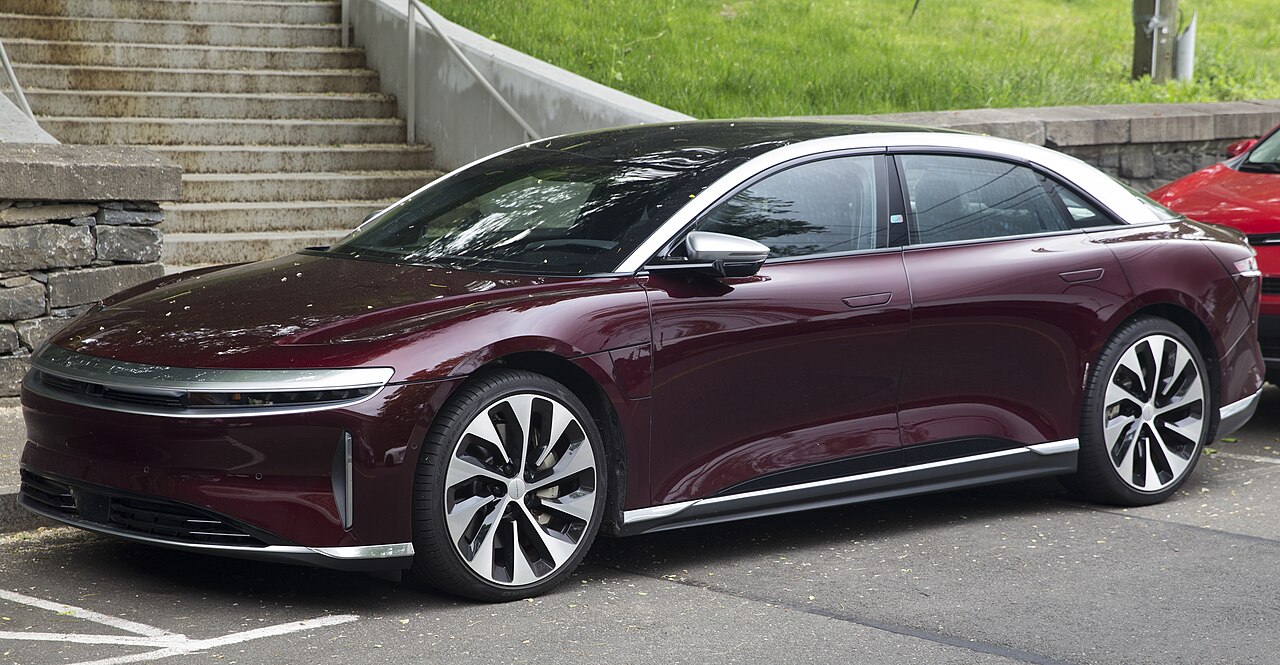
The Lucid Air Grand Touring in Zenith Red. It looks like a sedan that wandered out of a wind tunnel and decided to stay. Roughly 516 EPA miles per charge - which is to say, longer than most people's New Year's resolutions. Photo: Wikimedia Commons, CC BY-SA
A quiet factory in Newark is winning the argument about range
On any given morning at 7373 Gateway Boulevard, a car rolls off a line that does something most of the industry spent a decade insisting was impossible: it drives more than 500 miles, on electricity, without drama. The badge on the hood says Lucid. The math behind it says the rest of the car business has some catching up to do.
Lucid Motors makes luxury electric vehicles - the Air sedan, the Gravity SUV - from a base in Newark, California, with assembly in Arizona and a second plant ramping up in Saudi Arabia. It employs roughly 6,800 people and posted $1.35 billion in revenue in 2025. By the standards of the legacy carmakers it competes with, that is a rounding error. By the standards of what it has actually built, it is one of the more interesting engineering stories in modern transportation.
Range is the new currency of the electric age. Lucid mints it.
- The thesis, in one line
The company is majority-owned by Saudi Arabia's Public Investment Fund, trades on the Nasdaq under the ticker LCID, and has a habit of winning awards that were never meant to go to a startup. It is also, somewhat awkwardly for its rivals, a supplier - it sells its motors and battery technology to other automakers. Some of the competition, in other words, runs on Lucid inside.
The problem they saw
Everyone wanted electric cars. Nobody wanted to think about the plug.
For years the electric car came with an asterisk. It was clean, it was quiet, and it would absolutely leave you calculating kilowatts on the shoulder of an interstate. Range anxiety was not a marketing problem. It was a physics problem dressed up as a marketing problem.
The lazy fix was to bolt in a bigger battery. Bigger batteries are heavy, expensive, and slow to charge - which is a bit like solving "my suitcase is too heavy" by buying a larger suitcase. Lucid's founders looked at the same wall everyone else hit and decided the answer was not more battery. It was less waste.
The cheapest electron is the one you never had to carry.
- The efficiency argument
Efficiency is an unglamorous word. It does not sell magazine covers. But efficiency - getting more miles out of every kilowatt-hour - was the one lever that fixed range, charging speed, weight, and cost at the same time. That was the bet. It required building almost everything in-house, which is the expensive, slow, deeply unfashionable way to start a car company.
The founders' bet
Start with the motor. Build outward from there.
Lucid began life in 2007 as Atieva, a company that made batteries and powertrains rather than cars. For a while its claim to fame was supplying the battery packs for an entire season of Formula E racing. Not glamorous. Very instructive. You learn a lot about energy density when your customer is a race team that loses if the car stops.
The modern company took shape when Peter Rawlinson arrived. Rawlinson had been the chief vehicle engineer on the Tesla Model S - the car that proved an electric sedan could be desirable - and he came to Lucid convinced that the powertrain, not the styling, was where the next decade would be won. He became CTO, then CEO, and made the company's engineering reputation his personal signature.
It takes time to build awareness of a luxury car brand.
- Peter Rawlinson, former CEO & CTO
The bet was simple to state and brutal to execute: design the motors, the inverters, the battery systems and the software in-house, squeeze every loss out of them, and let the resulting efficiency do the talking. In 2025 Rawlinson stepped back into a strategic advisory role; in April 2026 Silvio Napoli was named permanent CEO. The engineering philosophy, by then, had outlived any single executive.
The product
Two cars, one obsession
What the bet produced is a remarkably small lineup that punches several weight classes above itself.
Lucid Air
The luxury sedan that started it all. EPA range up to ~520 miles, and in Sapphire trim, well over 1,200 horsepower. A car that hypermiled 687 miles on a single charge - the longest run of any production EV.
Lucid Gravity
The three-row SUV. Around 450 miles of range, fast charging, and a frunk you could plausibly nap in. Expected to be the volume driver from 2026 onward.
Powertrain & battery tech
The motors, inverters and battery systems Lucid also supplies and licenses to other automakers - including Aston Martin's electric program.
Robotaxi platform
Autonomous-ready vehicles bound for Uber's planned global robotaxi network, with a commercial debut planned in San Francisco in 2026.
1,050 horsepower from motors smaller than your carry-on. The trick was never the size of the battery.
- On the Air's drive units
The road so far
A 19-year overnight success
2007
Founded as Atieva, building EV batteries and powertrains - not cars.
2016
Rebrands to Lucid Motors; sets out to build its own luxury EV.
2018
Saudi Arabia's PIF invests over $1 billion, funding the path to production.
2021
Goes public via SPAC merger; first Lucid Air deliveries begin.
2022
Lucid Air named MotorTrend Car of the Year - a first for any debut automaker.
2023
Wins World Luxury Car of the Year at the World Car Awards.
2024
Sets a Guinness World Record - 9 countries on one charge - and ~5 mi/kWh efficiency.
2025
Revenue hits $1.35B (+68%); Gravity SUV deliveries begin.
2026
Silvio Napoli named CEO; PIF + Uber reinvest; robotaxi deal expands to 35,000+ vehicles.
The proof
The numbers nobody at a luxury brand expected to lose to
Awards are pleasant. Data is harder to argue with. The reason Lucid keeps showing up in conversations it has no business being in - next to names with century-old logos - is a single metric: how far the car goes on the energy it carries.
Figures approximate and vary by trim/model year. Source: EPA estimates as reported publicly.
That gap is not a styling choice or a battery the size of a kitchen island. It is efficiency - the thing Lucid decided to obsess over when everyone else was arguing about touchscreen sizes. The Air has crossed 687 miles on one charge in a hypermiling run, crossed nine countries on a single charge for a Guinness record, and recorded roughly five miles per kilowatt-hour. For context, that last number is the EV equivalent of a sports car that also wins the fuel-economy prize.
The first car from a brand-new automaker to win MotorTrend Car of the Year. The judges checked twice.
- 2022 MotorTrend Car of the Year
The validation is not only editorial. Aston Martin buys Lucid's powertrain and battery technology for its electric program. Uber has agreed to take at least 35,000 vehicles for a planned global robotaxi network and put real money behind it. And the Public Investment Fund - which has committed something on the order of $9.55 billion across multiple rounds - clearly treats Lucid as a long-term industrial asset rather than a quarterly bet.
The mission
Make the sustainable choice the obvious one
Lucid's stated mission is to inspire the adoption of sustainable transportation by building advanced electric vehicles centered on the human experience. Stripped of the press-release polish, it means this: the company believes people will choose electric not out of guilt but because the electric option is simply the better car. Quieter, faster, longer-legged, less hassle.
There is a second-order ambition hiding in the powertrain business. If Lucid's efficiency advantage is real, the fastest way to decarbonize transportation is not to sell every driver a Lucid - it is to put Lucid's engineering inside as many other vehicles as possible. Selling the secret sauce is, counterintuitively, the more sustainable play.
Four things that amuse and inform
Lucid started as a battery maker named Atieva and powered an entire Formula E racing season before it ever sold a car.
Its chief architect, Peter Rawlinson, was the lead vehicle engineer on the Tesla Model S.
The Air's rear drive unit is compact enough to weigh about as much as a piece of carry-on luggage.
Some rival EVs quietly run on Lucid powertrain technology - the competition is also a customer.
Why it matters tomorrow
The bet is no longer whether - it's how fast
The hard part of Lucid's story is the part every capital-intensive manufacturer knows by heart: building remarkable cars and building enough of them are two entirely different companies. Lucid has proven the first beyond reasonable doubt. The second - scale, cost, volume - is the work of the next several years, and it is where the Gravity SUV, the Saudi factory, and the Uber fleet deal all point.
If it works, the robotaxis rolling through San Francisco in 2026 will carry the same efficiency obsession that started in a battery shop in 2007. If it doesn't, Lucid will still have done something rare: it moved the entire industry's idea of what an electric car can do, and forced a lot of older, larger companies to recalculate.
Back to that morning in Newark
So the car still rolls off the line at 7373 Gateway Boulevard. It still goes more than 500 miles on a charge, still without drama. What has changed is the argument around it. The question is no longer whether an electric car can out-range a tank of gas. Lucid settled that one. The question now is who else will be running on its engineering by the time the rest of the industry catches up.