Person / Founder / Operator
Andreas
Andreas
Wallendahl
He builds the plumbing that makes going electric add up - one auto loan at a time.
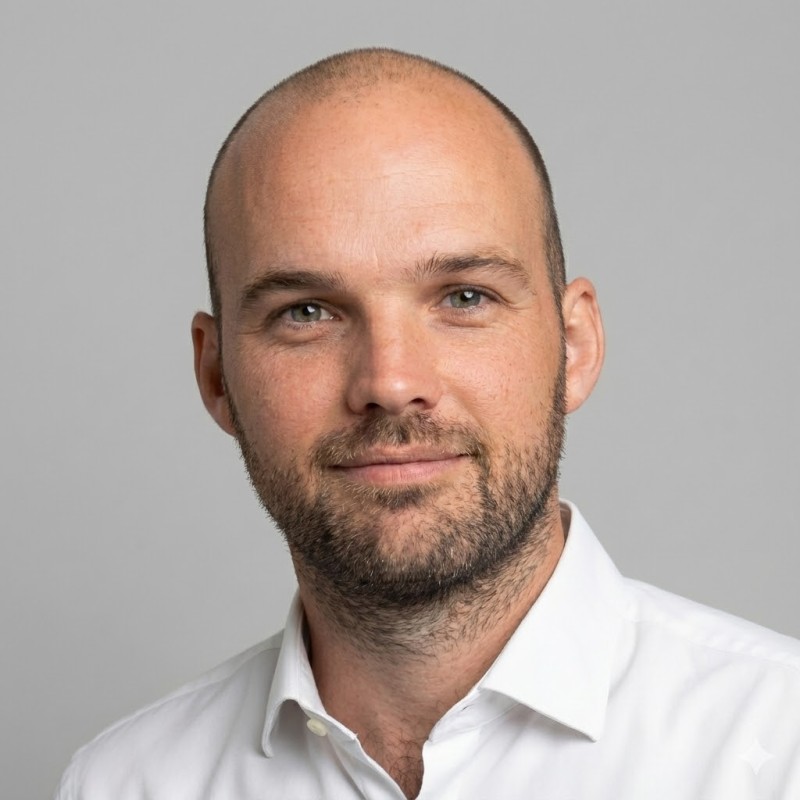
Andreas Wallendahl, co-founder & COO of Tenet - New York, NY
He builds the plumbing that makes going electric add up - one auto loan at a time.
Most people meet the climate fight at the showroom. Andreas Wallendahl decided it would be won at the financing desk. As a co-founder and chief operating officer of Tenet, he spends his days on a question that sounds unglamorous and turns out to be enormous: how do you make an electric car cheaper to own, not just cheaper to feel good about?
Tenet is a New York fintech that reworks how EV loans get made. Instead of asking drivers to hunt for a lender who understands electric vehicles, Tenet plugs into the balance sheets that already exist - credit unions, commercial banks, green banks like NY Green Bank, and asset managers - and routes lower-cost financing toward the people buying and refinancing EVs. The company calls itself the financial fabric of the energy transition. In plain terms: it wants to be the invisible layer that makes the switch pencil out.
"Our mission is to help our customers save money by electrifying their lives." - the shared thesis Tenet's founders repeat, and the reason the loan comes with more than a rate.
Here is the part that gives the pitch teeth. Tenet doesn't stop at the loan. Through a feature called TenetConnect, it bundles free smart charging into every customer account - software that times charging to cheap utility hours and driving patterns. The company estimates it can save drivers up to about $15 every time they charge at home, and roughly $40 a month. Financing gets you in the car; the charging math keeps the savings coming. The product is the marketing.
Wallendahl is the operator half of that equation - the person turning a mission statement into partnerships, warehouse facilities, and a lending marketplace that has to actually clear. He co-founded Tenet in 2021 with Alex Liegl, who runs it as CEO, and Paul Sebexen. By late 2023 the company had raised roughly $73 million in equity and lined up more than $100 million in committed loan funding, a structure that tells you the real product isn't an app - it's capital moving at a lower cost toward a cleaner outcome.
Electrify your life - and save money doing it.The idea Tenet is built around
Wallendahl's résumé reads like someone triangulating toward exactly this job without knowing it. He earned a dual bachelor's from MIT in civil and environmental engineering and management science - the two halves of a person who cares equally about how systems work and how they get paid for. Then an MBA from INSEAD.
Five years at McKinsey followed, in the private equity practice, staring at technology and telecom businesses and learning how value actually gets created and moved. In 2017 he jumped to the frontier: ConsenSys, one of the earliest Ethereum venture studios, where he worked on strategic initiatives and corporate development - growth strategy, global expansion, and M&A - and helped stand up new businesses. Around the same time he co-founded Kauri, a blockchain knowledge network, betting on open information before that was a crowded idea.
A stint as VP of strategic programs at the alternative-data company 7Park Data rounded out the toolkit: consulting rigor, crypto-era company building, and a fluency in data. Then, in 2021, he pointed all of it at electrification.
The environmental engineering wasn't a detour. It was a preview.
There's a tidy symmetry to it: the "environmental" in his MIT degree is now the "E" in the climate thesis he sells to credit unions. The blockchain years taught him how to build financial products that didn't exist yet. The consulting years taught him what makes them survive contact with a balance sheet.
Dual B.S. in Civil & Environmental Engineering and Management Science.
Business Analyst to Engagement Manager in the private equity practice, focused on technology and telecom.
Strategic initiatives and corporate development inside the Ethereum studio; co-founded the Kauri blockchain knowledge network.
VP of Strategic Programs at the alternative-data company.
Co-founds Tenet with Alex Liegl and Paul Sebexen; takes the COO seat.
Tenet publicly launches its electric-vehicle financing platform in New York.
$10M Series A led by Nyca Partners, plus a $20M SVB warehouse facility; rolls out free TenetConnect smart charging.
Rather than lend from a single pool, Tenet partners with credit unions, commercial banks, green banks and asset managers - routing lower-cost capital toward EV buyers and refinancers.
Loans come with TenetConnect - a suite of software features at no added cost, including smart charging that trims the true cost of ownership after the sale.
Charging is timed to cheap utility hours and driving patterns. Tenet estimates up to ~$15 saved per home charge and roughly $40 a month.
~$73M in equity plus $100M+ committed loan funding, with a $20M SVB warehouse facility - the plumbing behind a lending marketplace.
Nyca Partners led the Series A, with Assurant Ventures and Giant Ventures. Earlier support came from Human Capital, Breyer Capital, Global Founders Capital and Firstminute Capital.
The bet: cheaper capital, applied well, decarbonizes faster than any pitch about the planet. Make the switch pencil out, and adoption follows.
His MIT training is literally in environmental engineering - the "E" in his climate startup came with a diploma.
He co-founded a blockchain knowledge network (Kauri) back when open crypto information was still a fringe idea.
Tenet's pitch flips the usual green premium: the smart-charging math is designed to pay you back after the loan closes.
Ask what success looks like and the answer isn't a logo people love. It's a layer people never notice - the financial fabric humming underneath a country's switch to electric. Wallendahl's ambition is infrastructural, not flashy: make EV ownership affordable enough that the choice stops feeling like a sacrifice and starts feeling like arithmetic.
That's the quiet radicalism of the whole project. The loudest climate stories are about breakthroughs. Tenet's is about boredom - a better rate, a smarter charge, a partnership with a credit union in a town you've never heard of. Multiply it, and the boring thing moves the needle.
Loud is easy. Load-bearing is the point.
If he's right, the win won't come with fireworks. It'll show up in a monthly statement - a payment a little lower than expected, and a charge that happened at 2 a.m. so it cost almost nothing. That's Wallendahl's version of a moonshot: an EV that quietly, reliably, saves you money.
Profile compiled from public sources including LinkedIn, Crunchbase, BusinessWire, Axios and company materials. Titles reported publicly as co-founder & COO; some databases list CEO. Figures reflect the most recent public reporting and may change.