The first machine in Fabio Necco's professional life was not electric. It was an automobile engine, noisy and hungry, governed by an electronic control unit whose hardware he helped design at Magneti Marelli in Turin. The year was 1997. A car's intelligence lived in boxes bolted close to heat, vibration and an orchestra of mechanical indignities. The young engineer's job was to make electrons behave while everything around them shook.
Nearly three decades later, the engine has receded from view. Necco now leads Cambridge GaN Devices, a University of Cambridge spinout trying to make power conversion smaller, cooler and easier to use. The machines have changed: electric cars, factory drives and the densely packed racks that feed artificial intelligence. The old problem has not. Electricity is generous, but it is never tidy. Every useful conversion leaves a little behind as heat.
Necco's career is a long education in that untidiness. He has moved from circuit boards to applications, from product marketing to business leadership, and from silicon switches to newer materials. The titles became grander. The physical questions remained stubbornly plain. How much energy is lost? Where does the heat go? How quickly can the switch operate? Will the engineer on the other side of the table trust it in an actual machine?
01 / The apprenticeshipThe road out of Turin
Necco had studied microwaves, electronics and measurement systems at Politecnico di Torino. At Magneti Marelli, theory met the automotive production line. A component could not merely work on a pleasant Tuesday in the laboratory. It had to survive a vehicle's temperatures, service life and cost target. That distinction, between an ingenious device and a dependable product, would become the quiet subject of his career.
In 2000 he crossed both an ocean and a corporate boundary, joining International Rectifier in Southern California. Over nine years he worked through system design, applications and product marketing, eventually managing automotive marketing. He also completed a project-management certificate at UCLA. It is an almost too-neat combination for his later life: know the circuit, then know the schedule.
Fairchild Semiconductor recruited him in 2009 to direct its hybrid and electric-vehicle segment. This was before battery cars became rolling referendums on modernity, when electrification still had to explain itself in patient technical language. Power semiconductors were the obscure hinges of the argument. They controlled energy between the battery, motor, charger and the rest of the vehicle. Better switches meant less loss, less cooling and more useful work from the same stored energy.
Engine control
Applications + market
Hybrid + EV
Automotive power
GaN at scale
When Fairchild became part of onsemi in 2016, Necco continued upward through automotive power. By 2021 he was vice president and general manager of the Automotive Power Division, carrying worldwide responsibility for strategy, product development and growth. His public technical work ranged from silicon-carbide modules for faster vehicle charging to top-cooled MOSFET packages that moved heat directly toward a heat sink instead of through a circuit board.
Cooling is not the glamorous face of the electric future. It is closer to its stern building inspector. Necco once described it as a central constraint in high-power design because solving it allows engineers to cut size and weight. His proposed solution at onsemi was characteristically physical: shorten the thermal path. Electricity may be invisible, but its failures can be touched.
“Cooling is one of the greatest challenges in high power design.”Fabio Necco, on automotive power packaging
02 / The handoffA founder, an operator and a green circuit board
The photograph marking Necco's next job is agreeably literal. Giorgia Longobardi, co-founder of Cambridge GaN Devices, stands beside him beneath the company's logo. Each holds a circuit board. She is moving from chief executive to chief marketing officer; he is accepting day-to-day control. There is no ceremonial key, just hardware.
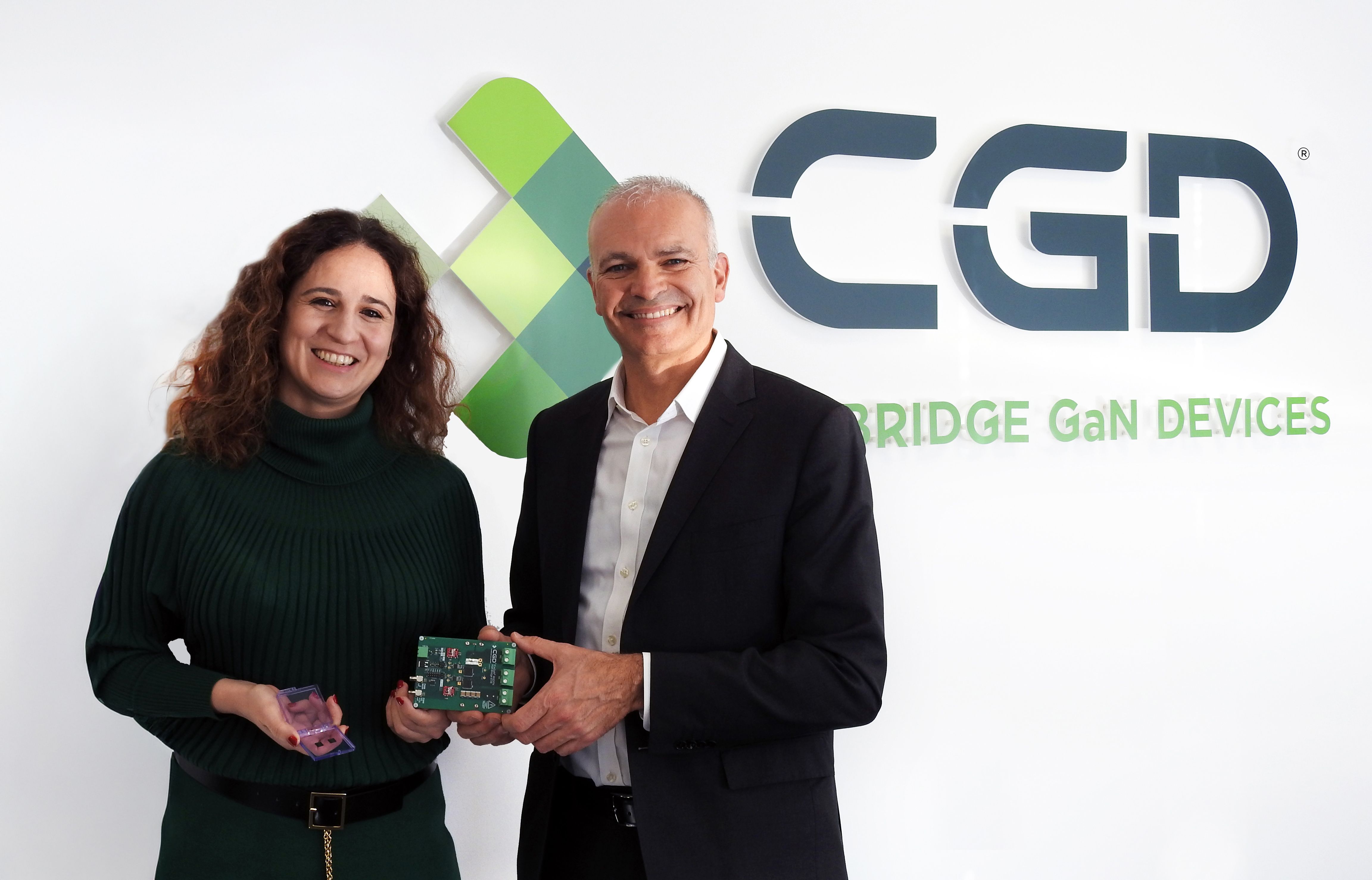
Necco did not arrive as a stranger. He said he had known both CGD and Longobardi for years and had watched the company develop under her leadership. The appointment, effective in late 2025 and announced in January 2026, paired the founder's technical and market-building continuity with an operator who had spent 26 years inside the power-semiconductor industry.
CGD itself began as research from Cambridge's high-voltage microelectronics group. Its distinctive proposition is called ICeGaN. Gallium nitride can switch faster than conventional silicon and waste less energy, but early GaN devices were famously particular about how their gates were controlled. A mistake could produce not a disappointed shrug but a failed device. CGD's answer was to put the power transistor and supporting control features together on one die.
The adoption problem
- Unfamiliar gate behavior
- Limited choice of dedicated drivers
- Extra protection and sensing work
The ICeGaN proposition
- Control features on the same die
- Standard silicon-driver compatibility
- A wider set of familiar design options
The list of integrated features is an engineer's small feast: a Miller clamp, gate-control functions, slew-rate control, current sensing, temperature sensing and desaturation protection. The commercial point is simpler. A designer can approach a new material with familiar drivers and more familiar habits. Progress is often sold as a grand replacement. Here it arrives politely, offering not to rearrange the desk.
“The main thing that ICeGaN was trying to solve is the ease of use of GaN in new applications.”Fabio Necco at PCIM Europe, 2026
03 / The commercial testHow a small company borrows weight
A clever component does not create its own market. Customers ask about reliability, supply, manufacturing capacity and the probability that a vendor will still answer the telephone years into a product cycle. These are fair questions, especially in a car or data center, where a modest-looking switch may be asked to perform billions of times.
Necco's response is notably free of David-and-Goliath theatre. When large semiconductor manufacturers invest in GaN, he argues, they help validate the category. A startup cannot by itself settle every doubt about a new material's reliability or availability. The giants make the conversation credible. CGD must then make its difference count: move quickly, select problems carefully and deliver products before organizational agility becomes merely a word in a presentation.
Partnerships are the other half of that arithmetic. In June 2026, CGD announced a long-term collaboration with NXP Semiconductors. The larger company gains access to CGD products, future developments and GaN expertise; the smaller one gains reach and the borrowed weight of an established name. Necco was candid about the reason. A smaller company is not automatically known. The right partner turns technical promise into a more credible purchasing decision.
Manufacturing matters too. CGD describes its process as fab-agnostic because it can be transferred to foundries offering a standard CMOS process flow. For an executive who has lived through the semiconductor industry's scale and supply constraints, that flexibility is not a footnote. It is an attempt to keep a promising design from becoming captive to a single narrow road.
The company entered this phase with capital behind it. A $32 million Series C round closed in February 2025 to support expansion in Cambridge, North America, Taiwan and Europe. The money preceded Necco, but the obligation now belongs partly to him: convert research, patents and demonstration boards into repeatable products for industrial systems, data centers and vehicles.
04 / The wagerPower hides inside everything
Artificial intelligence has made computing theatrical again. There are enormous models, expensive accelerators and data centers discussed with the awe once reserved for dams. Yet every rack still begins with the unromantic task of changing electricity from one form into another. More computing means more power, more heat and less room for waste. The same triangle appears inside an EV inverter and an industrial motor drive.
This is why Necco's move makes sense as the culmination of his route rather than a sharp turn. Engine-control hardware taught endurance. International Rectifier taught the passage from application to market. Fairchild placed him at the start of vehicle electrification. Onsemi taught him the organizational scale needed to supply cars around the world. CGD offers a different problem: preserve the speed of a small company while acquiring the trust normally attached to a large one.
He has said the time for GaN is “prime.” The remark contains both excitement and pressure. Timing a material transition is difficult. Arrive too early and the ecosystem is missing; arrive too late and the market belongs to somebody else. CGD's standard-driver strategy is an effort to narrow that dangerous interval by making adoption feel less like a leap.
Necco's public manner fits the job. He talks in the language of choices, partners and practical obstacles. He does not dismiss the large competitors. He recruits them into his explanation of why the market is ready. He does not describe ease of use as a concession to timid engineers. He treats it as an engineering achievement of its own.
Back in Turin, the electronic box beside a combustion engine had to work amid heat and vibration. In Cambridge, a gallium-nitride die must earn its place in cars, factories and computing halls by surviving a different variety of scrutiny. The distance between those two assignments is 29 years. The connective tissue is trust: first in a circuit, then in a product, finally in a company small enough to move quickly and serious enough to stay.
The small switch has reached the large test: can it become ordinary?The commercial question facing CGD