A woman can already have a job in technology and still feel she is standing outside it. In Cajigo’s published interview, cybersecurity professional Cathie Jayakumar describes being the only woman in her team, building an internal network, and realising she needed more help. She joined the fourth cohort of Cajigo’s accelerator. The telling detail is what she did next: attended weekly sessions, sought additional mentors, and eventually helped other women revise for Security+. Support had become something she could pass along.
- For girls: free school career talks from age 13, connecting STEM subjects with actual jobs.
- For women: industry mentoring, peer support and an annual 100-person career accelerator.
- For employers: a way to contribute mentors, support career development and meet a wider talent network.
That is a useful place to begin with Cajigo, the Bristol social enterprise founded by Rav Bumbra. Technology careers are often presented as a problem of skills. Cajigo works on the surrounding questions: Which role fits me? Who understands the route? How do I explain the experience I already have? A course can teach a tool. These questions usually require a person.
First, somebody had to listen
Cajigo grew out of Structur3dpeople, Bumbra’s diversity consultancy. Its company timeline records research with hundreds of women in 2015, followed by conversations with schools, teachers, students and parents in 2016. The subject was access: what made technology careers difficult to enter, difficult to advance in, or difficult even to picture?
An early mentoring programme supplied the encouragement to build further. Cajigo says half that cohort secured new jobs within six months. That belongs to the origin story, rather than serving as a forecast for the next applicant. The social arm followed in 2017; an app beta and company incorporation came in 2018; Cajigo dates its official launch to 2020. Founding, here, was a process with several opening nights.

The classroom door closed
Then the pandemic interrupted the school visits. In an interview published by Lombard, Bumbra describes using the bank’s accelerator to rethink the customer journey and business model. It helped sharpen a focus on schools and a goal of supporting 20,000 girls into technology. Cajigo’s own account describes virtual career talks during its 2020 launch. The delivery changed because getting into a classroom had become impossible.
Cajigo Girls now offers free STEM and STEAM career talks for girls aged 13 upwards. The programme connects subjects with career pathways and introduces role models. Its school work is visible beyond its own publicity: Hans Price Academy’s July 2024 newsletter records a virtual session for Year 8 girls and says Bumbra had worked with Cabot Learning Federation schools since 2018.
There is a practical insight in starting this early. Asking a girl to choose a subject without showing her the work it might lead to is rather like handing her a railway timetable with the destinations rubbed out. Cajigo supplies some destinations. A teacher or careers lead can use the talks to make choices more concrete.
Girls aged 13+
Career guidance
Industry mentors
A mentor, with a place in the diary
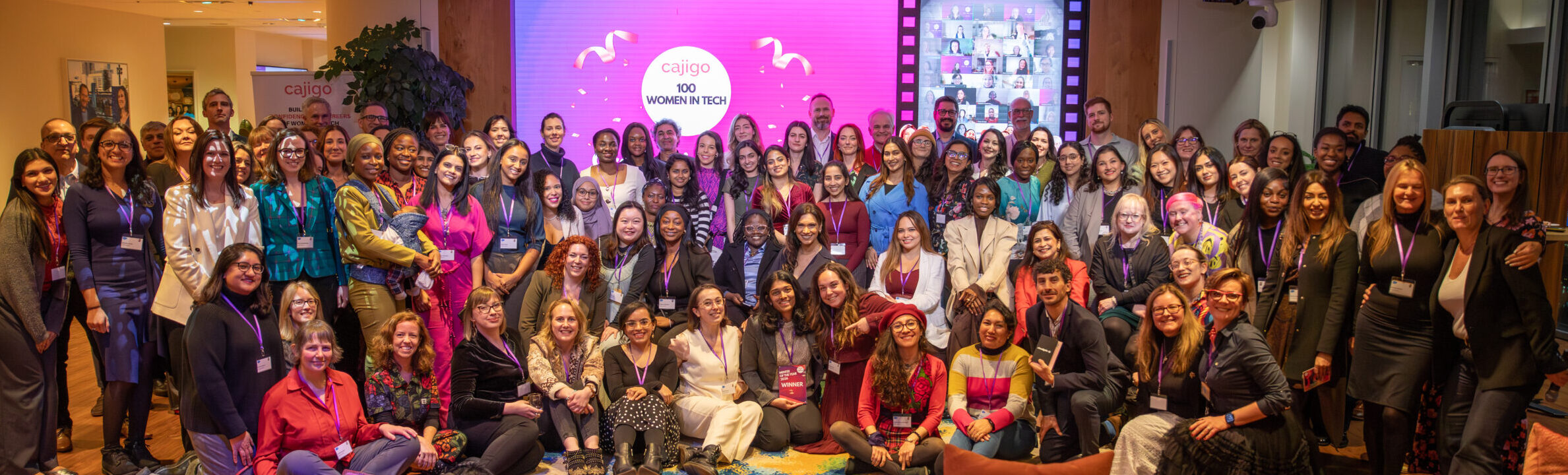
For adults, Cajigo serves university students, career changers, returners, jobseekers and women already working in industry. The 100 Women in Tech accelerator, launched in 2022, brings structure to that support. Mentor matching sits alongside regular cohort sessions, workshops and employer contact. The current programme page describes eight weeks; earlier cohorts were advertised as 16-week programmes. The current cohort’s terms matter when applying.
The employer connection makes the proposition more specific. EPAM publicly reported 19 employees acting as Cajigo mentors. Boldyn Networks sponsors the accelerator; its CIO Sharon Peters described two members of her team mentoring participants. These are people contributing professional experience, with companies helping sustain the programme around them.
Cajigo also published career changer Ramla Lipstein’s account of entering a data role with support from EPAM mentor Ushasree Sanyal. Alongside Jayakumar’s experience, it shows the kind of assistance on offer: perspective from someone familiar with the field, and a wider circle to consult. Individual stories give the mechanism a face. They do not establish what will happen to every participant.
The company says half of participants across cohorts secured new jobs within 16 weeks of joining. Treat this as a reported result, not a job guarantee or proof of causation.
Free access still has a bill
The model combines free school outreach and community resources with employer partnerships and sponsorship. The historical Google Play listing describes the app as freemium, with separate experiences for under-18s and adults. For companies, Cajigo offers mentor participation, visibility for workplace culture and jobs, and contact with women developing their careers.
“It’s been self-funded to date.”Rav Bumbra / Sondership interview, August 2021
That sentence gives the free offer its less glamorous underside. In the same interview, Bumbra said funding constrained how quickly she could scale. Personal support needs people’s time. Sponsorship and employee participation are therefore part of the delivery model, rather than decorations around it. The reader copying this approach should budget for coordination and sustained mentor involvement as well as software.
The network outlives the download
Cajigo sits beside coding education providers such as Code First Girls, while placing particular emphasis on mentoring, confidence and career navigation. It can complement technical study. Anyone needing substantial technical practice or a formal qualification should build that into the plan too. A mentor can help interpret a route; completing it still takes work, and employers still control their hiring decisions.
There is already another transition ahead. Cajigo’s homepage says the app is being retired in October 2026 and announces Cajigo 2.0. It also advertises applications for Cohort 5. The software is changing; the programmes continue to make people the centre of the offer.
For a school, the next step is a career talk. For a woman considering a move, it is checking the current accelerator and community options. For an employer, it is finding staff willing to mentor. Jayakumar’s account suggests a fourth possibility: receive useful support, then become useful to somebody else. That is a career conversation worth continuing.