Gather Federal Credit Union had a problem with its memory. The institution serving Kauai and Ni’ihau had used a CRM before, but its data did not inspire confidence. Producing reports took technical help. Employees needed a reliable account of the person in front of them; the software had made that surprisingly difficult.
In August 2026, Gather selected BusinessNext. Its wish list was refreshingly ordinary: useful branch reports, accessible member histories and workflows that matched the work. Gather’s roots go back to ten pineapple farmers pooling resources in 1954. Seventy years later, a software purchase turned on a familiar question: can the people involved trust one another?
- Banking CRM that connects customer data across departments.
- Pre-built workflows, with no-code tools for local adjustments.
- In-house implementation, training and ongoing development services.
The CRM that came after the CRM
BusinessNext Americas sells an answer to that problem. Based in Raleigh, it is the North American division of BUSINESSNEXT, the global enterprise software business behind CRMNEXT. The American pitch concentrates on banks and credit unions: give employees enough shared context to serve an account holder without beginning the investigation again.
Gather’s decision followed months of conversations and checks with existing customers. Pre-built workflows and reports that would require less technical intervention mattered. This is a selection story, with benefits still to be delivered. Its revealing detail is the buying criterion: a system useful during the working day, rather than another place to record what happened afterward.
Give the next employee the whole story
A core banking system keeps the financial record. Service requests, marketing messages and referral notes can live elsewhere. BusinessNext positions CRMNEXT across these systems, collecting the relevant information into a role-based customer view. The teller, relationship manager and service employee can work from the same relationship history.
The product combines case management, leads, lending workflows, campaigns and reporting. An employee can follow an inquiry, assign the next task and see its status. Managers can inspect queues and service deadlines. Marketing teams can segment account holders and track communications. The practical prize is less detective work between one interaction and the next.
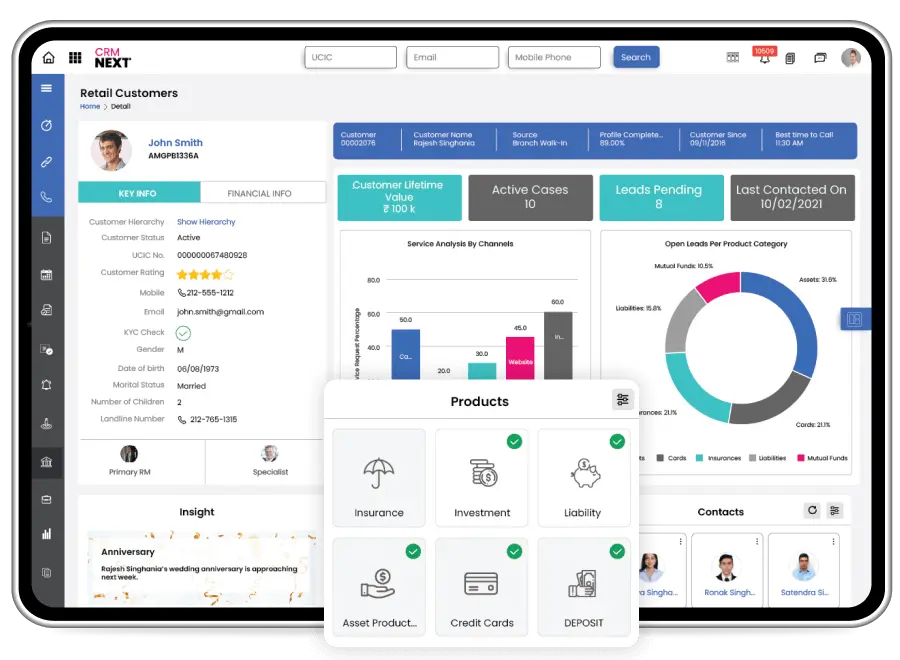
Its competitive argument is industry specificity. A general CRM can be adapted to banking; BusinessNext starts with banking processes and integrations. Its website says more than 80% of standard operations come pre-built. Treat that as the vendor’s proposition, then test your institution’s actual workflows against it. Configuration still requires decisions about responsibility, permissions and exceptions.
“Adding more people is not the answer”Nancy Sternitzky, CIO, Sound Credit Union
Company-published customer testimonial
Consider the difference between a customer record and a service process. A record can tell an employee that somebody called yesterday. A process also specifies who should respond, what information they need and when the request becomes overdue. CRMNEXT combines those functions. For buyers, the demonstration should include both the information on screen and what happens after the employee clicks.
The number that matters is adoption
Magnifi Financial offers a useful look at implementation. In BusinessNext’s published case, the credit union wanted an industry-specific alternative to larger CRM options. It connected banking data, brought leadership and frontline staff into the rollout, and aligned the IT work with business goals. More than 50 workflows previously handled through email and text were automated.
The case reports 19% more referrals and nearly 100% CRM adoption. Those are vendor-published customer results, rather than a controlled comparison. Still, the pairing deserves attention. A referral tool has limited value if the employee with the opportunity never opens it. Adoption belongs in the business case alongside features and price.
The software comes with people
BusinessNext’s Americas services team implements its own software. It also offers strategy consulting, process development and training in the no-code designer. An Innovation Subscription supplies professional services and developers for customers extending the platform. The purchase therefore involves software and delivery expertise, with commercial scope negotiated around the institution’s requirements.
There is a useful distinction between saving configuration effort and eliminating implementation work. Connecting systems, agreeing on a process and teaching employees take resources. A buyer should price those responsibilities explicitly. The meaningful comparison with Salesforce, Microsoft Dynamics or another financial-services CRM is the total work required to make a specific customer interaction function well.
A bigger family, a narrower American pitch
The global business grew from founder Nishant Singh’s ambition to build software products in India. In a published interview, he described returning from the United States in 2001 and developing the product core around 2004-2005. The broader BUSINESSNEXT brand followed CRMNEXT, reflecting ambitions beyond customer relationship management.
Today the parent’s portfolio includes digital journeys, data, lending and AI agents. AGENTNEXT was announced in November 2024. The group reports more than one million users globally. Its $16 million Series B in 2021 was co-led by Avataar Ventures and Ascent Capital. Those figures describe the global business; they are not standalone Americas financials or customer totals.
The local sales story remains concrete. General Electric Credit Union selected BusinessNext in May 2026 to connect marketing, service and relationship management. State Department Federal Credit Union announced its selection that March. These contracts show buyer interest in shared operations. Their announcements describe intended capabilities, so completed customer outcomes should be assessed separately.
That makes delivery experience part of the competitive position. A financial institution is choosing both a product and the team that will translate its operating habits into software. BusinessNext’s published values emphasize learning, customer focus and continuous innovation. The useful test for those promises is practical: who answers when an unusual workflow stops fitting the original plan?
Start with the handoff
The lesson a reader can copy is small enough to try: choose one service request that crosses departments. Track where its data sits, who owns the next step and how the customer learns what happened. Ask a vendor to demonstrate that journey with your exceptions included. Then measure completion and employee use.
This approach depends on accessible, trustworthy data and people willing to agree on how work moves. If departments keep separate definitions or nobody owns a stalled request, a shared screen has limited power. BusinessNext offers tools for connecting the institution. The institution still has to decide what remembering a customer should help its employees do.
For the employee answering a worried caller, the outcome is less abstract: see the relevant history, understand the request and know where to send it. That is a reasonable standard for banking software, and a demanding one to deliver consistently.