In the spring of 2020, Jordan’s Business Development Center had a problem familiar to almost every training organisation: the classroom had closed. BDC had prepared staff connectivity before lockdown. It then moved instruction online, bringing 52 vocational and entrepreneurship trainers into a distance-learning course. Experts could join from abroad. Lessons could travel. A sewing machine, however, had its own objection.
Nayef Stetieh, BDC’s founder and CEO, described the difficulty plainly. You could explain how a machine worked through a screen. Learning to stitch required something else: a factory. The distinction gives this organisation’s work its shape. Information can move easily; the conditions that let someone earn a living take considerably more arranging.
- BDC connects job preparation to employers and workplace experience.
- Its enterprise programmes combine training, mentoring and routes toward finance.
- Donors and institutional partners support delivery; young people and businesses use it.
- The lesson to copy: give every step after training an owner.
A sewing machine’s objection
Founded in 2004, BDC is a Jordanian nonprofit working on job creation and enterprise development. Its tools are courses, coaching, technical assistance and partnerships. Its participants include graduates, women, refugees and small-business owners. Its other constituency is the institutions that make opportunities possible: employers, universities, government bodies and development agencies.
That makes BDC an intermediary in a market with several awkward gaps. Education and workplace expectations do not always match. An entrepreneur may have an idea but lack a feasibility study. A company may need staff but hesitate over the expense of training someone new. Each gap requires a different counterpart. A lecture alone has rather limited negotiating powers.
“You have to do it in the factory.”Nayef Stetieh, on learning practical vocational skills
The employer gets a seat
Maharat, BDC’s skills programme, teaches professional habits alongside confidence and career preparation. BDC says seven Jordanian universities adopted it as a three-credit elective. Employability, in this arrangement, earns room inside the timetable. Students can practise the behaviours employers expect before the first interview makes those expectations painfully clear.
AZEM OJT extends the connection into companies. BDC maps vacancies, agrees training and recruitment arrangements with employers, and involves a supervising academy. Participants receive five days of soft-skills preparation before workplace training. Initial salary-support mechanisms help participating businesses absorb new hires. The design attends to both sides of recruitment: the applicant’s readiness and the employer’s cost.
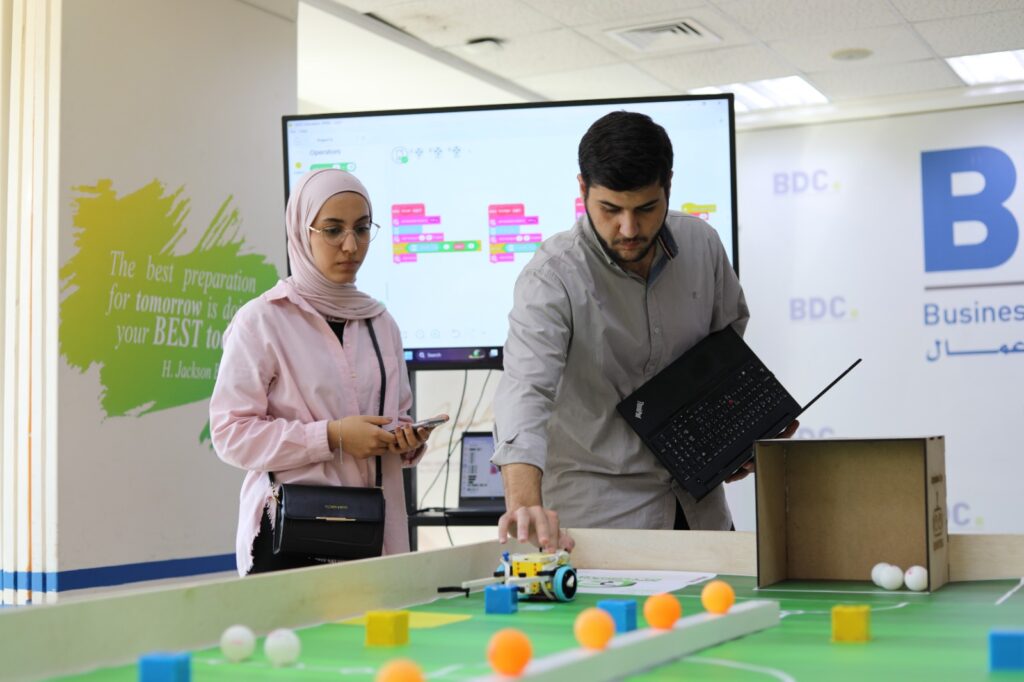
Tariqi, launched in 2015 through the King Abdullah II Fund for Development and The King’s Trust International, uses a related combination of life skills, technical preparation and experience in host companies. BDC delivers it across sectors including hospitality, ICT and logistics. Compared with a standalone course, the distinguishing feature is a planned destination beyond the classroom.
A business plan meets a bank
For self-employment, Inhad connects entrepreneurship preparation and mentoring with institutional finance partners. UNICEF supports the programme; BDC identifies partners including the Central Bank of Jordan, IRADA and the Jordan Loan Guarantee Corporation. The intended journey moves from an idea toward a business that can support its owner.
An independent UNICEF evaluation calculated Inhad 1.0’s 2020-2023 cost at JOD 1.36 million, or JOD 695 per participant. It also found a bottleneck: only 20% of participants with approved feasibility studies secured loans. Post-startup guidance was another weakness. The report recorded BDC’s willingness to involve lenders earlier in feasibility work. That was a proposed adjustment, rather than proof that the financing problem had been solved.
Calculated programme cost per participant.
Training completion does not guarantee borrowing.
Two weak handoffs appeared at access to capital and support for growing businesses. Anyone copying the model should arrange lender participation and continuing mentorship before enrolling a cohort. Better preparation cannot compensate indefinitely for a closed financing door.
Fifteen ideas, with equipment attached
GreenLinks gives BDC’s enterprise work a local environmental focus. In February 2025, its EU-funded Green Hackathon awarded fifteen youth-led initiatives from Zarqa and Azraq €2,500 each. The projects addressed energy, water, agriculture and environmental challenges. Equipment and continuing support accompanied the money. An idea was expected to acquire the means to do something.
*Calculated from the announced awards; equipment and other support are additional.
The project’s October 2025 closing ceremony highlighted organic farming, compost production, renewable energy and greywater reuse. EDAMA and the Climate Action Association were implementation partners. Those are concrete activities with local customers and operating requirements. September 2026 recruitment for a women’s green-economy employment project suggests that this area remains part of BDC’s agenda.
The handoff is the method
BDC’s business model depends on funded delivery and institutional cooperation. AFD’s €3 million Tanmyeh grant, for example, links vocational providers with manufacturing employers and targets 2,000 young Jordanians and Syrian refugees. The grant is project finance. It should not be mistaken for venture investment, company revenue or evidence that every participant found work.
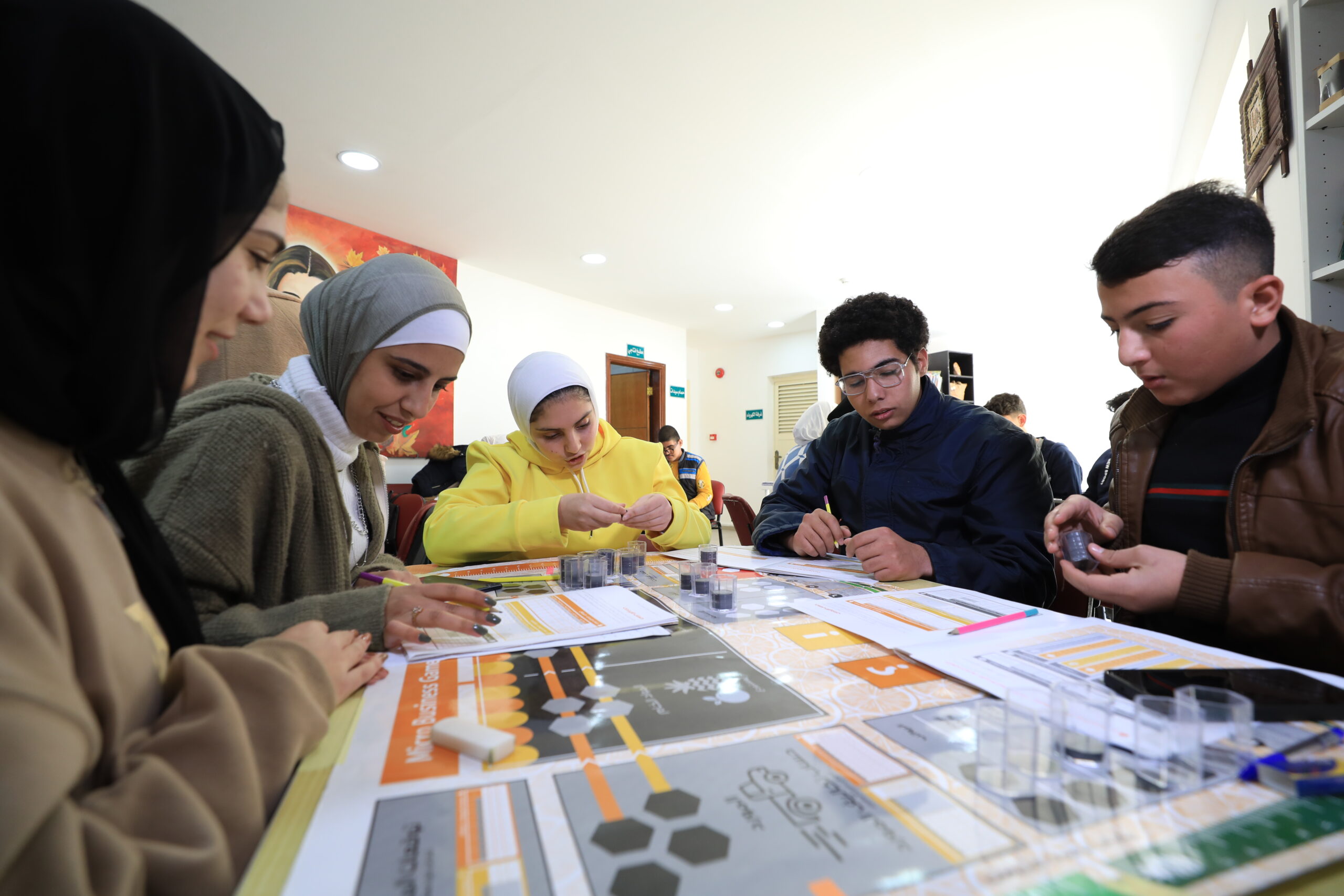
Its expertise lies partly in building repeatable delivery. BDC reports ninety Job Search Clubs involving 2,600 job seekers, with meetings lasting four hours a day for thirteen days. It also trained Ministry of Youth and university facilitators. Local institutions can carry the method forward. The useful product includes people able to run the next group. This is a useful distinction for programme designers: expanding attendance and expanding the capacity to deliver are separate tasks. A local facilitator network addresses the second, making expertise available where participants already live.
- 01 / ListenIdentify employers’ needs.
- 02 / PractiseBuild relevant skills.
- 03 / ConnectArrange placements or finance.
- 04 / Follow upSupport the next difficulty.
An editorial reading of BDC’s approach.
For a job seeker, the practical starting point is BDC’s employment and experience pathways. For a business owner, it is the enterprise programmes and their specific eligibility requirements. For employers and funders, the attraction is coordinated delivery. The approach needs willing companies, accessible capital and support that lasts. Where those conditions are absent, the classroom can be full while the next door stays shut.