A startup’s sales database is an unlikely place to look for an education. It has no lecture theatre, no reassuring answer key, and quite possibly three versions of the same customer. Yet this is one of the places Build It Up sends students. In its published work with Compri, an AI procurement platform, the assignments included auditing a CRM and database, assessing sales automation tools, and designing lead-qualification workflows. The glamour of entrepreneurship has apparently survived contact with data housekeeping.
- Startups receive a dedicated student team for six months, free of charge.
- Projects cover practical problems, from sales outreach to investor research.
- Students gain experience by taking responsibility for real deliverables.
That small example explains the association more neatly than a grand declaration about innovation. A founder has work that needs doing. A student needs work worth doing. Build It Up, an Italian nonprofit, makes an organised exchange between those two shortages. Money is absent from the startup’s program bill; responsibility is very much present.
Two shortages, one arrangement
The association began at ESCP in September 2012, on the initiative of students. Its original proposition was to help an entrepreneurial idea become something tangible through free consulting, while spreading entrepreneurial skills through conferences and business games. Marcello Tedeschi, an ESCP alumnus who chaired it until 2014, is identified as a founder by the school. Its annual report also identifies honorary president Silvio Marenco as a co-founder.
The setting matters. Universities contain people who can analyse a market but have had little opportunity to answer to one. Young businesses contain people who answer to a market every day but lack enough hands to investigate it properly. Build It Up gives each side access to the other. Today it describes itself as a multi-university network and calls its students fractional founder’s associates.
This places it between a student society and professional startup support. Paid consultants, student consulting organisations and university incubators offer other routes to help. Build It Up’s distinctive proposition combines a free program with a team that works directly on the founder’s projects. The educational value comes from the same assignment that produces the business value.
The six-month program is offered free of charge.
The assignment is the product
The current program runs from October through March. Each startup gets a project manager and four to five associates. It begins with scoping and team matching, moves into strategic work, then building and validation, and ends with delivery and handoff. Regular check-ins give that sequence some discipline. Six months is long enough to make a badly defined assignment expensive in time, even when the invoice is charmingly blank.
- 01 / OCTScope
& match - 02 / NOV–DECInvestigate
- 03 / JAN–FEBBuild
& validate - 04 / MARDeliver
& hand off
The case studies are usefully specific. For Tensive, which develops biodegradable breast-reconstruction implants, Build It Up reports mapping more than 20 competitors, examining market scenarios and conducting expert interviews. For Galeio, a satellite-imagery business based in Paris, the work covered adjacent markets and customer discovery in insurance. These are different questions requiring different evidence, rather than one presentation with the client’s name tastefully substituted.
Rosso, a blood and plasma donation technology startup, illustrates the fundraising side: prioritising investors and examining comparable transactions and valuation multiples. Build It Up lists a €3 million seed round in that case study. That is Rosso’s financing; it should not be mistaken for money raised by the association, or proof that student support alone caused the investment.
“Build It Up provided us with valuable market insights and strategic recommendations”Tensive, in a testimonial published by Build It Up
The deliverables offer a sensible way to judge the service. Can a founder use the research to choose a customer segment, improve a workflow or prepare an investor conversation? A deck is useful when it makes a decision clearer. Its existence, however handsome, is a rather poor substitute for that decision.
The room comes after the work
There is also the business of meeting people. In June 2024, five supported startups presented at an Investor Deal Table organised with Banca Generali in Milan. The association described the bank relationship as more than five years old. Founders from Amilis, Voys, Damō, Hausme and Talentware had the opportunity to present and answer questions from investors. An introduction becomes more useful when there is something prepared to introduce.
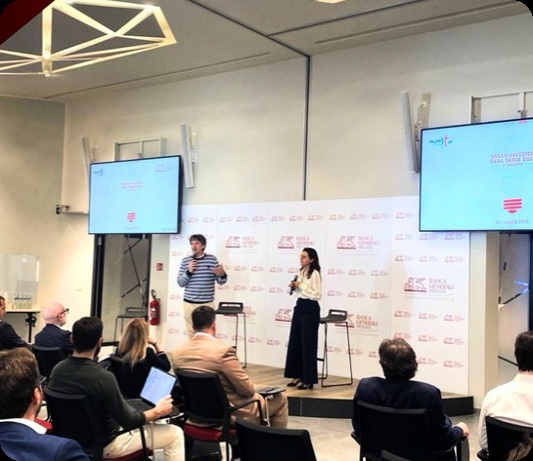
For students, the network has a second life. In a 2019 interview, DailyInternship co-founder and former Build It Up president Francesco Carboni credited the association with teaching him teamwork and helping him identify people with whom to build a company. The organisation’s value can therefore outlast a particular client project: people who learn to work together may later decide to found something together.
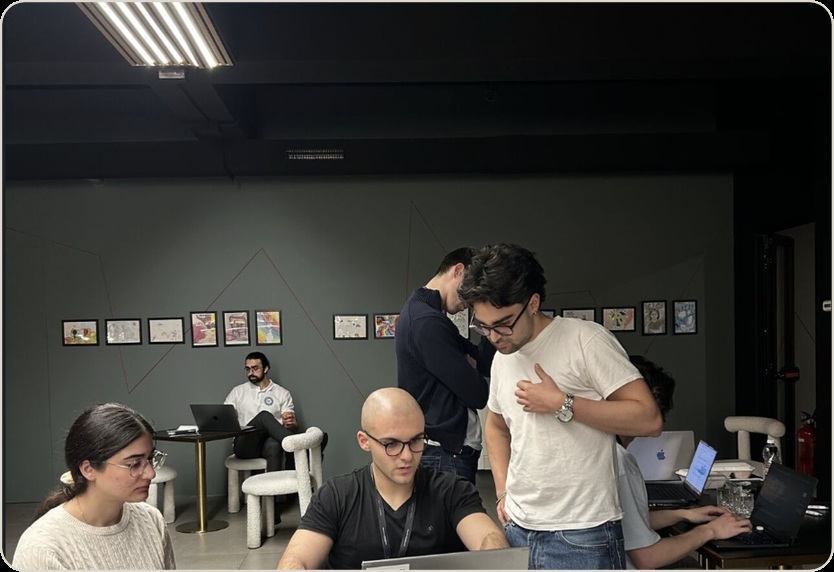
The format keeps evolving. Its first Automation Hackathon brought together 60 selected participants for ten hours of building, with SITPolito, a Compri challenge and technology partners n8n, ScrapeGraphAI and Manufact. Workshops and company visits sit alongside these shorter bursts of work. The connection to a real business problem survives the change in timetable.
A free team still needs your time
For a founder considering an application, the practical question is whether there is a project a student team can own. “Help us grow” is an aspiration. A competitor map, a customer-discovery exercise or an audit of sales data is an assignment. The published cases suggest that bounded questions are where this arrangement becomes useful.
There is a corresponding obligation. As an inference from the program’s structure, founders should expect to supply context, share relevant information and give feedback. A team learning the business cannot replace the founder’s judgement. Work requiring an immediately available specialist or continuous operational ownership may fit a different service better than an October-to-March student project.
Readers can copy the structure without copying the association: define a question, assign an owner, agree on a usable output, review progress and plan the handoff. Build It Up makes that structure available to early-stage founders while giving students something a classroom cannot fully reproduce: another person waiting for their answer.