A fire truck, a boom lift and a refuse vehicle do not naturally sit together in the mind. Add a military vehicle, an airport rescue truck and a concrete mixer, and the collection starts to resemble a very specialized traffic jam. This was the central communications problem waiting inside Oshkosh Corporation: its machines were recognizable, its product brands had earned loyalty, and the parent company still needed a story that made the whole portfolio feel intentional.
Bryan Brandt's assignment was to find that story without turning rugged equipment into marketing scenery. He arrived at Oshkosh in 2016 as vice president of global branding and communications. In September 2018, he became senior vice president and chief marketing officer. His remit now stretches past the familiar CMO map. It includes global branding and communications, community relations and enterprise simplification. The last item is the revealing one. Brandt is not only responsible for how the company speaks. He also has a hand in making a complicated enterprise easier to operate.
That combination makes sense when the products have to work on burning roads, construction sites, airport ramps and battlefields. An industrial brand cannot float too far above the machine. Every broad promise eventually meets a firefighter, operator, mechanic or service member who needs the equipment to do what the brochure said.
The apprenticeship in unglamorous products
Before Brandt told stories about specialty vehicles, he spent more than two decades at Bemis Company, the flexible-packaging supplier now part of Amcor. Public company records describe a career of increasing responsibility that ended with his role as vice president of marketing and transformation for Bemis North America from 2014 to 2016.
Packaging is useful preparation for industrial marketing. It is everywhere and usually invisible. Customers notice it most when it fails. The work forces a marketer to live close to operations, materials, cost and customer requirements. Brandt's path included commercial and operational responsibility, a background that helps explain why his later language at Oshkosh tends to connect culture with execution. A brand is not something a company applies after the real work. It is what the real work adds up to.
Brandt earned a bachelor's degree in business administration from the University of Colorado Boulder, then built his career inside one company for more than twenty years. That long tenure matters more than a tidy sequence of titles. It suggests an executive education conducted through the recurring cycles of an industrial business: customer demands, production constraints, reorganizations and the slow accumulation of credibility. By the time he arrived at Oshkosh, he had already worked where marketing and transformation met. He was not being asked simply to promote an existing arrangement. He had practice helping an organization explain change while it was still carrying it out.
Oshkosh offered the same lesson at a different scale. Pierce fire apparatus, JLG access equipment, McNeilus refuse vehicles and Oshkosh Defense arrived with distinct customers and histories. Their independence was an asset. It was also a corporate storytelling challenge. A parent identity strong enough to connect them could not ask the brands to surrender the trust they had built.
Culture before campaign
In 2019, Oshkosh introduced a refreshed identity and website. The visible pieces were a new expression of the company, but Brandt's more interesting account of the transformation came years later. Speaking at the University of Wisconsin E-Business Consortium's 2025 annual conference, he framed the change as cultural before it was promotional.
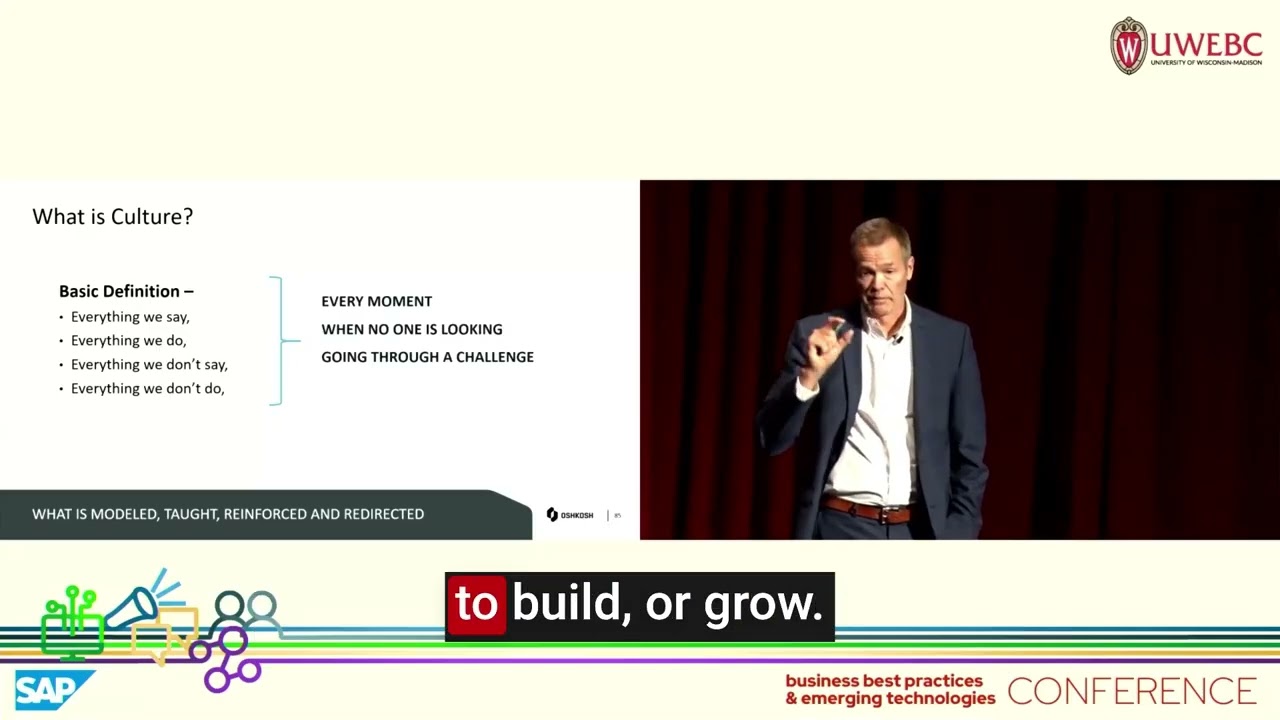
His conference definition was concrete. Culture includes everything an organization says and does, as well as what it declines to say or do. It shows up in ordinary moments, when nobody is looking and when the organization is under pressure. That is a harder standard than choosing a new typeface. It asks whether leaders model the behavior, whether teams reinforce it and whether decisions redirect the business when practice drifts from principle.
The shared expression that emerged was “Technology for Everyday Heroes.” The phrase points the camera away from the corporation and toward the user. Firefighters, refuse collectors, construction crews, airport workers and service members become the reason for the technology. Electrification, autonomy, artificial intelligence and connected systems are not presented as trophies. Their value sits in the work they help someone perform.
Everyday Heroes
This architecture is commercially useful because the same technical capability can travel. Collision-avoidance work developed through Pratt Miller Motorsports, for example, has been tested on Pierce fire apparatus. Sensors and artificial intelligence monitor approaching traffic while an emergency vehicle is stopped, giving a crew more information before members step out. The corporate story earns its keep when it helps expertise move between businesses, then helps customers understand why that transfer matters.
For a portfolio company, the parent brand should do three jobs: help teams share capability, help audiences understand why the businesses belong together and keep the customer's work visible in every technology claim.
A scoreboard for the story
Brandt's public remarks at CES reveal another side of his approach. He calls the show a global stage where Oshkosh's important audiences gather for four days. The company uses that stage to place industrial systems beside the consumer technology conversation: robotic boom lifts, electric airport rescue vehicles, intelligent job sites and connected equipment.
He also talks about the event like an operator. Oshkosh tracks analyst attendance, interviews, social media mentions and booth traffic. The enthusiasm has a dashboard. This is a helpful detail because corporate transformation stories can dissolve into soft language. Brandt's version leaves room for a count.
The stage also helps Oshkosh alter a durable perception. A company founded in 1917 and known for heavy vehicles can look like a traditional manufacturer even while its engineers work on AI, autonomy and advanced energy systems. Showing those systems together makes the technology portfolio visible. The marketing does not need to claim that Oshkosh has stopped being a manufacturer. It can show that modern manufacturing includes software, sensors, batteries, data and the difficult work of integrating them into machines that endure.
The local test of a global promise
Brandt's corporate role is global, but his public commitments remain distinctly local. He serves in leadership positions with the Oshkosh Area United Way and the Oshkosh Corporation Foundation. He is also president and trustee of Feed the Body Feed the Soul, a Wisconsin nonprofit. In 2020 and 2021, he co-chaired United Way fundraising campaigns, returning for a second year as the community emerged from a period of disruption.
These roles are not decorative details beside the business story. They give the language of “everyday heroes” a nearby audience. The people keeping a community moving are not hypothetical personas. They are neighbors, volunteers and workers whose lives overlap with the company. A purpose that sounds persuasive in a Las Vegas convention hall also has to make sense in Oshkosh.
That local test may be one reason Brandt's language stays focused on usefulness. In a 2026 discussion of the company's portfolio, he described shared expertise as a way to accelerate innovation and produce better customer insight. In his own pre-CES post, he wrote about innovation that “quietly shows up when and where it matters most.” Quietly is the important adverb. A good day for the machine may be one when its intelligence attracts no attention because the operator simply gets the job done.
What the portfolio is learning to say
Brandt's career has an unusual continuity. At Bemis, he worked in a material world where transformation had to survive contact with production. At Oshkosh, he moved from communications leader to CMO while taking on simplification and community relations. The scale grew. The operating constraint remained.
His contribution is easiest to see as translation. Engineers create capabilities. Product brands place those capabilities into specific machines. Operators use them in environments where failure is costly. The corporate brand explains why knowledge should move across the system and why a firefighter might benefit from something first tested in motorsports. Translation cannot replace invention, but invention travels farther when someone makes the connection legible.
There is also restraint in the framework. “Technology for Everyday Heroes” does not ask the audience to admire technology alone. It assigns the technology a customer and a task. For an old manufacturer repositioning itself in an age of electric platforms and machine intelligence, that is a durable place to stand. The tools will change. The work, and the people doing it, provide the through line.
Brandt has spent a decade at Oshkosh making that through line easier to see: first in the corporate identity, then in the culture beneath it, and now across a portfolio trying to learn from itself. The result is not a neat collection of identical brands. It is a more useful idea. Different machines can belong to the same company when they share a purpose, move expertise between them and remember who is waiting in the cab.