At the 2023 24 Hours of Le Mans, Corvette Racing had an expensive sort of problem: its right-front damper needed replacing. The repair sent the No. 33 C8.R two laps down. A car that had started on class pole was suddenly spending its advantages in the garage. Driver Ben Keating’s verdict afterward was admirably plain: “I thought we were out of it.”
- The work: race cars, robotic platforms, vehicle engineering and simulation.
- The buyers: manufacturers, race teams and government customers, including GM and the U.S. Army.
- The tension: racing expertise travels; customer demand does not arrive automatically.
By the following afternoon, the Corvette had won its class. Fast stints, engineering decisions and pit work gradually erased the deficit. The recovery gave Corvette Racing its ninth Le Mans class victory. It also offers a useful entrance to Pratt Miller, the Michigan company behind the program: a business in which a model, a machine and the person using it must eventually agree.
Two laps behind, with time to think
There is a temptation to describe a racing engineering company through its trophies. They are handsome evidence, but they leave out the work. A suspension problem requires someone to diagnose it, someone to change the hardware and someone to drive the result. The feedback is immediate and public. A clever explanation cannot improve a lap time by itself.
Gary Pratt and Jim Miller founded their company in 1989. Its history includes the Chevrolet Intrepid prototype and the Corvette Racing program, alongside engineering support for Chevrolet’s NASCAR and IndyCar efforts. Aerodynamics, tire models, software and simulation were part of that support. These are capabilities a manufacturer can buy even when the manufacturer’s badge gets the photograph.
Pratt Miller now serves motorsports, defense and mobility. Its vehicle-development offering reaches from suspension and chassis modeling to fabrication, low-volume builds and durability testing. The commercial proposition is concrete: help a customer carry a vehicle problem through analysis, construction and validation. A sketch is welcome, but eventually something has to turn a wheel.
Buy the car. Borrow the laboratory.
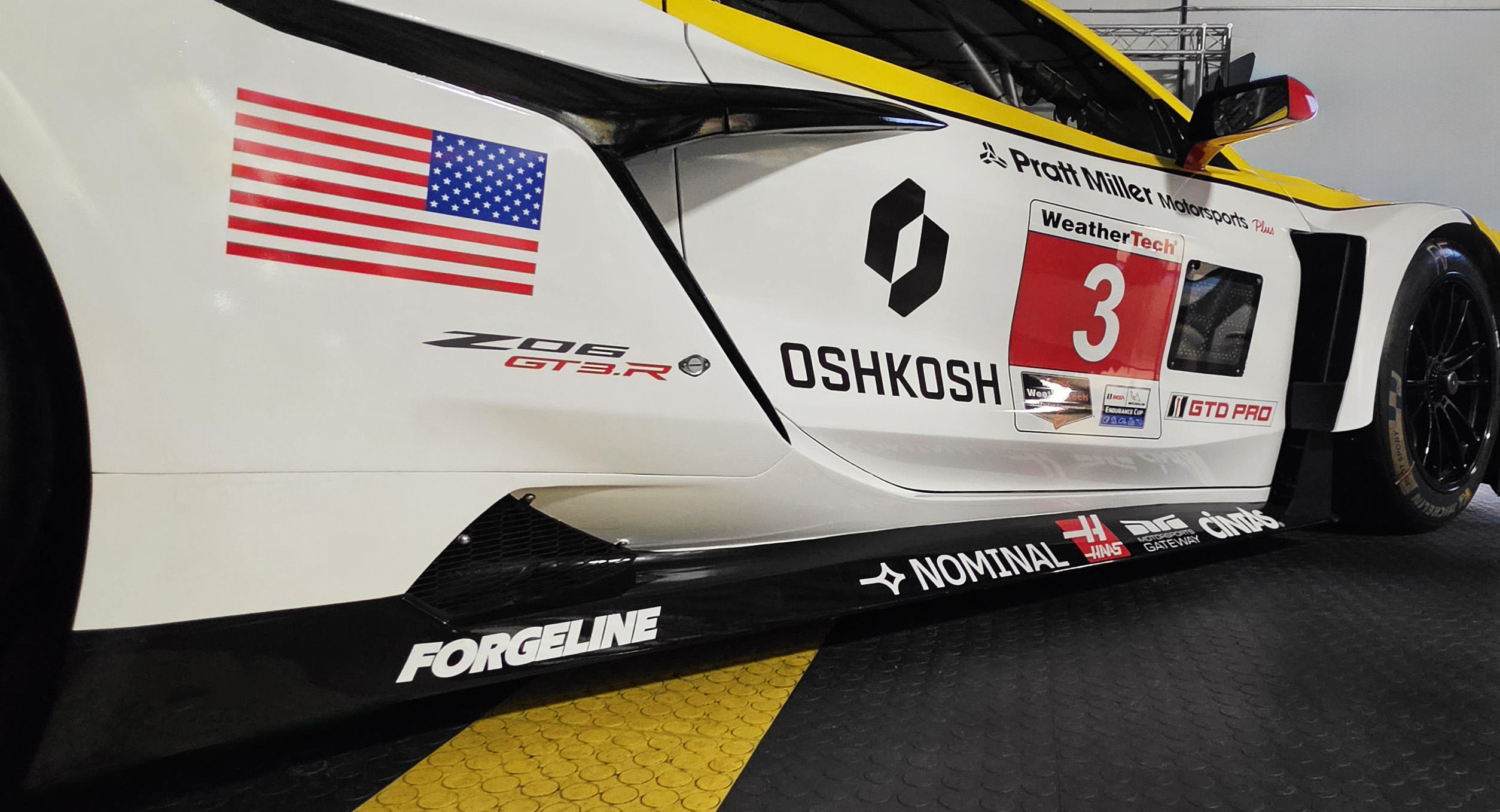
The Corvette Z06 GT3.R makes the relationship between engineering and manufacturing unusually easy to see. Developed jointly by GM’s Competition Motorsports Engineering division and Pratt Miller, it entered competition in 2024. Its aluminum chassis begins at Chevrolet’s Bowling Green assembly plant. At Pratt Miller, a purpose-built steel roll cage is added as the road-car foundation becomes a racing machine.
This Corvette was conceived for customer racing, with parts and technical support for teams. That changes the brief. Engineers have to think about the people who will operate the car after it leaves their hands. The offering includes a machine and the means to keep using it. In 2025, the No. 3 Corvette Racing by Pratt Miller Motorsports entry won IMSA’s GTD PRO team championship.
A team can also hire part of the laboratory. Pratt Miller offers its driver-in-the-loop simulator to outside racing programs, with modeling expertise alongside it. The equipment includes an AB Dynamics aVDS rig engineered by Williams F1, six degrees of motion and nine projectors serving a wraparound screen. Telemetry and driver communications reproduce parts of a trackside working session.
The useful feature is the human in the model. Engineers can change a setup and ask a driver what happens, rather than accepting a neat graph as the end of the discussion. Pratt Miller’s own FAQ makes the boundary explicit: simulation can reduce the number of full-scale prototypes, but cannot eliminate them. Virtual testing earns its keep by helping teams choose what to build and test next.
A simplified reading of Pratt Miller’s development offering. The application changes; the need for feedback remains.
The target has somewhere to go
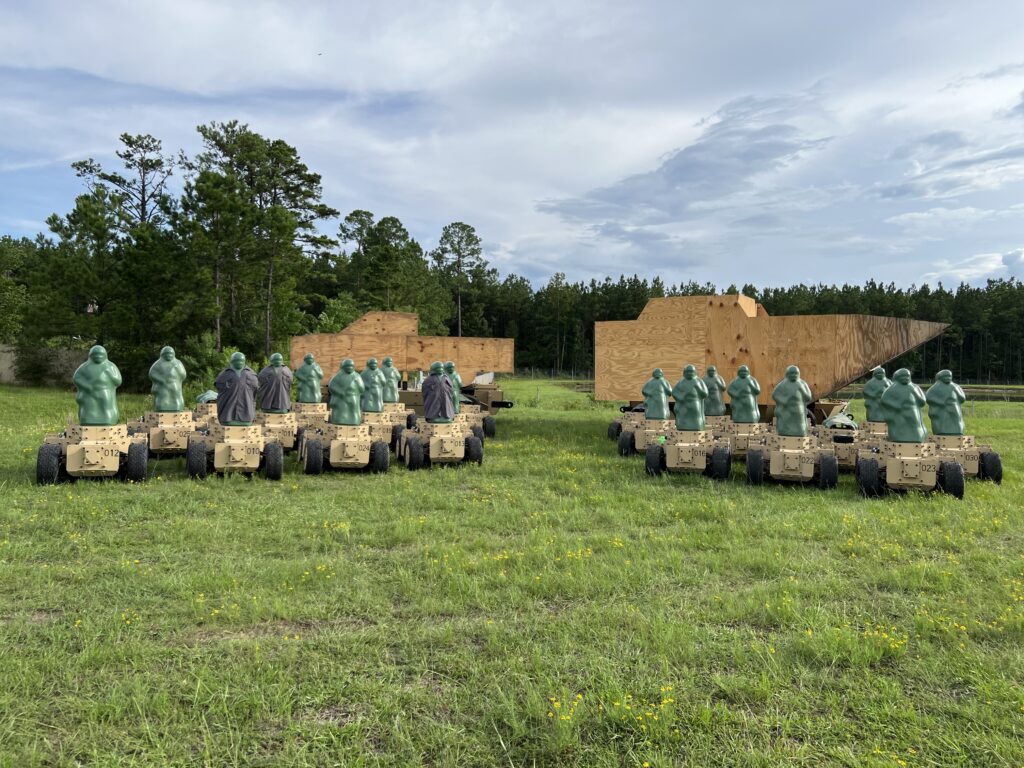
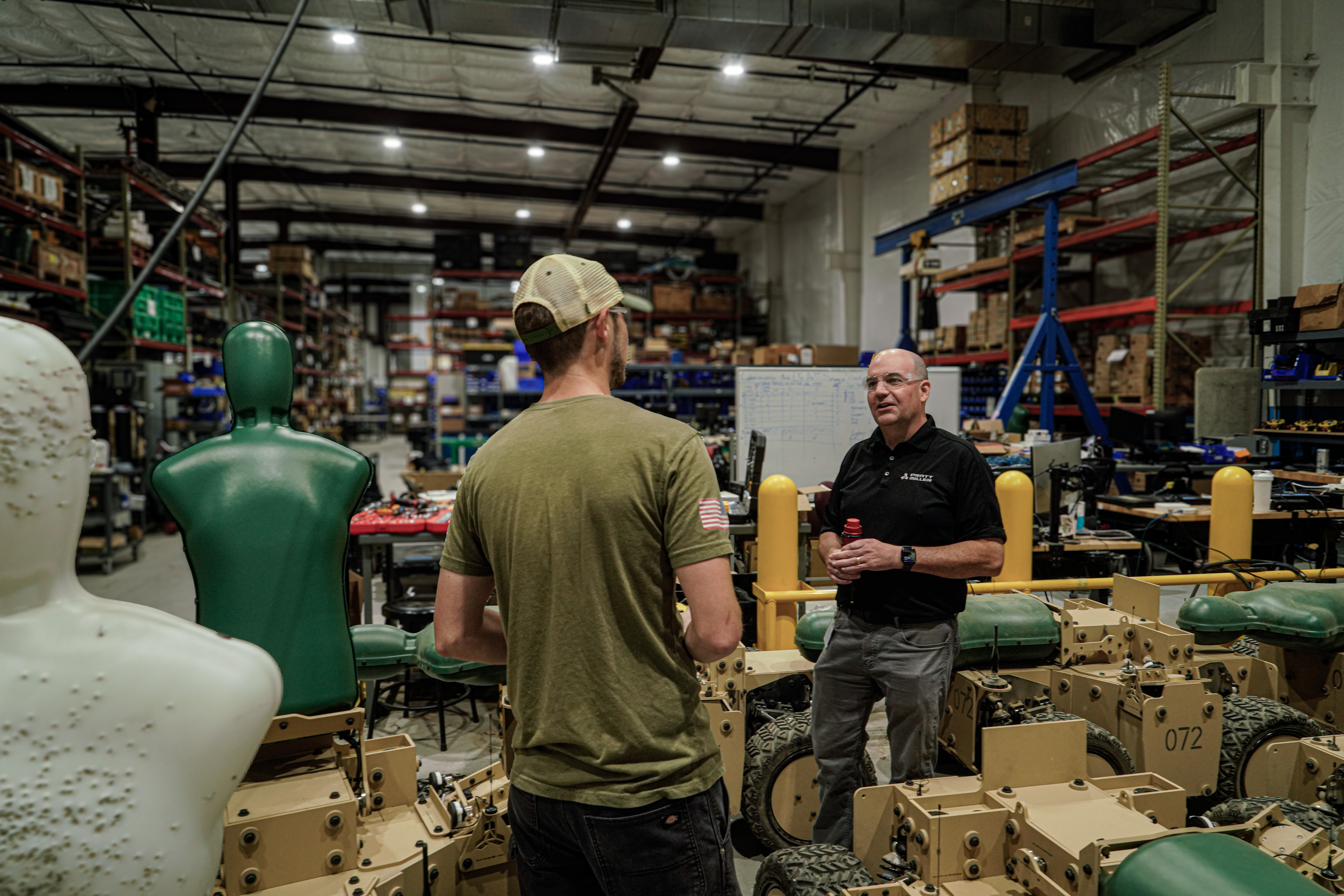
On a military range, predictability can be a defect. A stationary target, or one traveling along a fixed line at a steady speed, gives a trainer only so much to work with. Pratt Miller’s Trackless Moving Targets combine mobile armored platforms, GPS-based path following and hit detection. Infantry and vehicle versions allow more varied movement and reactions.
In December 2024, the company announced a multi-year U.S. Army production contract after years of development and soldier evaluation. The program had begun as a Small Business Innovation Research effort 12 years earlier. Requirements were refined around soldier feedback, safety, compatibility with range software and durability. Soldiers were intended to operate and maintain the systems themselves.
The duration matters. Racing encourages urgency, but a new defense product has to fit the customer’s operating world. Pratt Miller’s COO, Kris Houghton, later identified contracting requirements as the principal challenge in entering defense. The company began through prime contractors in 2008 and started government-direct contracts in 2011. Technical credibility still needed an education in buying procedures.
“Our largest challenge in making the leap into defense was understanding the contracting process and requirements”
Kris Houghton, COO · August 2026
A $115 million idea meets its forecast
Oshkosh Corporation completed its acquisition of Pratt Miller in January 2021 at an announced $115 million cash-free, debt-free purchase price. The attraction included robotics, autonomous and connected systems, electrification and engineering expertise. Pratt Miller retained its name, facilities and motorsports focus. Oshkosh was buying capabilities it could use in other vehicles.
The forecast proved less accommodating. In the second quarter of 2024, Oshkosh recorded $51.6 million of Pratt Miller intangible-asset impairments after unfavorable mobility and motorsports conditions reduced expected cash flows. It also disclosed lower anticipated third-party work. In July, reporting responsibility moved from the Defense segment to the Chief Technology and Strategic Sourcing Officer, with a wider role across Oshkosh.
In the second quarter of 2025, another $5.7 million charge impaired the remaining goodwill, reflecting reduced expectations associated with defense contracts and royalties. These charges mark revisions to accounting values and anticipated performance. They are not equivalent to cash spent that quarter. The distinction matters when assessing an engineering acquisition whose laboratories and people can still do useful work.
Announced acquisition price
Intangible-asset impairment
Remaining-goodwill impairment
The change in reporting suggests a practical adjustment: use the engineering team more broadly inside the parent while outside markets remain difficult. That is an interpretation of the disclosed move, rather than a claim about private deliberations. An Army production award and a racing championship can coexist with disappointed financial expectations. Each answers a different question.
Hydrogen is an ingredient, not a vehicle
Pratt Miller’s mobility work concentrates on the connections between components. Its electrification services include battery-pack engineering, thermal management, power electronics, drivetrain design and supervisory controls. The problem for a customer is seldom obtaining a motor alone. It is making the motor, battery, cooling and software perform together under the intended duty cycle.
A January 2025 partnership with GreenGT follows that logic. GreenGT supplied hydrogen fuel-cell expertise; Pratt Miller supplied engineering and integration capabilities. Units of GreenGT’s NGT 75 kW system had already been delivered when the partnership was announced. That is a specific starting point for development, rather than proof of a finished fleet or a new mass-market vehicle.
Some of the work is less photogenic. PM-FlexTire, integrated with Altair’s EDEM platform, models tires interacting with soft soil, including deformation, changing air pressure and tread contact with particles. Altair describes its complexity and licensing cost as best suited to that specialized simulation environment. It is a tool for a particular engineering problem, with particular demands on its user.
Other work reconnects simulation to hardware. Pratt Miller’s Core Lab won a technology-demonstration award at GVSETS in August 2025. The demonstration linked virtual assets and a remote robotic system with a physical scaled-down weapon station at the event. It illustrates the company’s interest in testing across virtual and real environments; an award for a demonstration establishes that achievement, not battlefield deployment.
Copy the feedback loop
Pratt Miller occupies a recognizable part of the engineering market: specialized development between a customer’s internal team and a finished vehicle. Alternatives include Multimatic’s race engineering and simulation services, or Ricardo’s vehicle and defense engineering. Its distinctive pitch rests on the combination of racing execution, software, physical fabrication and robotic products within one business.
For a manufacturer, the useful opening brief would specify the duty cycle, payload, environment, test criteria and intended production volume. A race team might need simulator time; an industrial developer might need a configurable robotic base; a government customer might need an integrated training system. Those are different purchases. Pratt Miller’s breadth makes sense when the problem crosses engineering disciplines.
The transferable lesson is to reuse a capability while taking the new customer’s world seriously. Learn procurement. Let operators alter requirements. Keep physical validation in the plan. A team with racing experience still had to spend years making a target suitable for soldiers. The damper at Le Mans was replaced quickly. The habit worth copying is the willingness to find out what the machine needs next.
The machines, the people, the footage
Explore Pratt Miller, its products, simulator offering and company news. Follow the team on LinkedIn, X, Instagram and Facebook.
More films on Pratt Miller’s YouTube channel ↗