An engineer kept emailing Brook Armstrong. He had found a cheaper flight himself. The corporate booking tool offered a worse deal, more screens, and less say over the journey. He sent comparisons for weeks. Most businesses have procedures for people who refuse to follow procedures. Armstrong eventually found himself asking whether the procedure deserved the loyalty.
The episode appears in the founders’ account he published in October 2026. It offers a useful entrance to his working life: a customer complaint that becomes an argument about how an industry organizes itself. A plane ticket looks like a simple purchase until the traveler, employer, airline, agency and payment provider each need their own account of it. Then the paperwork acquires a social life.
Armstrong is the Boston-based co-founder and co-CEO of Blockskye, alongside Michael Share. Their company builds corporate travel and payment infrastructure. His recurring concern is the distance between the person taking a trip and the companies supplying it. Every additional system has its own record, incentives and invoice. Armstrong wants those parties to agree on what happened before anyone has to reconcile the disagreement.
An invitation with very little ceremony
Share’s invitation into the business was refreshingly short on grandeur. A colleague had quit; he needed Armstrong to join calls and help. Their partnership grew through work already in progress, rather than a carefully staged founding moment. The two eventually left their respective companies and built Blockskye, founded in 2017.
Armstrong brought a background broader than airline distribution. He holds a BA from Columbia University, and his career spans startups, venture capital and travel. That combination matters here. Corporate travel asks an entrepreneur to think about software, contracts, working relationships and payment economics at once. A prettier booking screen can leave the commercial arrangements beneath it untouched.
Share brought experience building and selling the business that became HRG North America. Together, they were looking at suppliers whose consumer apps were improving while the corporate systems between suppliers and travelers lagged. The engineer’s frustration gave that mismatch a human scale. A person buying something for work could have fewer useful choices than the same person buying it on Saturday.
A taste for the supposedly boring
Armstrong’s interests extend into the more speculative corners of digital ownership. In an April 2022 conversation with retail analyst Oliver Chen, he discussed cryptocurrencies, NFTs and smart contracts. Chen introduced him as an investor in crypto since 2016 and in NFTs since 2019, with interests spanning several categories and blockchains.
What makes the conversation revealing is where Armstrong’s enthusiasm lands. Alongside art and gaming, he talks about property titles, stock certificates, identity documents and corporate receivables. These are hardly the things one puts on a nightclub flyer. They are, however, records whose ownership and transfer have real consequences.
He describes smart contracts in terms of conditional business instructions governing assets. That is a practical way into a subject often buried beneath its vocabulary: what must happen before value moves, and who can establish that the conditions were met? His travel business asks a related question every time a booking changes, a payment settles or an unused ticket retains value.
The attraction, in his account, is the possibility of different parties transacting against reliable shared information. That helps explain why his public discussions keep returning to administrative chores. There is considerable drama in digital ownership. Armstrong also makes room for the accounts department.
One trip. Several accounts of it.
The itinerarySupplier
The bookingEmployer
The expense
From a ledger to a working itinerary
An early institutional connection arrived in 2019, when Airlines Reporting Corporation made its first outside investment in Blockskye. ARC was already collaborating with the company, a major US airline and a corporate customer. For Armstrong and Share, it put an established participant in travel settlement alongside a young business proposing different infrastructure.
By the 2022 Phocuswright Conference, Armstrong was describing live activity: roughly 2,200 transactions, worth $1 million to $2 million, each day. Those were figures he reported at the time, rather than a present-day measure of the business. He appeared with executives from Arise Travel and Dtravel in a discussion of blockchain applications already operating in travel.
The distinction between a technical demonstration and an actual itinerary is substantial. A traveler might change dates, cancel a ticket, choose a seat or need help after booking. Any system that makes the first purchase easy still has the rest of the trip to contend with. Armstrong’s emphasis on supplier connectivity reflects that less glamorous stretch of the work.
Blockskye was named among PhocusWire’s Hot 25 Travel Startups for 2024. Its stated direction was already clear: connect corporate buyers more directly with suppliers while bringing booking, payment and expense information together. KAYAK supplied a familiar consumer booking experience. Blockskye worked on the financial and data connections underneath it.
The receipt meets a real employer
PwC US provided a consequential test of the approach. KAYAK’s July 2024 enterprise announcement described a solution developed with Blockskye and PwC, which had been involved since the enterprise offering launched in 2022. More than 75,000 PwC US employees had access to the booking platform. Access is the relevant measure; it does not mean every employee booked a trip.
The updated product allowed customers to manage bookings through selected airline websites or apps, KAYAK for Business, or an agent. Blockskye Pay was introduced to charge eligible travel expenses directly to employers and automate unused-ticket-value management. The aim was to remove the familiar obligation to reconstruct a trip for an expense report after taking it.
These are rather personal ambitions for enterprise software. A traveler would prefer to finish traveling. A finance team would prefer a record that already matches the transaction. An airline would prefer its customer to receive the services and recognition it offers directly. Making those preferences compatible is the work behind Armstrong’s otherwise technical vocabulary.
employees had access to KAYAK for Business Enterprise
The entrepreneur who could wait
In October 2024, Armstrong described a selective approach to bringing customers onto the enterprise product. He said Blockskye had turned some prospective customers away while seeking partners willing to change how their programs worked. Diageo and Tripadvisor were among the publicly named customers. Rapid growth was not his immediate priority.
That patience had an edge. Asked about difficulties elsewhere in travel blockchain, he rejected the idea that an entrepreneur could simply blame the industry for being unready. “The bar is higher than that,” he said. It is a demanding view of the job: the market’s awkwardness belongs in the business plan.
His language about travelers is equally instructive. “Travelers do what they want; that’s just the market speaking.” He resists treating direct bookings as a behavioral failure. The practical task, in his view, is to support those choices while preserving the employer’s ability to manage the trip.
The useful evidence in that discussion came from PwC’s experience: a reported 10 percent reduction in intermediary fees on typical airline purchases and 92 percent fewer agent interactions for bookings outside global distribution systems. These were specific customer results, with specific denominators. They should stay that way. An operating example is more useful than a percentage wandering free of its context.
“Travelers do what they want; that’s just the market speaking.”Brook Armstrong · 2024
Trust has a commercial address
In a 2025 London conversation with Business Travel News editor Elizabeth West, Armstrong focused on buyers’ doubts about whether the travel options they saw reflected their interests. His argument connects trust with incentives: a client should be able to understand how its travel partner earns money and why particular choices appear.
He also acknowledged the continuing need for skilled help. VIP travel, groups, meetings, complex payment arrangements and global servicing can require an intermediary. His preferred direction allows different kinds of travelers and trips within one managed program, with the information brought back together. The idea accommodates people rather than assuming every journey can follow an identical script.
In July 2025, Blockskye announced $15.8 million in funding led by Blockchange, with United Airlines Ventures and other investors participating. The company said it would use the money for payment products, international expansion and hiring. Its announced total funding reached $33 million. Capital gave Armstrong and his colleagues more room to pursue the infrastructure work; it did not make the integration problems disappear.
A forecast, and the work before it
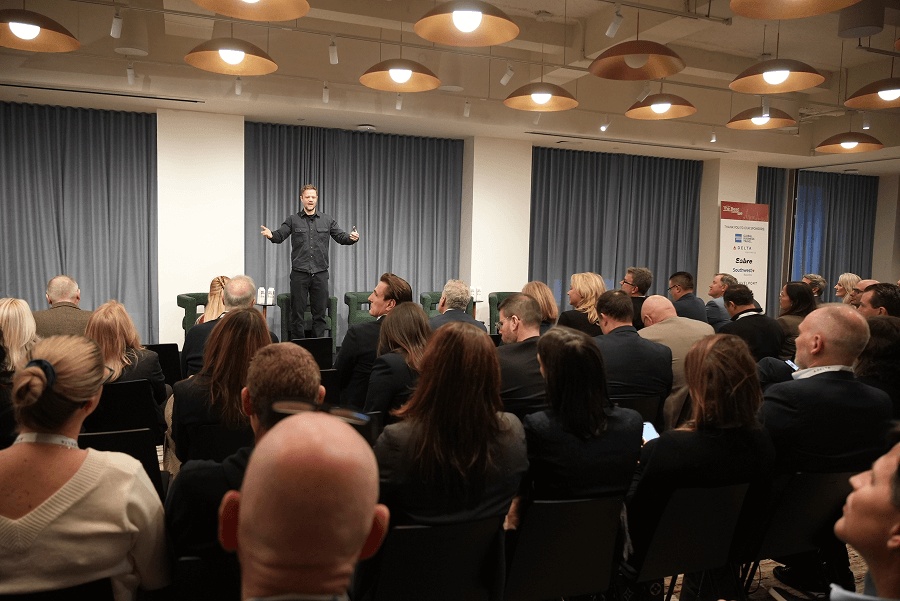
At The Beat Live in December 2025, Armstrong set out a prediction of broad change in corporate travel and payments by 2030. He expected direct supplier connections and artificial intelligence to alter booking and servicing. It was a forecast with a date attached, rather than a description of a finished transformation.
A concrete expansion of the partnership model followed in May 2026. Blockskye, FCM Travel and KAYAK for Business announced plans for an integrated enterprise offering. KAYAK would contribute booking, Blockskye its payment and data infrastructure, and FCM its service reach across more than 95 countries. Flight Centre Travel Group, FCM’s parent, also invested in Blockskye. The announcement described an offering being developed, with further availability details to follow.
For Armstrong, that arrangement brings the global service question into the same conversation as the ledger and the booking screen. It also makes his original proposition easier to judge. Can travelers use the channels they prefer? Can companies understand the economics? Can the record follow a booking through its changes?
The questions are ordinary enough to be asked at an office desk, long before a conference keynote begins. That is part of their force. Armstrong’s career at Blockskye has made a business out of taking them seriously. Somewhere between choosing a seat and closing the books, a routine trip becomes a test of how well the whole arrangement works.