The Porsche came first. Not first in the story, exactly, but first in the chain of events that made the story worth telling. Brian Hoang had sold SURVIVR, the virtual-reality training company he started while still young enough to be mistaken for an intern. The sale in 2021 produced the first meaningful money his family had seen. So he did a thing both predictable and useful: he bought a sports car.
The predictable part was the Porsche. The useful part was what followed. Hoang entered Dallas car culture, started a community on Discord and organized cruises. He learned the rituals, met the people and noticed the machinery behind automotive retail. The cars were increasingly computerized. The retail experience surrounding them could feel curiously preserved in amber.
Dealerships missed calls during busy hours. Leads arrived when the building was dark. Customers repeated themselves across departments. Staff navigated a cabinet of software, each drawer requiring its own login. Hoang saw a vertical market large enough to anchor the American economy and particular enough to punish generic solutions. By early 2023, generative AI had supplied a new instrument. The question was where to point it.
The five-year warm-up
Hoang did not arrive at Mia Labs as a tourist in software. He studied software engineering at the University of Texas at Dallas, graduated magna cum laude in 2019 and gave a commencement address. His extracurricular list read like an impatient rehearsal for the rest of his career: the Venture Development Center, Blackstone LaunchPad, entrepreneurship groups and the university’s Artificial Intelligence Society, where he served as a co-founder and executive director.
At 19, he co-founded Immosis, a virtual- and augmented-reality consultancy. Its client work crossed gaming, education and other industries before the company made the choice that many founders avoid for too long. It pivoted. In 2018, the business became SURVIVR, a public benefit corporation building immersive training for police and military customers.
This was emerging technology aimed at an institution with long purchasing cycles, complicated budgets and very little patience for novelty without proof. Hoang learned to recruit domain experts and to care about operating economics early. SURVIVR won the UT Dallas Big Idea Competition, joined Techstars Austin and MassChallenge Texas, and secured customers across ten states. Its technology was used by police agencies, universities, private security organizations, the U.S. Air Force and the Department of Homeland Security.
A student software venture starts with VR and AR consulting.
The company focuses on immersive public-safety training.
InVeris buys SURVIVR; Hoang joins the acquirer.
A second startup points generative AI at dealership communication.
Mia announces $20 million in new capital.
InVeris acquired SURVIVR in August 2021. Hoang became director of VR and AR strategy, then vice president of products. The transition put him inside a company of a few hundred people after years of running a startup. It enlarged the scope, but not the central obligation. Whether CEO or product executive, he concluded, leadership is still the work of aligning a collection of humans around a mission.
He stayed for a two-year post-acquisition term. Then the familiar itch returned. Hoang had written that he was guaranteed to start more companies because the work was simply too enjoyable to abandon. SURVIVR, he hoped, would someday look like the warm-up. By the time he left InVeris in August 2023, the second act was already taking shape.
Candor, with office hours
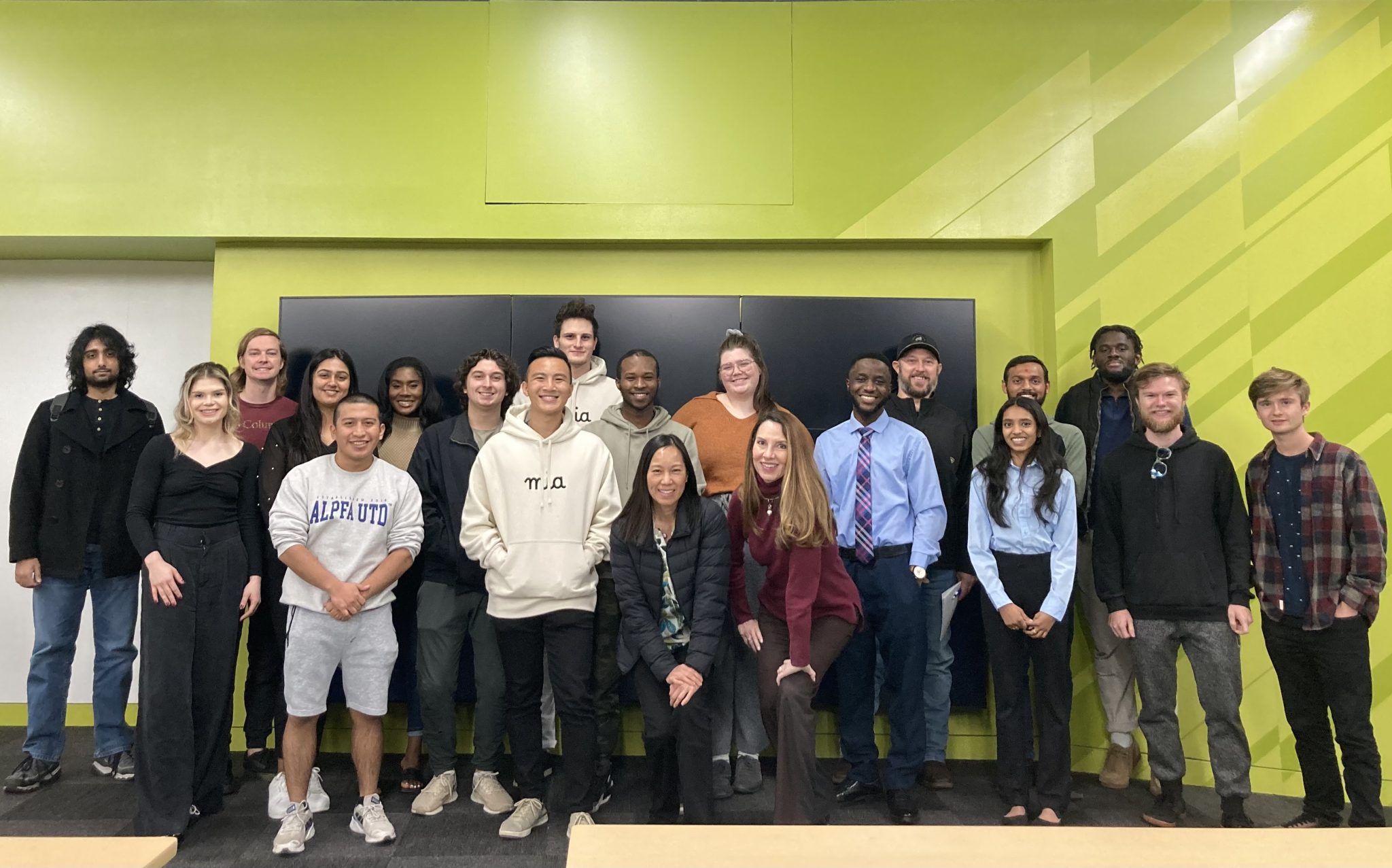
While the new company was young, Hoang returned to UT Dallas as an adjunct instructor. He was 25. The computer-science graduate crossed campus to the business school and rebuilt Startup Launch, an advanced entrepreneurship course, as a small accelerator. Students applied with real companies. Wednesday sessions ran for three hours. The semester moved from market validation through teams, law and finance to a pitch before judges.
His teaching philosophy was not upholstered for comfort. Hoang believed startup classes could become dangerous when enthusiasm outran evidence. A student could spend years on the wrong market because an instructor had been too polite to challenge the premise. He offered tough feedback and expected students to return with better research, clearer thinking and thicker skin.
The line sounds severe until paired with his two opening promises: he would care about the students, and serious effort would produce serious growth. The combination explains more than the bluntness alone. Hoang designed the class to rebuild after it challenged. His proudest outcomes were not the founders who arrived with momentum. They were the uncertain students who discovered enough confidence to think bigger and keep going.
There was a limit to the simulation. No syllabus could reproduce the responsibility of payroll or the strange emotional weather of a company in trouble. Hoang had felt the weight of issuing a first payroll at both startups. Each time, the thought was the same: other people now depended on this. The classroom could offer an honest rehearsal. The stage itself remained less forgiving.
He taught four semesters, ending in spring 2025 because Mia was accelerating. He called teaching a favorite passion project. In a neat reversal, the university that gave a beginner patient mentorship had received a founder back, now carrying the scars, stories and occasional Gen Z slang of two companies.
A phone call is a systems problem
Mia Labs began with an unglamorous unit of work: answer the phone. A dealership receives routine questions, service requests, sales inquiries and calls meant for specific employees. At peak times, some calls go unanswered. After closing, nearly all of them do. A missed call is not merely an inconvenience; it can be a customer calling the next store.
Mia’s conversational agent answers calls and texts, checks inventory, schedules sales and service appointments, routes customers and alerts staff. It can work across departments and languages, connect with dealership systems, and turn conversations into analytics. In Hoang’s formulation, the AI augments the business development center by absorbing repetitive volume, leaving people freer to work with customers who are physically present.
The human boundary matters to Hoang. He has described Mia’s broader role as helping “elevate and advance humanity,” an ambitious phrase attached to a practical division of labor. Software handles the late-night lead, the hours question and the batch of follow-ups. Employees greet the person arriving on the showroom floor or service drive, exercise judgment and build the relationship.
The model expanded from inbound voice into outbound communication and text. It also exposed a second opportunity. Once a system participates in thousands of conversations, it can show operators what customers ask, where requests fail and what happens after a transfer to a person. The receptionist becomes a listening post.
Company-reported results released with the January 2026 Series A announcement.
In January 2026, Mia announced a $20 million Series A led by Permanent Capital Ventures, with participation from Norwest and earlier investors including Eniac Ventures, Vine Ventures, Analog Ventures and Logos Fund. The round brought reported total capital to $29 million. Mia said it had grown beyond 50 employees and supported more than 350 franchise dealerships during the prior year.
Funding announcements invite confetti. Hoang’s more interesting statement came a few weeks later at NADA 2026. The company, he said, was beginning to move beyond automating dealership conversations toward automating the dealership itself.
Twenty logins walk into a showroom
The joke is that none of them knows what the other nineteen are doing. Dealership technology has grown by accretion: a tool for calls, another for texts, a customer relationship manager, a dealer management system, campaign software, analytics and a collection of point solutions acquired at different moments. Each may solve a problem. Together they create a new one.
Hoang wants Mia to become a unified layer for dealership intelligence and automation. The aspiration is fewer dashboards, fewer fragmented data trails and fewer opinions about what performance means. A customer conversation would not end when the phone disconnects. It would become a useful event inside the operation: an appointment, a follow-up, a surfaced pattern, a next action.
There is continuity here. SURVIVR took an emerging interface and applied it to the precise constraints of public-safety training. Mia takes generative AI and applies it to the precise messiness of automotive retail. Both bets depend less on technological spectacle than on whether the product survives contact with a traditional institution.
Hoang has described himself as better at execution than at generating ideas. It is a useful confession in a culture that adores lightning-bolt inspiration. His career looks more like conversion: convert a student project into a company, a consultancy into a vertical product, a sale into operating experience, a sports-car purchase into proximity, and an unanswered phone into a business system.
The Porsche remains the charming hinge. A purchase that could have been a trophy became an entrance ticket to a community. The community made an industry legible. The industry supplied a problem. Then came the less cinematic part: calls, integrations, appointments, payroll and the steady business of making software useful.
That last part is where Hoang seems most at home. He kept his promise to start again. Now he has to make the warm-up look small.