A conference-room speakerphone and a yellow electric drone seem unlikely members of the same family. One sits on a table while people discuss next quarter. The other leaves the ground. Brian Hinman has helped build both kinds of machine, and his career becomes easier to follow once you notice how much time he has spent dealing with interruptions.
A voice that cannot get through. A video connection that asks too much of the network. Broadband that needs to reach the rest of the house. An aircraft whose battery gives up while there is still useful work below. The products change. The inconvenience remains familiar: you would like to carry on, but the equipment has other plans.
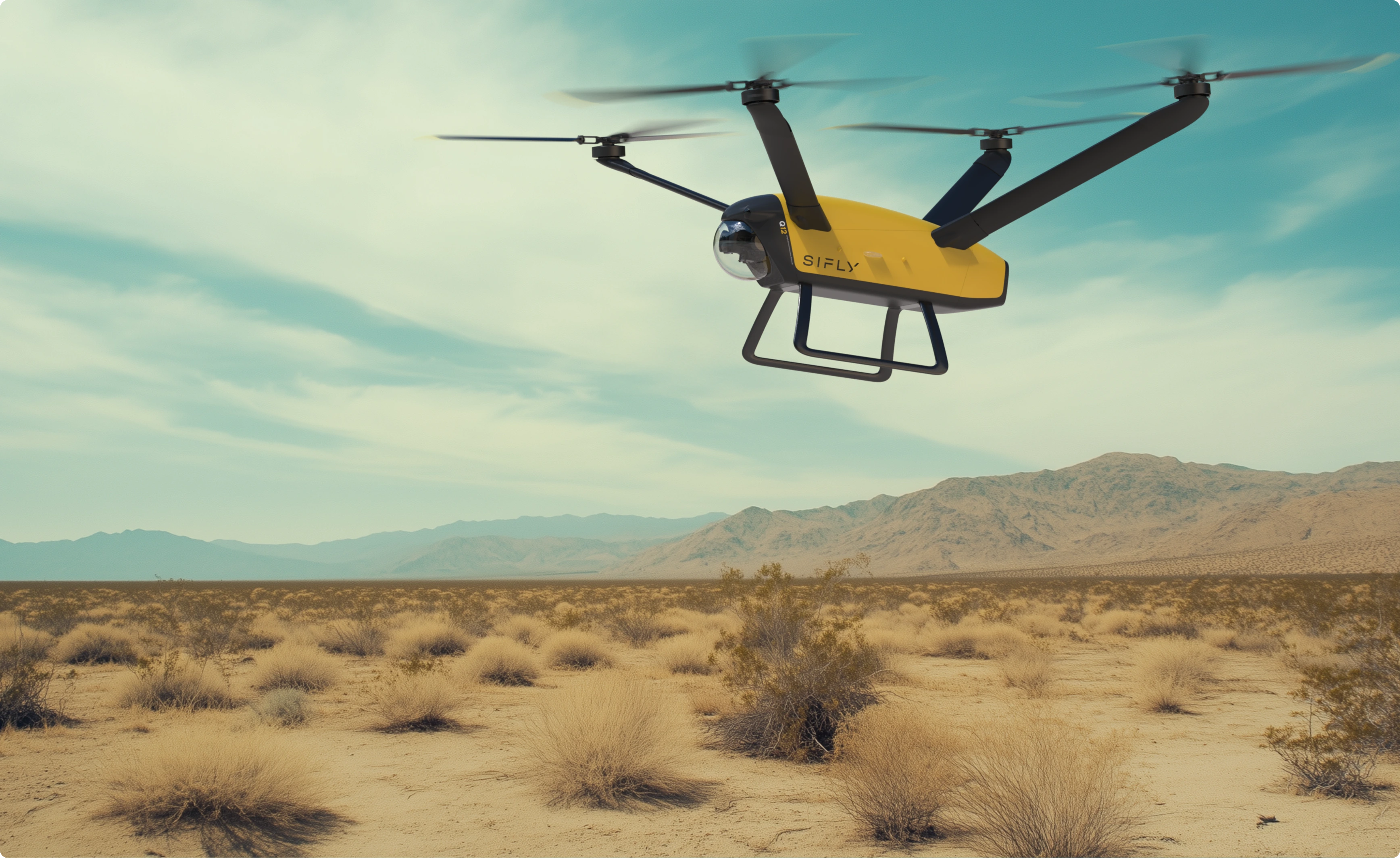
Hinman is now the founder and CEO of SiFly. On July 26, 2025, its Q12 drone flew for three hours, eleven minutes and fifty-four seconds at Amaral Ranches in California’s Salinas Valley. The flight earned Guinness recognition in the category for electrically powered prototype multirotors weighing between five and twenty kilograms. It is an unusually precise punctuation mark in a career that began four decades earlier.
Q12 electric multirotor prototype, 5-20 kg category.
Record announced August 19, 2025.
The application before the business plan
Before there were companies, there was an electrical engineering student at the University of Maryland who wanted to own a technology business. Hinman graduated in 1982, summa cum laude, then headed to MIT for a master’s degree. His application contained a revealing ambition: he wanted to meet people who might eventually start a company with him.
Graduate school has many attractions. Finding your future business partners is a pleasantly practical addition to the list. It suggests that Hinman understood something about the gap between having technical ability and putting it to work. An idea can fit comfortably inside one head. A company generally requires a few more.
He completed his MIT degree in 1984 and co-founded PictureTel at twenty-two. His specialty was digital signal processing. PictureTel worked on video compression, including motion compensation and transform coding, making moving images more manageable for communications systems. These are technical terms for a very human wish: to see the person at the other end without making the network collapse under the effort.
The appeal of this early chapter is its combination of abstraction and usefulness. Signal processing involves mathematics, but the outcome is a conversation. Hinman’s later work would keep returning to that relationship between an invisible engineering decision and an experience that someone else could immediately understand.
A place at the conference table
Polycom followed around the turn of the 1990s, with Hinman as a co-founder and CEO. Its SoundStation speakerphone became a familiar conference-room object. Full-duplex audio allowed people at both ends to speak and hear at the same time, bringing a telephone meeting a little closer to the untidy rhythm of an actual conversation.
People interrupt each other. They laugh before the other person has quite finished. They offer a quick agreement halfway through a sentence. A useful communications device has to accommodate these small discourtesies. Otherwise, the machinery begins chairing the meeting, and machinery has a rather poor sense of when to let somebody finish.
In 1998, Hinman co-founded 2Wire, moving into equipment for home broadband. The destination shifted from the office table to the household network. In place of a single dramatic invention, there was the work of making several functions cooperate: a DSL connection, routing, wireless access and the interfaces through which a home could use its connection.
That history gives his present venture some context. He has repeatedly worked on hardware whose value depends on fitting into a larger system. A speakerphone needs the call. A gateway needs the network. An aircraft doing a remote assignment needs more than the ability to rise impressively off the ground.
- 1984PictureTelMoving images
- 1990PolycomRoom audio
- 19982WireHome broadband
- 2012MimosaWireless networks
- 2021SiFlyElectric aircraft
The company he helped other people start
There is a second line through Hinman’s working life, running back toward Maryland. After building companies himself, he helped fund an environment in which students could try it. The Hinman Campus Entrepreneurship Opportunities Program brought undergraduates from different disciplines together to live and develop ventures in the same residential community.
The university announced the initiative in 1999; its residential intake began in fall 2000. Students would have access to spaces and equipment for working together, alongside instruction and mentoring. Business, engineering, computer science and other subjects could meet without waiting for a chance encounter across campus. A possible collaborator might be much closer to the kitchen.
“I just wish they’d had such a program in place when I was there!”
Brian Hinman, on the Maryland initiative, 1999
His reaction was wonderfully direct. He had gone looking for collaborators at MIT. Now he was helping make that search easier for someone else. A 2005 account described his $2.5 million contribution as support for the program’s first decade. The concept treated entrepreneurship as something students could practice together while still being students.
Anthony Casalena began building Squarespace in the Hinman CEOs residences in 2003. The program’s alumni also include OpenGov co-founder Zachary Bookman, and two participating students founded Alertus. Those are the students’ companies and achievements. They also give substance to the original premise: proximity can help capable people find one another and begin.

Hinman also supported an international dimension to the program, with an additional $1 million gift described in 2010. The proposed work included international entrepreneurship teaching and exchanges. His view of preparing founders extended beyond learning how to pitch a company at home; students should encounter markets and collaborators elsewhere, too.
From the wire to the air
There were other turns before SiFly. Hinman joined Oak Investment Partners as a venture partner in 2006, working with clean technology businesses. In 2012, he co-founded Mimosa Networks, returning to communications through wireless broadband hardware. His public writing there included arguments for bringing high-speed internet to underserved communities.
The recurring interest was access: how to get a connection somewhere it could be useful, at a cost that allowed people to use it. That concern makes the move into cloud-connected aircraft less surprising. A drone gathering information over a farm or a stretch of infrastructure is another device at the edge of a network, only this one must budget for gravity.
Hinman founded SiFly in November 2021. His starting point was a prediction about the work drones would eventually do. If aircraft increasingly travelled beyond the operator’s view, their design would have to suit sustained travel. Endurance and forward-flight efficiency would matter more. So would cellular and cloud connectivity.
In describing conventional drones, he has used the phrase “flying bricks.” It is an engineer’s complaint with an unusually good silhouette. Aircraft designed mainly to hover nearby need different compromises from aircraft expected to go somewhere, remain useful and return. SiFly’s answer has been to revisit the quadcopter’s physical design around that longer assignment.
The old customer in the new conversation
One of the people accompanying Hinman into this discussion is John Donovan, the former CEO of AT&T Communications. Their relationship reaches back to Hinman’s DSL equipment days. In a February 2026 conversation, Hinman said they had known each other for about twenty years and had reconnected roughly two years earlier.
Donovan’s description of him centres on attention to components: how each performs, what each costs, how the pieces combine. It is an outside view of the same habit visible in the products. A founder can talk about a market in sweeping terms. An engineer eventually has to choose the parts.
Hinman’s publicly listed patents trace that shift in interests. Antenna and radio work sits alongside electric rotorcraft systems, charging and flight-control inventions. The list makes a quiet counterpoint to the corporate résumé. Beneath the company names, he has continued dealing with the details that decide whether a machine can do what its maker promises.
A stopwatch is easier than a production line
In August 2026, SiFly announced a $20 million Series A led by Shield Capital, with participation from Qudit, BBK Capital and Alumni Ventures, among others. The planned uses included scaling Q12 production and deliveries, strengthening manufacturing and supply chains, and developing and validating its DronePort infrastructure system.
There is a distinction here between a flight record and an operating business. The record establishes what a particular aircraft achieved under particular conditions. Customers need repeatable performance, support and equipment that arrives when expected. By August 2026, the target for first revenue-generating deliveries was the first quarter of 2027, later than the timetable discussed at launch.
For Hinman, that is the next chapter to earn. A long flight opens possibilities for inspection, mapping and public safety. Production determines whether those possibilities become part of somebody’s working day. His previous companies provide experience of the distance between engineering a product and supplying it at scale; the distance still has to be travelled again.
The speakerphone stays on its table. The broadband gateway stays in the house. SiFly’s aircraft gets to leave. Across those different settings, Hinman’s work keeps returning to the same practical wish: let the person using the machine finish what they came to do.
Keep following the flight
- Brian Hinman on LinkedIn
- SiFly: aircraft and company updates
- Watch SiFly on YouTube
- SiFly video featured on its company site
- Listen: Hinman and John Donovan on Explain to Shane
- Watch or listen: the Hangar X Studios conversation
- Explore the Hinman CEOs Program
- Read the August 2026 financing announcement
- Read the production and delivery reporting