Brian Gray began his construction career asking a surprisingly consequential question: was the rock angular enough? Fresh from Oregon State in 1993, he went to work in a quality-control laboratory at Morse Bros. in Corvallis. Testing aggregate for asphalt was perhaps an unexpected destination for a civil engineering graduate. “My parents thought I was crazy,” he recalled. Gray liked being able to connect the work in front of him to something that would remain in the world: a road, a bridge, a useful piece of somebody else’s day.
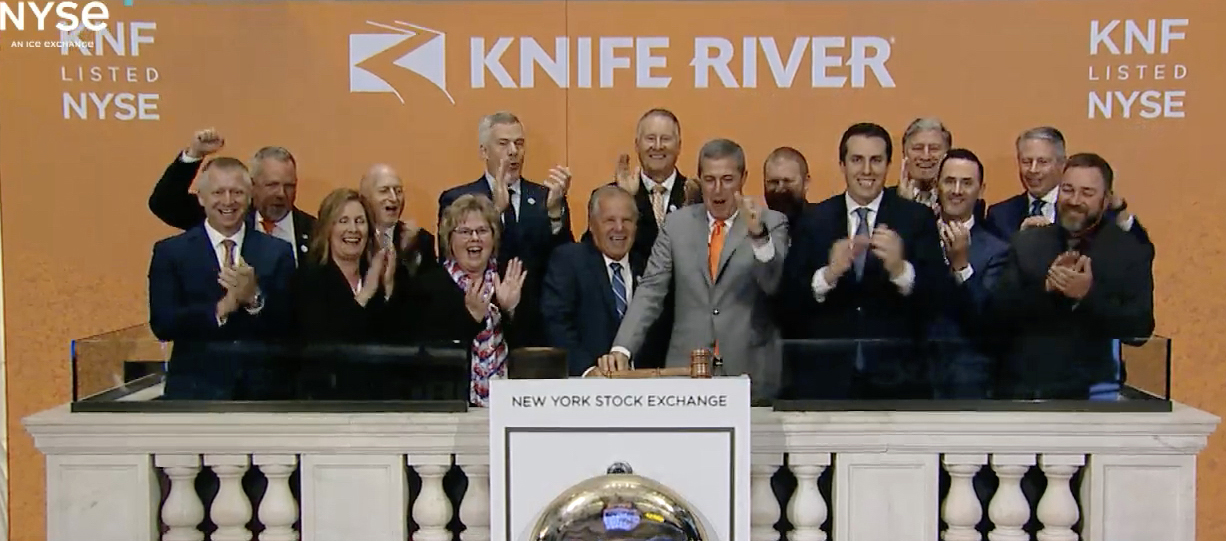
Thirty years later, he was at the New York Stock Exchange, representing a business that had absorbed the family-owned company where he started. There was rather more orange in the scenery. Knife River’s name and trading symbol filled the backdrop as its leaders marked the company’s independence in June 2023. A laboratory technician had become the chief executive. The material under discussion was still rock.
That continuity makes Gray interesting. His career has followed the construction-materials business through consolidation, expanding expectations for training, and the transition from regional operations to public-market scrutiny. He has participated in each stage. Now the executive who learned to evaluate a sample has investors evaluating his own results.
A buyer who had once been bought
Knife River acquired Morse Bros. in 1998. Gray therefore encountered acquisitions from inside a business being purchased, years before he would lead deals himself. It is a useful detail in a career otherwise easily reduced to a sequence of increasingly responsible titles. He had joined a family business; the company around him was changing its scale and ownership.
By 2012, Gray was president of Knife River’s Northwest segment, a job he held through 2022. Its operations combined aggregates, ready-mix, asphalt, prestressed concrete and construction. These are related businesses, but they make different demands. A quarry supplies material. A concrete operation makes and delivers a product. A contractor takes responsibility for completing work. Managing them together means paying attention to the connections as well as the individual operations.
Gray led eight acquisitions during his Northwest tenure. Baker Rock Resources, serving the Portland metropolitan market, was among the additions. When MDU Resources announced his promotion to Knife River president in November 2022, its chief executive, David Goodin, singled out Gray’s strategic thinking and business-development experience. The promotion put a regional operator with a record of buying businesses in charge of helping a much larger business prepare for independence.
Joins Morse Bros.
Quality-control laboratory
Morse Bros. acquired
Joins the Knife River family
Northwest president
A decade of regional leadership
President and CEO
Knife River becomes independent
The classroom with room for an excavator
One of Gray’s lasting projects occupies a former quarry near Albany, Oregon. The Knife River Training Center opened in 2022, and he helped develop it while leading the Northwest business. It gives a construction company something unusually tangible to point to when it talks about developing people: a campus where students can practice before working on an active job.
The site covers 230 acres. Its enclosed dirt arena occupies an 80,000-square-foot dome, alongside a 16,000-square-foot training building. Outside are a haul road and a simulated town. The arrangement joins classroom instruction to equipment practice in a controlled setting. A lecture on maneuvering heavy machinery becomes considerably more persuasive when there is heavy machinery available to maneuver.
The campus also poses a practical question about growth. A company can buy another plant or acquire another reserve of aggregate. Finding people who can operate equipment, deliver material and manage the work takes a different kind of investment. Training creates a route into those jobs and a route forward for people already doing them.
In February 2023, Knife River partnered with NAMC-Oregon, the Oregon chapter of the National Association of Minority Contractors, on $250,000 in training scholarships for historically underrepresented groups. The funding came from a larger Business Oregon outreach grant. Equipment instruction, commercial driver’s license training and leadership development were among the available courses. The partnership addressed access as well as instruction: a place in a classroom means more when someone can afford to take it.
Gray’s public case for the partnership was that construction benefits from a wider range of voices and viewpoints. NAMC-Oregon brought its own relationships and outreach to the effort. The distinction matters. Building a facility supplies capacity; reaching prospective students requires people who already know those communities.
He had been showing people around for years
Long before the training campus, Gray was helping new students find their bearings at Oregon State. As an undergraduate, he gave campus tours, worked in New Student Services and helped lead summer orientation. He graduated in civil engineering in 1993. His university later recognized him with admission to its Academy of Distinguished Engineers in 2022.
His connection to the university continued through recruiting, work with professors and construction education. That history gives the training center a personal context. Helping people enter an unfamiliar institution was part of his college life; helping people enter an industry became part of his executive work. The settings changed, while the task retained a recognizable shape.
“I received more than just an academic education.”
Brian Gray, reflecting on Oregon State
Gray has also worked through industry organizations. He served as president of the Oregon-Columbia chapter of the Associated General Contractors in 2017 and has served on the National Ready Mixed Concrete Association’s board and executive committee. In his AGC inaugural remarks, he emphasized the relationships construction builds alongside its physical projects. The observation suits an industry in which another firm can be a supplier, customer, project partner or acquisition prospect.
There is a less corporate Oregon connection, too: he follows Oregon State sports. Away from work, his publicly described interests include golf, hunting and time with his family. His attachment to the university has survived well beyond the diploma. Apparently, the engineering degree did not come with an expiration date on being a Beaver.
A very orange morning on Wall Street
Gray became Knife River president in January 2023 and CEO in March, succeeding David Barney in the latter role. On June 1, the newly independent company began regular trading under KNF. Gray and Barney shared the opening-bell occasion. It was a public celebration of a business built over decades inside MDU Resources, rather than the unveiling of a company assembled for the occasion.
Independence gave Gray a new audience for familiar operating questions. Investors could now judge Knife River directly on its own financial results, capital decisions and promises. With that came a strategy bearing the name Competitive EDGE: EBITDA margin improvement, discipline, growth and excellence. Beneath the acronym was a series of practical commitments about prices, spending, acquisitions and execution.
The first year supplied an encouraging result. Knife River’s adjusted EBITDA margin reached 15.3% in 2023, passing the 15% goal it had initially set for 2025. The company then turned its attention toward a longer-term ambition above 20%. Clearing an early target changed the discussion from whether independence could work to how much improvement the business could sustain.
The measurements get less comfortable
The subsequent record contains both growth and friction. Knife River reported $3.146 billion in revenue for 2025, up 9% from 2024. Adjusted EBITDA rose 7% to $496.5 million. It completed five acquisitions during the year and entered 2026 with a $1 billion year-end backlog. Those figures support Gray’s account of a company continuing to expand.
Other figures complicate the picture. Net income fell 22% in 2025, while adjusted EBITDA margin slipped from 16.0% to 15.8%. A larger business had produced more of the adjusted earnings measure, but a smaller proportion of revenue. For a chief executive who had made margin improvement central to his program, that distinction deserved attention.
+9% year over year
16.0% in 2024
Revenue grew. The margin narrowed. Adjusted EBITDA is a non-GAAP measure.
In the second quarter of 2026, revenue increased 13% to $938.6 million, while net income declined 13% to $43.9 million. The West region faced less available public-agency work in Oregon and project delays in Hawaii and Alaska. Company-wide growth could coexist with difficult local conditions. Gray’s regional experience had become directly relevant to explaining an uneven national picture.
Then came an explicit challenge. On September 24, 2026, shareholder Starboard Value announced a letter to Gray and the board. It called for stronger pricing and cost reductions, a path to a 22% adjusted EBITDA margin by fiscal 2029, and consideration of strategic alternatives. These were the shareholder’s demands and assessment, rather than settled conclusions about the company.
Knife River replied that it welcomed shareholder input and would engage with Starboard. It defended its integrated business model and reiterated its focus on improving margins, allocating capital carefully and growing profitably. The exchange brought a public disagreement into view: how quickly the assets and operating model should translate into better returns.
Gray’s career now sits between two kinds of patience. Learning to run equipment takes practice. Integrating an acquired business takes time. Shareholders, meanwhile, can measure progress every quarter. His task is to make the investments in people and operations pay on a timetable that keeps those owners persuaded. The former laboratory technician is still working with samples and specifications. Only now, the whole company is on the test bench.