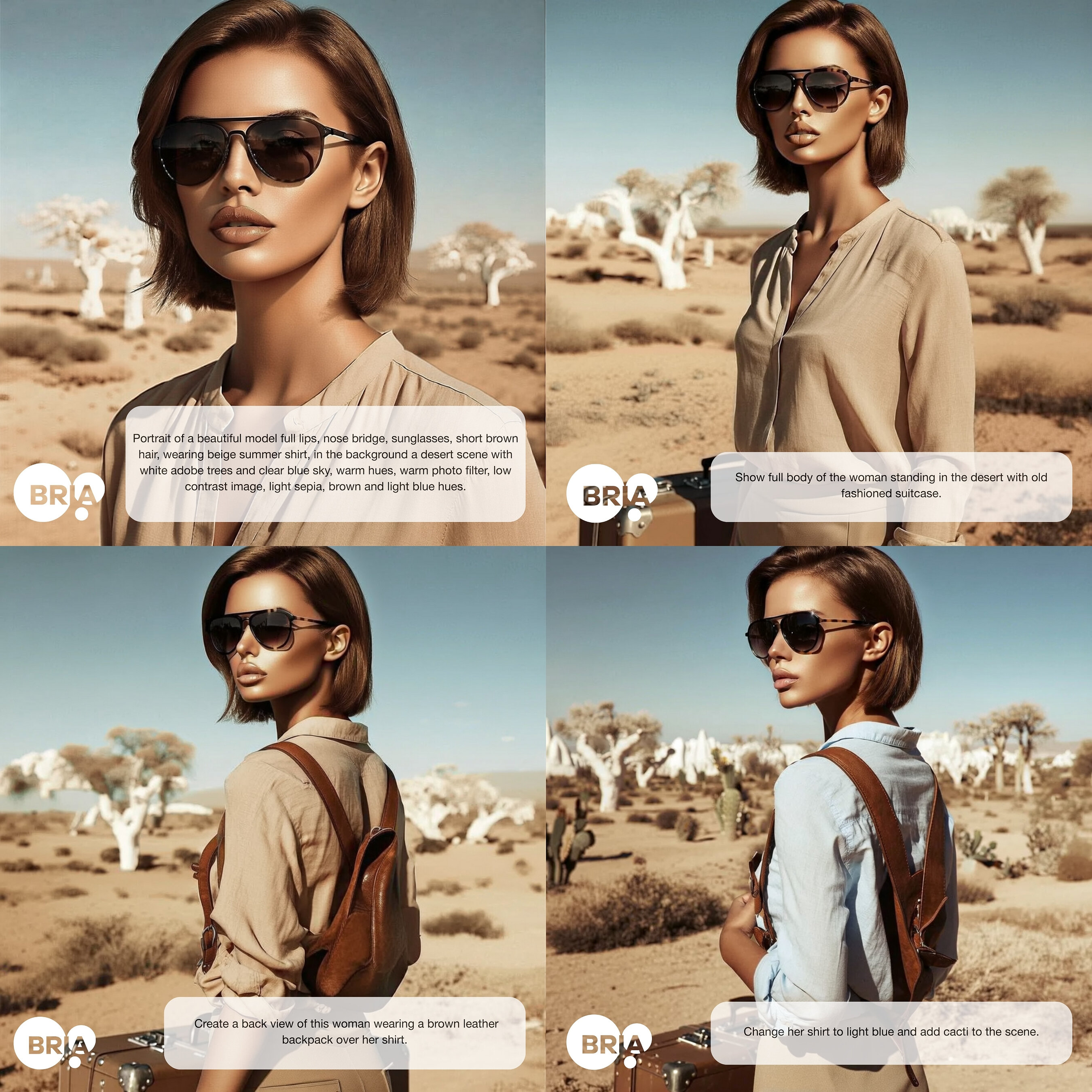
Consider the second request. The first is easy: make a picture of a woman in the desert. The second is where the trouble begins: keep the woman, add a backpack, change her shirt, and please leave everything else alone. Bria’s FIBO demonstration follows precisely this sequence. The interesting object is not the desert. It is the instruction to preserve what has already been approved. For a business buying visual AI, the second request may matter more than the first.
- Make and revise visuals: image models, product scenes, editing APIs, and advertising tools.
- License the ingredients: training content comes from commercial data partners.
- Keep a working brief: FIBO returns structured descriptions alongside generated images.
- Buy by use: API charges or negotiated enterprise deployment.
01 Permission becomes infrastructure
Founded in 2020 by Yair Adato and Gal Jacobi, Bria develops visual generative AI for enterprises. Its public offices span New York and Tel Aviv. Adato previously served as CTO at retail computer-vision company Trax. That background is suggestive: a retail system has to do something useful with the picture after recognizing what is in it.
Bria’s central choice was to train on licensed content. Getty Images, Envato, Alamy, and Depositphotos are among its named data partners. Instead of treating a rights holder as someone to negotiate with after the model becomes popular, Bria brings that relationship into the training pipeline. Permission is an input.
Then comes attribution. Bria describes a system that compares generated visuals with concept-level representations of training content, measuring similarities in composition, objects, texture, and other dimensions. Those measurements support revenue sharing with content owners. Think of it as an accounting system attached to the image generator. It measures influence; it does not claim that a generated picture is simply five photographs pasted together.
- 01 License
- 02 Train
- 03 Generate
- 04 Attribute
- 05 Pay partners
02 The picture gets a specification
Licensing answers one enterprise question. Control answers another. FIBO, launched in November 2025, uses structured JSON descriptions to specify visual attributes. A short prompt can be expanded into a detailed description; an existing image can supply a starting point. The resulting brief becomes something software can inspect and revise.
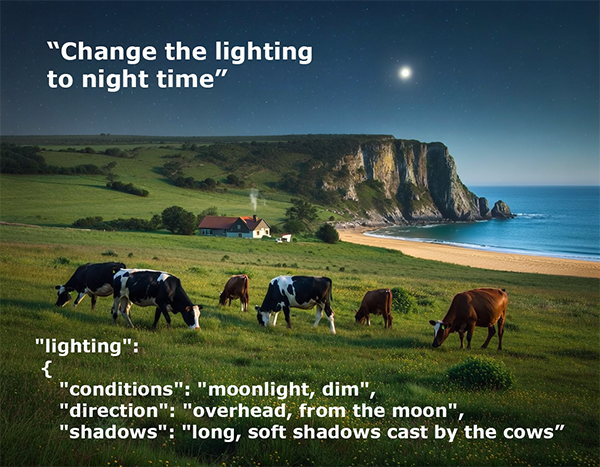
Lighting, framing, and style become explicit parts of the request. FIBO’s name borrows from Fibonacci, a rather elegant pedigree for a model whose practical appeal includes making an image brief machine-readable. The poetry is in the name. The production value is in the fields.
“Teams can’t build workflows around randomness, or scale what they can’t control.”
Yair Adato · FIBO launch, November 2025
That is Bria’s argument, rather than a promise that every edit will be perfect. A structured description lets a team see what it asked for and keep a record of revisions. Predictable instructions are useful even when a human must still judge the result.
03 The catalog is the customer
The obvious users are developers, retailers, agencies, and media teams. Product Shots builds lifestyle scenes around supplied product images, isolates items, and adds shadows. The constraint is familiar to anyone who has shopped online: the setting may be imaginary, but the object for sale ought to remain recognizable.
Tailored Generation adds brand-specific fine-tuning, with tools to compare checkpoints and retain training parameters. Bria Create tackles the work after an ad gets approved: separate an image into editable layers, adapt its composition to different sizes, localize the text, or animate elements. A brilliant campaign concept can still spend its afternoon being resized. Bria has noticed the afternoon.

04 Three cents is a starting point
On its pricing page, checked in October 2026, Bria lists FIBO generation at $0.03 per image, background removal at $0.018, and image expansion at $0.02. Enterprise arrangements add negotiated pricing, private deployment options, and contractual protections. Selected models can run in a customer’s cloud or on premises.
The API bill is only one part of the cost. Repeated attempts, integration, review, and brand approval consume time too. A useful pilot would count approved assets and the minutes spent getting them approved. Cheap rejected pictures make a poor bargain.
There is also a licensing distinction worth preserving. Downloadable code and weights do not automatically grant unrestricted commercial use. FIBO’s model card separates noncommercial access from commercial licensing. Bria’s self-hosting attribution agent supports its compensation system outside the company’s cloud; deployment and coverage depend on the applicable agreement.
05 A supplier can become a storefront
Getty Images announced its Bria partnership in October 2022. Its current generative-service FAQ identifies Bria as the technology partner behind a custom model trained on licensed content and proprietary data. Here, the company supplying imagery also helps put the resulting technology in front of customers.
Bria announced a $24 million Series A in February 2024 and a $40 million Series B in March 2025, when it reported $65 million raised in total. NVIDIA and Microsoft integrations broadened distribution. These arrangements give Bria routes into existing development environments rather than requiring every buyer to start in a new application.
Its market has alternatives. Adobe Firefly also trains on licensed and public-domain content and offers enterprise indemnification. Bria’s case rests on its particular combination of structured control, model access, deployment flexibility, and output-linked compensation. Licensed data alone is not an exclusive category.
06 The idea travels beyond the image
In March 2026, the News/Media Alliance announced an opt-in licensing agreement with Bria for its members. Bria Exchange, currently seeking early-access partners, applies licensed content to retrieval and verification for AI responses. Membership in the alliance does not mean every publisher has joined.
The transferable lesson is practical: carry rights information with the data, save the visual specification, and test revisions before committing a catalog. The approach suits teams with defined brand assets and a review process. It offers less to someone who merely wants a surprising picture. Bria’s bet is that businesses will pay for permission and repeatability because, sooner or later, somebody always makes a second request.