Before there was a company to sell, there was a world to enter. Brett Hurt’s early multiplayer game, Renegade Outpost, gave people a place to meet through their computers. In his telling, friendships formed there. Some players married. Software had done something rather difficult to put on a product roadmap: it had introduced people who wanted to keep knowing one another.
The later milestones are easier to arrange on a business card. Coremetrics, founded in 1999, went to IBM in 2010. Bazaarvoice, which he co-founded with Brant Barton in 2005, went public in 2012. data.world, built with Matt Laessig, Jon Loyens, and Bryon Jacob, became part of ServiceNow in 2025. Hurt now leads Love Conquers Fear, a holding company whose activities include a podcast and books about humanity’s technological future.
That progression can look like a series of departures. Spend a little longer with it, and a recurring interest emerges. Hurt builds things that help people understand what other people are doing, saying, or trying to discover. The game supplied an early demonstration. The businesses found customers for different versions of the problem.
A mother who learned the language
Hurt grew up in Austin. At seven, he received a computer bought by his mother and paternal grandfather. His mother, Brenda, learned programming with him, then drove him to user-group meetings where the other enthusiasts were older. A child arriving among adult programmers needed transport and permission. She supplied both.
By ten, he had built a bulletin board system. By his college years, there was Renegade Outpost. These projects offered practice in making a place that other people would choose to visit. They also made programming social, however solitary the typing might appear.
The family connection continued through his education. His grandfather James Mann Hurt had taught mathematics at the University of Texas. Brett earned his management information systems degree there in 1994, worked at Deloitte, and later attended Wharton for an MBA. He would eventually return to UT with office hours of his own. First, he had a shop to understand.
The shop with invisible customers
At Wharton, Hurt and his wife, Debra, started BodyMatrix, an online retailer. He had built the commerce software himself. The orders could travel across borders; the customers remained oddly hard to see. In his parents’ physical stores, a merchant could watch someone browse and ask a question. Online, much of that ordinary human information disappeared behind the browser.
Hurt began recording what visitors did: how they arrived, which products they examined, what they bought, and what they left in their shopping carts. He used the information to personalize offers. When he showed the system to classmates working at Amazon and CDnow, he expected advice about improving it. They encouraged him to build a business around it.
Coremetrics grew from that experiment. His demonstration used BodyMatrix itself: someone browsed the shop, and the analytics showed what had happened. A prospective customer could see the problem and the answer in the same sitting. The sales pitch had the considerable advantage of being demonstrable.
The timing was less accommodating. Hurt has written that 97 of Coremetrics’ first 100 customers went out of business after the dot-com bubble burst. The company found a path working with established retailers, including Walmart, as they moved online. The usefulness of the underlying tool survived the disappearance of much of its original market. IBM acquired Coremetrics a decade after its founding.
Coremetrics customers that Hurt says went out of business after the dot-com bust.
- 1999CoremetricsSee the customer
- 2005BazaarvoiceHear the customer
- 2015data.worldConnect the information
- 2025Love Conquers FearDiscuss the future
Please let the customers complain
Bazaarvoice arrived with a proposal that now sounds almost domestic: let shoppers leave reviews on a retailer’s website. In 2005, Hurt remembers, friends in ecommerce questioned the wisdom of it. What if competitors attacked the products? What would moderation cost? What happened when a negative review left the retailer staring at unsold inventory?
These were reasonable questions from people responsible for selling things. A retailer buying review software was also buying the possibility of being contradicted in its own shop. Bazaarvoice had to make that prospect useful. Hurt and Barton named the business for the voice of the marketplace, drawing inspiration from The Cluetrain Manifesto and its account of markets as conversations.
The work extended beyond installing a comment box. Reviews needed moderation, analysis, and a route back to the merchant. By the company’s first year of public operation, clients included Sears, Macy’s, PETCO, and Golfsmith. Customers could tell businesses something about their merchandise that the sales copy had perhaps neglected to mention. Commerce acquired a less obedient narrator.
Bazaarvoice went public in February 2012. Later that year, when Hurt moved into a venture-partner role at Austin Ventures, the company had nearly 2,000 clients and nine offices worldwide. The business that began with a disputed invitation to shoppers had become an international operation. Hurt’s attention was also moving toward what those years could teach other founders.
A library that could introduce its books
With data.world, the unit of connection changed again. Organizations had data, often in abundance. Finding the right dataset, understanding its meaning, and knowing whom to ask about it could still be maddening. A file could be technically available and practically out of reach.
The founding team brought existing relationships into the problem. Laessig and Loyens had worked at Bazaarvoice; Jacob came with connections through Austin’s technology community. They founded the business in 2015 and publicly launched it on July 11, 2016. Hurt enjoys pointing out that the date was Slurpee Day. Even a discussion of data infrastructure can accommodate a frozen drink.
The platform combined linked-data technology with familiar social features: profiles, comments, annotations, and ways to discover other people’s work. It aimed to make information understandable in relation to other information. Think of a library in which the books could introduce their neighbors, explain their terminology, and tell you who had been working with them.
The structure of the company mattered to its founders. They established a public benefit corporation and pursued B Corporation certification, combining a commercial business with a stated public mission. An open-data community and paid enterprise tools could exist within the same enterprise. At Wharton in 2018, Hurt described the ambition as a “100-year mission.” The phrase suggests he had stopped planning around a conventional retirement date.
“I always pronounce the dot.”
Brett Hurt, on saying data.world
By 2025, ServiceNow saw a use for that work in its AI platform. Its acquisition announcement emphasized data catalogs, governance, and the context AI agents need to operate. The deal closed that July. Hurt did not join ServiceNow; he pursued Love Conquers Fear. His co-founders’ work continued inside the acquiring company, while he began asking broader questions in public.
Office hours, with a longer reach
Austin supplies more than a location in this story. In 2013, Hurt returned to McCombs as entrepreneur-in-residence, mentoring students and hosting conversations with other founders. He urged incoming MBAs to “swing for the fences.” For all the software, a good deal of his work has involved sitting down with someone who has a question.
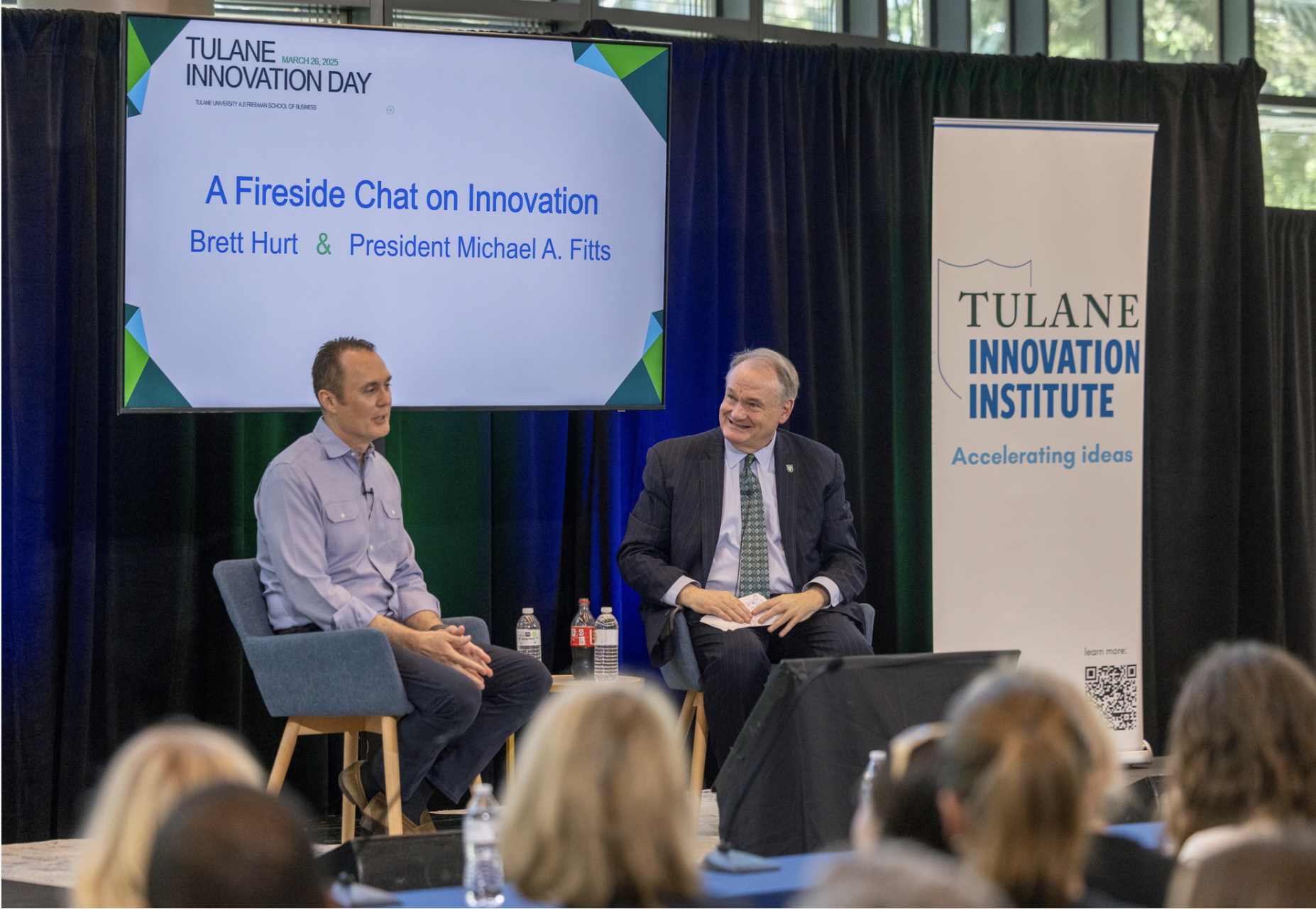
In March 2025, he took that conversation to Tulane, discussing entrepreneurship with university president Michael Fitts. His daughter Rachel, then a student there and an entrepreneur herself, was in the audience. Hurt spoke about the tools available to people beginning businesses, including AI. The exchange carried a familiar family pattern: an interest encouraged, then put to work.
He and Debra also co-own Hurt Family Investments. Their current public biography lists involvement in more than 150 startups and 50 venture funds. That gives the teaching another setting: the decisions, introductions, and uncomfortable questions involved in supporting someone else’s company. The couple received the LBJ Humanitarian Award in 2014 for their community work.
His written lessons have traveled through several formats. Lucky7 began in 2012; The Entrepreneur’s Essentials followed as a free online book in 2019, then an expanded print edition in 2022. There are recordings and a digital companion. He later experimented with AI-generated audio conversations around the chapters. Publishing, for Hurt, appears to invite the same tinkering as software.
The next question has a microphone
Love Conquers Fear launched as a podcast in September 2025. Its conversations bring together technology, philosophy, science, and spirituality. Hurt’s accompanying book carries the subtitle Humanity, AI, and the Age of Abundance for All. He has also written The Lattice, a science-fiction novella imagining the years from 2030 to 2085. Apparently, one future was insufficient to keep him occupied.
His optimism is explicit. He wants powerful technologies to widen opportunity, and he treats cooperation and human values as part of the work. That is a position he argues for, with all the uncertainty that the future deserves. In July 2026, he joined Jamie Metzl and moderator Chadia El Meouchi at the Aspen Institute for a conversation about AI’s possibilities and risks. The questions have grown larger than any one product.
There is continuity in the change. The child who learned programming beside his mother built an online game that acquired a social life. The merchant wanted to understand the people inside his store. The founder invited customers to speak and helped colleagues find shared information. Now the host asks people how they want to live with what they are building. Renegade Outpost began with people entering a world someone had written. Hurt is still interested in what they might do once they get there.
Keep the conversation going
- Lucky7 / essays and biography
- Love Conquers Fear / current work
- The Entrepreneur’s Essentials / read free
- LinkedIn / Brett Alexander Hurt
- X / @brettahurt
- YouTube / Love Conquers Fear
- Instagram / the podcast
- Made with Love / the 2026 interview
- The Coremetrics shop experiment / in his words
- Bazaarvoice’s early customers / 2006 coverage
- How data.world began / Hurt’s account
- A public benefit corporation / the Wharton conversation
- ServiceNow / the acquisition announcement
- UT Austin / entrepreneur-in-residence
- Tulane / the conversation with Michael Fitts
- Aspen Institute / the 2026 AI conversation
- The book’s changing formats / Hurt’s essay
- The dot-com bust / Hurt’s retrospective
- Why he pronounces the dot / the 2023 interview
- A mother and a computer / the McCombs profile