Brad Murray had already spent time evaluating young companies when he became responsible for one. In June 2023, Delve Bio made its public debut with a $35 million Series A. The lead investor was Perceptive Xontogeny Venture Fund II. Murray, Delve’s co-founder and CEO, had previously worked at Xontogeny. He knew something about the people asking the questions. Now his own company would have to answer them.
There is an appealing symmetry here, though symmetry is easier to appreciate when somebody else is responsible for the budget. Before Delve, Murray’s work had taken him from the Broad Institute to Intellia Therapeutics and into early-stage investing. He had written algorithms, worked on building a scientific platform, and considered which companies should receive capital. Founding brought those responsibilities closer together.
The financing makes a convenient starting point because it gives the story a date and a number. The more revealing subject is the preparation behind it. Murray’s route to the CEO’s chair involved several changes of position within the same broad enterprise: organizing scientific work so that other people could build on it. The job titles changed more dramatically than the underlying material.
Biology, with an economics problem attached
At Georgetown University, Murray studied biology and economics, earning a bachelor of science. He attended from 2009 to 2013. It is a pairing that makes considerable sense beside his later résumé. Biology concerns living systems. Economics concerns choices made with limited resources. A young scientific company has ample opportunities to become acquainted with both.
That observation does not require a story about an undergraduate secretly planning his future company. The degrees are interesting enough without assigning them a destiny. Murray subsequently added an MBA in finance and entrepreneurship from Boston College. His formal education covered the science, the money, and the act of starting something. His employment would supply the less tidy practical experience.
At the Broad Institute of MIT and Harvard, he worked as a computational associate, developing algorithms to analyze genome-sequencing data. The technical role matters. Algorithms require a person to make a method explicit: what goes in, what happens to it, and what constitutes a meaningful result. An attractive explanation still has to survive contact with the data.
Seen from his eventual position as a founder, this early work supplies a useful point of reference. Murray entered the scientific enterprise through its computational work. He had experience with the underlying analysis before his responsibilities expanded to organizations and financing. The sequence gives his business career a technical beginning that remains visible beneath the later titles.
- Broad InstituteAlgorithms & analysis
- IntelliaPlatform development
- XontogenyEarly-stage investing
- Delve BioCompany leadership
Career sequence; the spacing does not represent time.
Five years inside the machinery
Murray spent five years at Intellia Therapeutics. His work combined computational biology with managing the build-out of platform capabilities. Genomics, gene editing, and machine learning were among the areas he worked across. It was a setting where software and experimental work had to be useful to one another.
Platform building is an unglamorous phrase for a consequential responsibility. It means making it possible for work to continue beyond a single result. Tools, methods, and colleagues have to fit together. The achievement is partly what a team can do next. This is the organizational dimension of Murray’s Intellia experience, alongside the computational one.
There is a difference in scale between developing an algorithm and helping develop capabilities across a group. The latter involves work that other people will use, extend, and depend on. Murray’s role put him at that junction. By the time investing entered his career, his experience included both technical analysis and the construction of a broader scientific operation.
It would be convenient to turn every former job into a lesson he consciously collected for Delve. The chronology supports a more restrained reading. He had done several kinds of work that a founder would later have reason to understand. Each move added another part of the enterprise to his field of view.
When the questions came with a cheque
At Xontogeny, Murray became a senior associate focused on seed and Series A investments across the life sciences. A December 2021 conference announcement lists him in that role among the Digital RESI JPM panelists. The computational biologist was now participating in the financing world that supports young scientific companies.
Early-stage investing changes the object under examination. A technical result sits inside a proposed organization, with people, plans, and a request for money attached. The investor has to consider the whole arrangement. Murray’s work had moved from developing scientific capabilities to evaluating companies seeking the means to develop theirs.
His later Xontogeny advisor biography describes work with biotechnology companies seeking financing and partnerships. Those two needs would reappear in Delve’s own development. Capital and collaborators are concrete parts of the founder’s job. Murray’s previous work had already involved both, from a different position.
Then came the change of seats. Delve was established in 2022 and emerged publicly the following June. Its financing was led by a fund connected to Murray’s former workplace, with Section 32 and GV also participating. The overlap makes the transition easy to follow. A former investor was helping build a company within an ecosystem he already knew.
Delve Bio’s Series A at its June 2023 public debut.
Led by Perceptive Xontogeny Venture Fund II, joined by Section 32 and GV.
A company with several signatures
Murray’s founder story includes a substantial cast. Delve’s scientific co-founders are Charles Chiu, Joe DeRisi, Michael Wilson, Pardis Sabeti, and Matthew Meyerson. Murray brought computational, operating, and investment experience to a company with academic roots at the University of California, San Francisco. The organization grew around work and expertise shared among several people.
That distinction matters when describing what a CEO actually contributes. A company can have a clear leader and several origins. Delve’s formation involved an exclusive UCSF technology license as well as financing and corporate work. Each is a separate undertaking. Put together, they begin to explain how academic work becomes the foundation of an independent business.
Murray’s own announcement kept the group visible. Alongside the launch, he thanked the co-founders, investors, and team. A later public post included a brief expression of the same sentiment: “It’s a privilege to be part of such an amazing team.” The phrasing is ordinary. The list of people behind it is specific.
“It’s a privilege to be part of such an amazing team.”
Brad Murray, on Delve Bio’s collaborators
In October 2024, Delve announced a partnership with Broad Clinical Labs, a subsidiary of the Broad Institute. An earlier institution in Murray’s career had reappeared in the company’s development. He described the partnership in terms of laboratory operations and sequencing at scale. The emphasis was on the practical capability the collaborator would bring.
The connection gives the biography an unusual loop. Murray once worked on analysis at the Broad Institute; as a CEO, he was announcing work with an organization in the Broad ecosystem. The roles were different, and so were the responsibilities. The institutional thread remained. His career can be followed through relationships as well as employers.
The work after the announcement
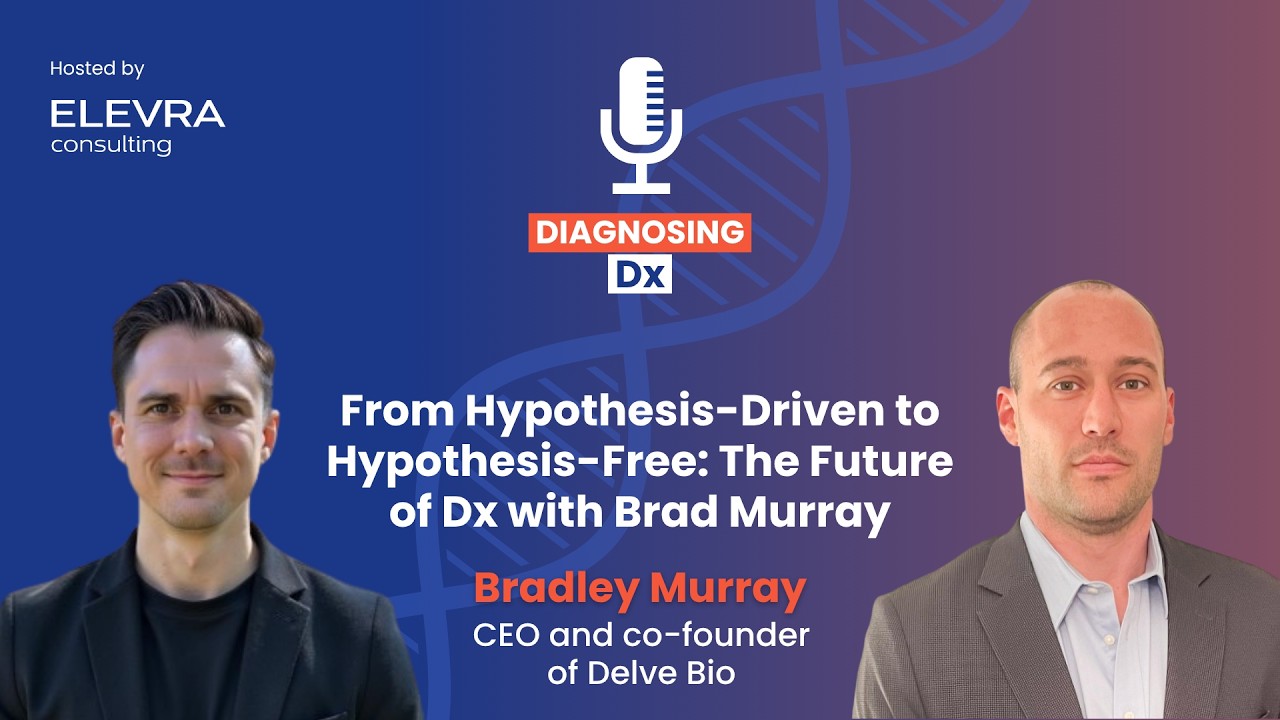
In a 2025 conversation with David Filby, Murray discussed his passage through academic research, a biotechnology company, investing, and entrepreneurship. Operational execution was one of the conversation’s advertised themes. It is a subject that fits the sequence of his jobs: the recurring challenge of getting several kinds of work to function together.
The funding announcement is a moment a reader can grasp at once. Execution takes longer to describe because it consists of decisions spread across people and time. Murray’s background gives that subject some texture. He had experience with methods, platforms, and investment before becoming accountable for the organization connecting them.
By January 2025, Murray was listed as Delve’s presenter at Biotech Showcase, with the company identified as based in Boston and established in 2022. It is a small entry in a conference document, but it records another aspect of the role: representing the business in public. A founder has to make the organization understandable to people outside it. Murray had once appeared in a conference lineup as an investor at Xontogeny. Here he appeared as a CEO, with a company profile beside his name. The two listings give his transition a particularly concrete form.
His connection to Georgetown also continues beyond his degree. He is listed on the advisory board of the university’s Office of Technology Commercialization. The setting is apt for someone whose career has moved between academic work and company formation. It places him among people concerned with what happens when a university’s ideas acquire a business life.
Outside the sequence of roles, there are a few welcome particulars. Murray enjoys making homemade pasta. He supports the San Francisco 49ers and the Georgetown Hoyas. These details provide some relief from the institutional roll call. A person’s loyalties can include both a scientific company and a basketball team, without either explaining the other.
The pasta is especially tempting material for a business metaphor. It can also remain dinner. Murray’s professional life already supplies enough connections: biology and economics, analysis and operations, investing and founding. The personal details make room for something less instrumental. Even a CEO may occasionally do something because it tastes good.
What makes his career worth following is the continuity across its changes. By Delve’s public debut, he had worked on the science, helped build capabilities inside a company, and evaluated businesses seeking capital. He entered the founder’s role with those experiences behind him. The other side of the table was familiar. The responsibility for what happened next was his to share.