Bradley Murray has spent his career teaching machines to notice what people might miss. At the Broad Institute, the material was cancer-genome sequencing data. At Intellia Therapeutics, it was the computational terrain around CRISPR. At Delve Bio, the company he co-founded and now runs, the search concerns microbial genetic fragments hiding inside a clinical sample. The code changed. The deeper habit did not: begin with a large and unruly field of possibility, then construct a system that can turn it into an answer.
That may sound like a tidy destiny. Careers are rarely so considerate while they are happening. Murray graduated from Georgetown University in 2013 with a BS in biology and economics, an academic pairing that appears almost suspiciously well tailored to his eventual job. He then entered computational biology, moved into gene-editing therapeutics, studied finance and entrepreneurship at Boston College, and crossed to the investor's side of the table at Xontogeny. By the time Delve Bio formed in 2022, he had seen new science as a researcher, an operator, and a financier.
His biography is a tour through the modern biotech machine. Its important feature is not the number of stops. It is the view from each one.
01 / Learning the search
Before the company, there was the code
At the Broad Institute of MIT and Harvard, Murray developed algorithms for analyzing cancer-genome sequencing data. Xontogeny's account of his work says it contributed to novel drug targets, trials in new indications, and publications that accumulated more than 10,000 citations. The useful lesson was larger than a citation count: genomic data does not arrive with its meaning politely attached. Meaning has to be separated from noise, ranked, checked, and made legible to people deciding what comes next.
He joined Intellia Therapeutics in late 2015 and remained for roughly five years, advancing from computational-science work into management. There, according to his Xontogeny biography, he helped build T-cell therapeutic platform capabilities and applied genomics, gene editing, and machine learning to in-vivo and ex-vivo CRISPR/Cas9 programs. The context had shifted from describing biological patterns to helping change them. It was also a lesson in translation: a promising mechanism must pass through coordinated scientific, technical, and organizational work before it becomes something usable.
Broad Institute
Cancer-genome algorithms and large-scale sequencing analysis.
Intellia
Computational work, CRISPR programs, platform building, and management.
Xontogeny
Seed and Series A investing across early life-sciences companies.
Delve Bio
Turning licensed academic technology into an operating clinical service.
While working at Intellia, Murray added an MBA in finance and entrepreneurship from Boston College. In 2020 he joined Xontogeny, where he made seed and Series A investments in life-sciences companies and later remained an advisor. The scientist now had to ask investor questions. Is the evidence persuasive? Which milestone removes the most risk? Can a skilled team build a durable company around the technology? What happens when the money, the biology, and the calendar disagree?
Those are not glamorous questions, which is precisely why they matter. A laboratory result can be brilliant in isolation. A company has to make brilliance repeatable on an ordinary Tuesday.
“Delve Bio prioritizes leading with evidence.”Bradley Murray, writing about the company's 2025 conference data
02 / Building the routine
The product is every handoff
Delve Bio emerged publicly in 2023 with a $35 million Series A led by Perceptive Xontogeny Venture Fund II, with participation from Section 32 and GV. Its scientific roots came from work at the University of California, San Francisco, and its founding group includes Charles Chiu, Joe DeRisi, Michael Wilson, Pardis Sabeti, and Matthew Meyerson. Murray's job was to help wrap an operating company around a substantial body of academic and clinical work.
The basic idea behind Delve Detect, launched in 2024, is unusually easy to state and unusually difficult to execute. Rather than testing for one suspected organism at a time, the service sequences DNA and RNA in cerebrospinal-fluid samples, filters away human genetic material, and compares what remains with a curated library of microbial references. The company's software then organizes the data for clinical interpretation and reporting.
The important word is service. Sequencing is only one link. The sample must travel correctly. The laboratory process must be consistent. The cloud pipeline must be fast, traceable, and resilient. A database must be broad without becoming careless. Specialists must interpret a complex output. The report must arrive in a form a clinician can use. In diagnostics, a chain is not improved by admiring its cleverest link.
A Delve technical poster makes the operational ambition visible. Its pipeline is modular, containerized, auditable, and designed to scale from one sample to many. Tasks are cached; failures produce alerts; releases move through development, staging, and production environments. These details would make poor material for a cinematic founder montage. They make excellent material for a dependable product.
Murray has a memorable analogy for one of the less cooperative steps. During a 2026 laboratory visit reported by The New Yorker, he compared extracting fungal genetic material to “trying to get the meat out of a walnut.” It is a good founder metaphor, too. Valuable things are often protected by stubborn shells, and enthusiasm is not a substitute for the right process.
03 / The founder's operating system
Vision gets a sentence. Execution gets a calendar.
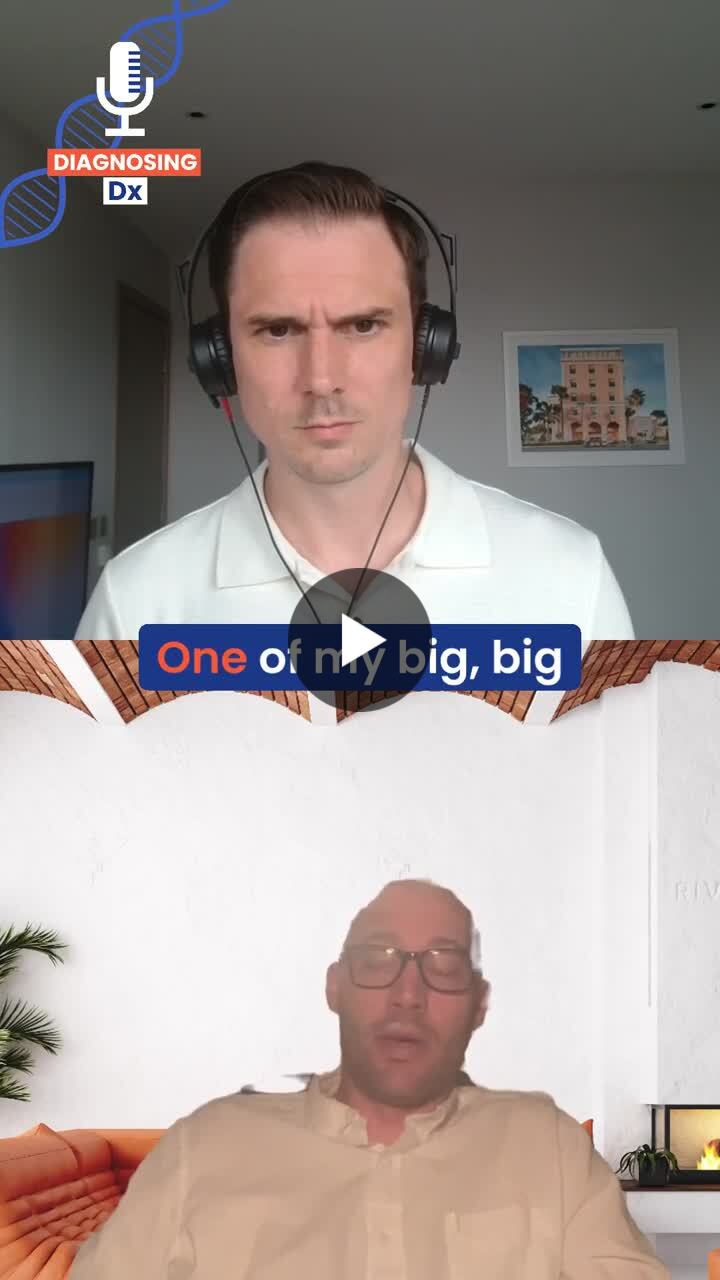
In his 2025 conversation with Diagnosing Dx, Murray emphasized operational excellence, evidence generation, reimbursement, and patient-centered company building. The episode's animating phrase was “execution over vision.” It is an unfashionably sober argument. Vision can align a team, attract capital, and make a complicated future briefly visible. It cannot validate an assay, fix a broken handoff, persuade a payer, or shorten turnaround time by itself.
His public comments repeatedly return to evidence and teams. After Delve presented 2025 data at the Association for Molecular Pathology meeting, Murray wrote that the company prioritizes leading with evidence. Elsewhere, commenting on the product, he credited the team that delivers on the mission every day. Both statements fit the biography. Computational biology teaches humility before messy data. Investing teaches skepticism toward unsupported promises. Operations teaches that no complicated result belongs to one person.
A seven-year clinical performance evaluation, published in Nature Medicine in 2024, gave Delve's underlying approach a substantial evidence base. Murray was among the paper's authors. Delve then continued presenting utility data, reducing turnaround time, and documenting its platform. The pattern is incremental by design. Clinical adoption is less like launching an app and more like earning a place in an established ritual. Each study, workflow improvement, and support function is another reason for a laboratory or clinician to trust the routine.
“While genomic testing has been transformative for oncology, rare disease and women's health, infectious disease has been largely overlooked.”Bradley Murray, at Delve Bio's 2023 launch
Murray's ambition is to help bring infectious-disease diagnostics into what he calls the genomics era and make metagenomic sequencing part of standard care. The phrase sounds futuristic. The practical route is almost comically grounded: more data, cleaner workflows, better reports, credible economics, dependable logistics, and patient capital. The future arrives wearing a lab coat and carrying a checklist.
04 / Range as an advantage
The career makes sense from the intersection
Founders are often advised to become world-class at one thing. Murray's path suggests a companion strategy: become fluent at the borders between things. His scientific training lets him speak with researchers. His computational work gives him a feel for data systems. His operating experience exposed the constraints of product development. His MBA and investing years added capital allocation and company formation. Delve sits precisely where those languages collide.
This is the stealable part of his story. A nonlinear career becomes valuable when each move earns a new vantage point on the same class of problem. Random motion produces anecdotes. Deliberate range produces judgment. Murray did not leave science when he entered investing, nor leave investing behind when he became a founder. The old views became part of the new one.
There is one domestic detail in Delve's official biography that makes the process-minded executive easier to picture: Murray enjoys making homemade pasta. He also roots for the San Francisco 49ers and his Georgetown Hoyas. Pasta is the more irresistible metaphor. It rewards good ingredients, practiced judgment, and respect for sequence. Rush the dough and it protests. Ignore the texture and no mission statement can save dinner.
Delve Bio now has to perform a similar transformation at greater consequence and scale: take something once concentrated in expert research settings and make it repeatable enough for wider use. Murray's story is not about discovering the underlying science alone. It is about recognizing when science is ready for an institution - then doing the quiet, interconnected work required to build one around it.
The algorithm searches widely. The founder's job is narrower: make tomorrow's run work better than today's. That is how a wild search becomes a routine.