The first thing Delve Bio asks a hospital to send is not a petabyte or a purchase order. It is one milliliter of cerebrospinal fluid. That small vial may hold fragments of genetic material from a bacterium, virus, fungus or parasite causing meningitis or encephalitis. The trouble is that the clinician may not know which kingdom to suspect. Medicine's usual answer is a lineup of targeted tests: culture this, amplify that, check a short panel, then reconsider when the answers come back negative. Delve's answer is closer to a search warrant. Sequence all the DNA and RNA in the sample, subtract the human material, and compare what remains against a curated library of more than 68,000 pathogen references.
That is the pitch behind Delve Detect, the Boston company's flagship laboratory-developed test. The supplied transfer kit travels at room temperature. Broad Clinical Labs processes and sequences the sample. Delve Decide, the software and database layer, sorts millions of reads. A report is then reviewed with clinical context, and an on-call Clinical Microbial Sequencing Board is available to discuss difficult findings. Delve advertises results within 48 hours after the sample reaches the laboratory.
01 / The failed first test
A guessing game with terrible stakes
Targeted diagnostics are excellent when the target is right. A rapid PCR can answer a narrow question quickly and cheaply. Central nervous system infections are harder because symptoms overlap, the list of possible organisms is long, antibiotics may suppress cultures, and the relevant pathogen may be rare enough that nobody thought to order its assay. What fails first is often not medical competence. It is the premise that the culprit must be named before the test is chosen.
The academic technology behind Delve grew at the University of California, San Francisco, where researchers used metagenomic next-generation sequencing, or mNGS, in puzzling neurological cases. Delve Bio was founded in 2022 and holds an exclusive license to the UCSF platform. Its scientific founders are Charles Chiu, Joe DeRisi, Michael Wilson, Pardis Sabeti and Matthew Meyerson - a roster spanning infectious disease, neurology, genomics and pathogen discovery. Brad Murray, a former computational biologist and life-sciences investor, became co-founder and CEO.
“We formed Delve Bio with the vision of bringing infectious disease diagnostics into the genomics era.”Brad Murray, co-founder and CEO
In June 2023, Delve emerged with a $35 million Series A led by Perceptive Xontogeny Venture Fund II, joined by Section 32 and GV. That figure answers one version of “what did it cost?” Commercializing academic diagnostics means paying for more than an algorithm. The assay has to be licensed, validated, automated, documented, staffed, sold and supported. The company has not posted a public test price, so any neat claim about per-patient cost would be guesswork.
02 / The evidence
The missed fifth
Delve's strongest calling card is a seven-year clinical series published in 2024. Researchers assessed 4,828 CSF mNGS tests performed from 2016 through April 2023. The assay detected 797 organisms in 697 samples, representing 437 unique pathogen species. In a clinically adjudicated UCSF subset, 48 of 220 infections - 21.8 percent - were identified by mNGS alone. That is the useful number. It does not mean the test diagnosed 22 percent of every person tested. It means that among confirmed infections in that subset, roughly one in five would have been missed by the other direct-detection methods used.
What the evidence actually says
The distinction matters because diagnostic marketing loves a loose denominator. Delve has legitimate evidence, but the people tested were not a random walk-in population. They were patients with suspected, often difficult-to-diagnose CNS infection. This is where broad sequencing should look best. The study also documented an operational problem the company later attacked: median time from sample collection to result was 11.4 days for non-UCSF patients, although the laboratory portion took 3.8 days. Decisions, shipping, accessioning and batch schedules ate the difference.
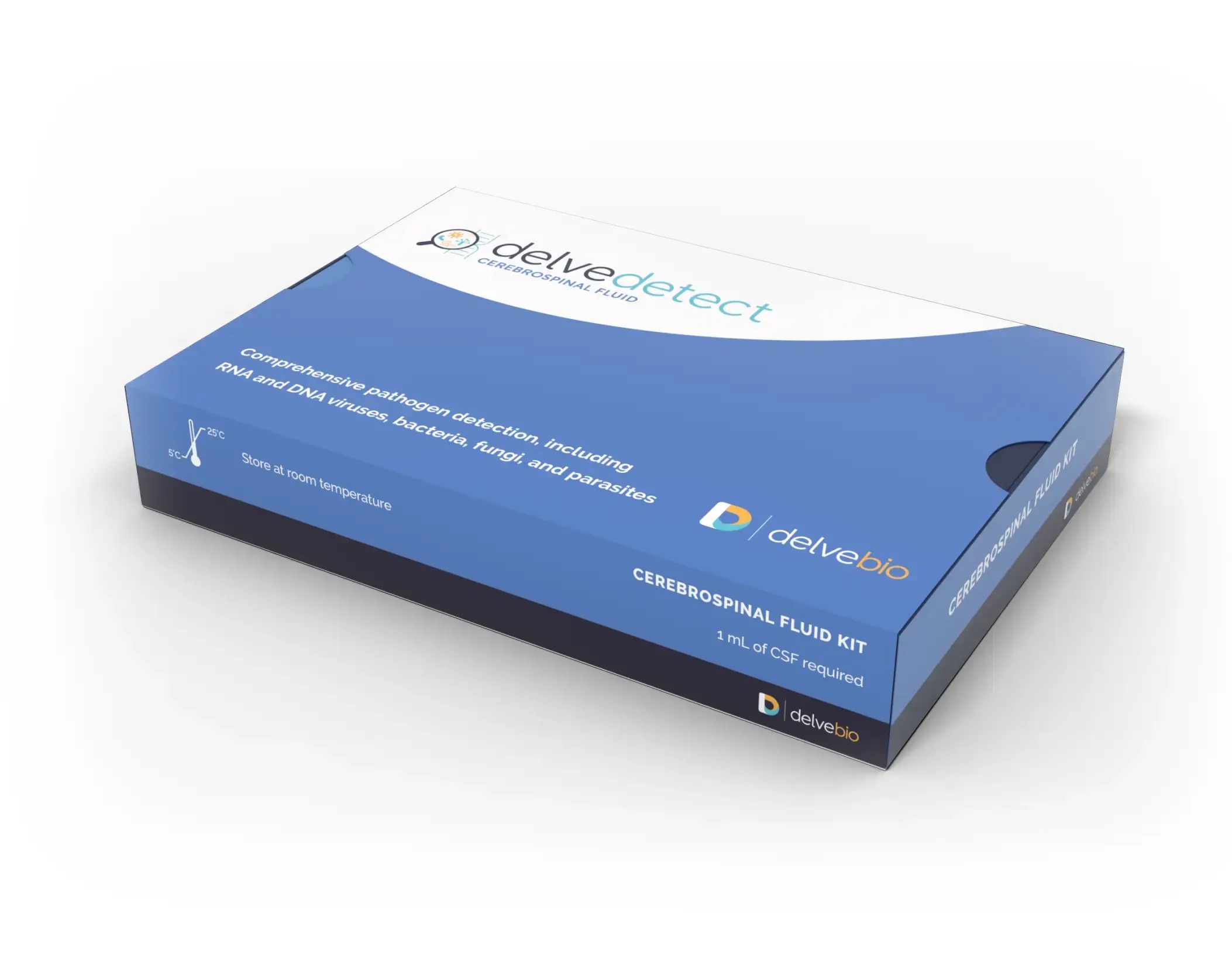
Delve's commercial version compresses that back end. The kit includes transfer tools and expedited return shipping; Broad Clinical Labs brings CLIA-certified, CAP-accredited scale; Delve analyzes and interprets the output. This partnership, announced in October 2024, is the quiet center of the business. Delve is not asking every hospital to buy a sequencer or install a pipeline. It sells an answer as a reference-laboratory service.
03 / The product decision
Software with a specimen bag attached
Delve Detect launched commercially in December 2024. Look at the bundle and a broader lesson appears. A hard-science startup rarely wins by handing customers its technically novel component. Hospitals need the requisition, transfer kit, shipping, laboratory process, analysis, report and someone who will answer the phone when a result is weird. Delve turned those pieces into one product. The code is essential; the choreography is what customers use.
The old loop
Form a hypothesis → order a targeted assay → wait → receive a negative → form another hypothesis.
Delve's wager
Take one CSF sample → sequence broadly → filter against a curated database → interpret once in clinical context.
Its market sits across several familiar boxes. Delve competes with Mayo Clinic Laboratories and UCSF offerings in CSF metagenomics, while Karius searches microbial cell-free DNA in plasma. Those specimen choices are not interchangeable. Blood can be easier to obtain and useful for systemic infection; CSF samples the compartment of interest in suspected CNS disease. In practice, the biggest competitor is still the established stack of cultures, multiplex panels, targeted PCR, serology and broad-range PCR.
The business model is institutional and service-based. Hospital labs and clinical teams open an account, receive kits, send samples and buy the resulting test and interpretation workflow. Delve does not disclose commercial volume, reimbursement mix or list price. That opacity matters because broad sequencing has to earn its place against cheaper targeted tests, not merely outperform them in breadth.
04 / What changed
From rescue mission to opening move
At first, clinical mNGS was naturally treated as a rescue tool - what to order after the usual panel failed and the patient kept getting sicker. Delve's newer argument moves it earlier. A 2026 modeling study examined what might have happened if comprehensive mNGS had been ordered after the first lumbar puncture. In an infectious cohort, the model suggested nearly 64 percent of microbiology tests could have been avoided and time to diagnosis shortened by almost seven days. In an autoimmune encephalitis cohort, it estimated 92 percent fewer microbiology tests and more than ten days saved.
That is what changed the commercial conversation: the company is no longer selling only the dramatic rare-pathogen save. It is selling workflow compression. But the study modeled counterfactual care; it did not prospectively randomize hospitals to a Delve-first pathway. Even one of its investigators said more studies are needed. The responsible takeaway is an operating hypothesis, not a universal protocol.
The real sale is not “we can find a rare bug.” It is “we may remove days of low-information work before the rare bug is found.”
Recent case reports give that hypothesis a human outline. Delve described a toddler whose initial multiplex panel was negative for herpes simplex virus; clinicians changed course, the child worsened, and CSF mNGS identified HSV-1, enabling antiviral treatment. In other cases involving ventriculitis or brain abscess, mNGS found organisms after cultures and PCR were negative and helped clinicians avoid brain biopsy. These are instructive cases, not population-level proof, but they show exactly where customers feel the pain.
When the broad search can disappoint
- A low pathogen burden can leave too little genetic material to detect.
- Abundant human DNA can drown out microbial reads.
- Contaminants and harmless organisms can look more important than they are.
- A fast, cheap targeted test remains better when the likely culprit is clear.
- Shipping, reimbursement and local ordering rules can erase the promised speed.
Broad detection is not omniscience. A sequence match is evidence, not a diagnosis. Delve's database and contamination controls reduce noise, while its laboratory directors and sequencing board interpret read counts, quality metrics and clinical relevance. That human layer is not decorative. It is part of the product's safety case and, potentially, its moat.
05 / What to copy
Steal the workflow, not the lab coat
Founders outside diagnostics can borrow the structure. Start with a costly sequence of guesses. Identify the common input that can support a broader search. Wrap the new engine in every mundane step required for adoption. Then attach judgment at the point where automation becomes ambiguous. Delve did not merely commercialize a sequencing pipeline. It commercialized the distance between a lumbar puncture and a confident next decision.
The Delve playbook
- Find a workflow where customers repeatedly pay to narrow uncertainty.
- Use one rich input to replace part of the serial hunt.
- Own the ugly handoffs: collection, shipping, processing and reporting.
- Pair automation with experts where false confidence is expensive.
- Prove the broader tool saves time, not only that it finds more things.
Under which conditions does this playbook fail? When the broad input is expensive or hard to obtain; when the answer is already obvious; when the output creates more ambiguity than it removes; when the buyer cannot capture the savings; or when turnaround is slower than the workflow it promises to replace. Delve has addressed collection and laboratory speed. It still has to show that earlier ordering works across institutions and that the economics travel with the science.
The company now has roughly four dozen people by public professional-network counts, a founder bench built for scientific credibility and a partner built for scale. Its Delve Decide platform can also derive viral subtype and strain context for selected pathogens, pointing toward richer reports and, eventually, more sample types. The market fit is narrow today: critically ill patients, scarce CSF and clinicians who need an answer quickly. That narrowness is a feature. It gives the company a place where a broad search can be worth the complexity.
Delve Bio's wager is therefore less mystical than “sequence everything.” It is that one carefully packaged broad test, ordered at the right moment and interpreted by the right people, can beat a pile of individually sensible guesses. The science got it into the hospital. Logistics made it usable. Evidence may move it up the order set. The next result Delve needs is not another exotic organism. It is proof that hospitals consistently know when to reach for the box.