The useful clue in Giordano Bottà’s story is a gap. Not a glamorous gap, the sort that arrives with a market-size chart and an exclamation point. This one appeared at a lab bench. Genomics was producing discoveries at astonishing speed, while the tools that could carry those discoveries into ordinary professional use lagged behind. Bottà was working at the University of Oxford when the mismatch became impossible for him to ignore. His response was less academic than logistical: he packed his bags and went back to Rome.
Bottà had trained as a molecular biologist and earned a doctorate in public health at Sapienza University of Rome. At Oxford’s Wellcome Trust Centre for Human Genetics, his work sat inside population genomics, where reassuringly simple labels tend to collapse on contact with data. He was part of the Anopheles gambiae 1000 Genomes Consortium, studying the mosquitoes that transmit malaria across Africa. The consortium sequenced 765 specimens from 15 locations and found more than 50 million genetic variants.
The paper appeared in Nature in 2017. Its scale is a useful preface to Bottà’s later work. Population genetics is an education in variation. A category that looks tidy from far away becomes a thicket of migrations, mixtures, selection pressures, and local histories up close. The world does not owe the spreadsheet a clean row.
The return ticket
At Oxford, Bottà’s realization was blunt: genomic science had advanced quickly, but there were few platforms that allowed people to benefit from it. The discovery itself was no longer the only bottleneck. Translation was. Research could find a signal; somebody still had to turn the signal into a dependable product, wrap it in a comprehensible interface, protect the data, validate the model, and fit it into a real workflow.
“There was a gap between the scientific discoveries and the tools to get to the persons.”Giordano Bottà, reflecting on Allelica’s origin
So the scientist became a founder, though the border was never as sharp as that sentence makes it sound. Bottà returned to Rome and, in 2017, co-founded Allelica with geneticist George Busby and software engineer Paolo Di Domenico. The company’s name refers to allelic frequency, the measure of how common a genetic variant is within a population. It is a rather elegant bit of nominative intent: diversity is not a complication around the product. Diversity is the raw material.
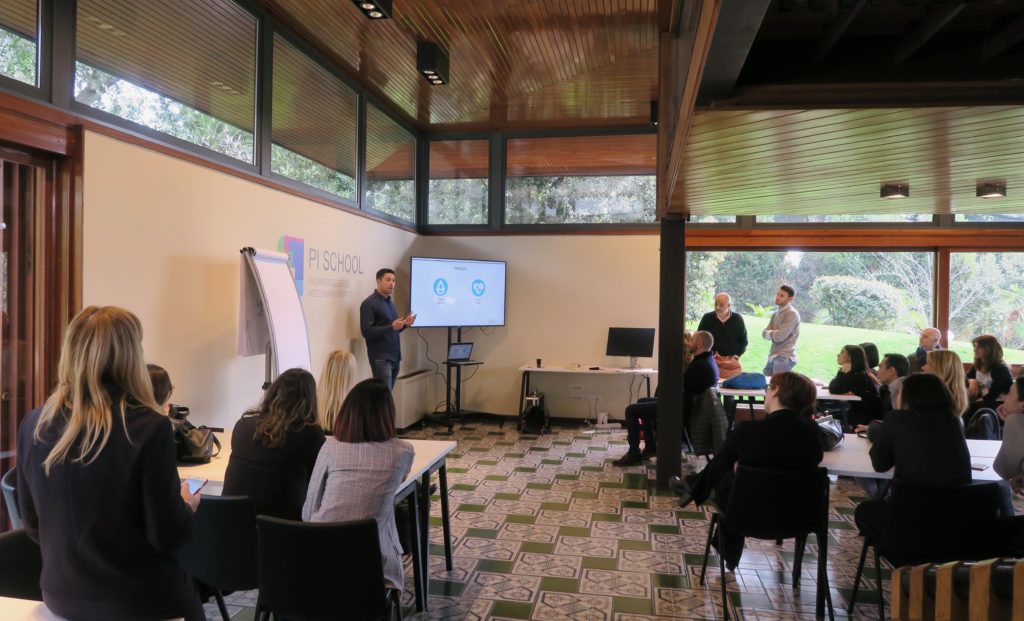
Allelica joined the Pi Campus community in early 2018. The first chapter was consumer-facing, built around DNA analysis and personalized recommendations. Bottà told an Italian interviewer that the startup had been financed with the founders’ own money, support from entrepreneurs, and a €50,000 pre-seed investment from Pi Campus. They had transformed an idea into a product. It was a beginning, not a final form.
Keep the problem; let the product move
Companies often reveal their seriousness through what they are willing to revise. Allelica’s presentation evolved from direct consumer kits toward software and testing infrastructure for laboratories and physicians. The founding problem survived the change: genomic knowledge still needed a bridge into practice. But the bridge became more clinical, more technical, and more specific.
The core tool is the polygenic risk score, or PRS. Unlike a single-gene test, a PRS aggregates the small effects of many variants across the genome. The arithmetic may end in one number, but arriving at a useful number is not simple. The model must be constructed from appropriate datasets, calibrated, tested against independent populations, and interpreted alongside established factors. The most seductive error in predictive software is to mistake a clean output for a clean reality.
This is where Bottà’s early education in variation returns. Allelica emphasizes multi-ancestry models and individual-level genetic ancestry analysis. A broad population label can hide very different genetic backgrounds, especially in admixed populations. Bottà has repeatedly argued in public that self-reported ancestry is too blunt for the job. His preferred answer is to measure genetic ancestry and choose or calibrate the model accordingly.
There is a business lesson tucked inside that scientific position. A software company earns trust not merely by simplifying complexity, but by knowing which complexity must remain visible. Good product design removes friction. Responsible product design refuses to remove the caveat that keeps the result honest.
A breakthrough is only halfway home when the journal accepts it. The remaining distance is where companies are built.
Research, now wearing work clothes
Bottà did not stop publishing when he took the CEO title. In 2019, he and colleagues described a software-as-a-service approach for genomic prediction of complex diseases. Later work examined how polygenic background changes the risk associated with LDL cholesterol, and whether adding a coronary artery disease PRS to conventional assessment could be cost-effective in a United States health system. That cost-effectiveness analysis appeared in the Journal of the American Heart Association in 2022.
The continuity matters. Allelica is not presented as a magic oracle, and Bottà’s public argument depends on evidence accumulating through papers, validations, and clinical studies. Under his leadership, the company says it has filed four patent applications and published in journals including Circulation and Nature Communications. Its products can run in the cloud or on premises, an unflashy detail that becomes crucial when genomic data cannot leave a laboratory’s building.
A 2021 financing round gave the company $1.75 million, led by Valor Ventures with participation from Sternberg Health and Pi Campus. Allelica shifted its United States base, and Bottà’s operating map widened from Rome and Oxford to San Francisco. The geography tracks a familiar startup migration. The more interesting continuity is intellectual: wherever the company sits, it remains occupied with the troublesome last mile between a statistical model and a decision.
The test of a Tuesday afternoon
In 2026, that last mile became more literal. Allelica announced that it would provide multi-ancestry coronary artery disease scores and pharmacogenomics testing for a randomized study with the U.S. Department of Veterans Affairs. Another randomized study, PROACT 3 at Mass General Brigham, was designed to examine whether disclosing a genomic risk score changes measurable factors and behavior. Five hundred participants were planned for the study, with immediate versus delayed disclosure.
For Bottà, these projects move the conversation from prediction in principle to consequence in practice. Does the information change what a clinician does? Does it change what a person does? Does the system work outside the pristine conditions of model development? Clinical utility is an unsentimental test. It asks software to stop being impressive and start being useful on a Tuesday afternoon.
His public style reflects that impatience with abstraction. Bottà’s posts are dense with calibration, reclassification, model parameters, and study design. He writes like somebody who believes a technical audience can survive technical information. Yet the aspiration beneath the details has remained remarkably stable since the Oxford insight: give people a practical way to benefit from the genomic revolution.
Stable does not mean simple. Genomic prediction is probabilistic. Its performance can vary across populations. The evidence base keeps moving, and implementation raises questions about validation, privacy, access, and equity. Bottà’s chosen arena supplies no shortage of ways to be confidently premature. His answer has been to keep pushing the model toward diverse datasets and the product toward clinical evidence.
The founder as translator
The charming temptation in a founder profile is to locate one cinematic transformation: researcher enters a phone booth, CEO emerges with a cap table. Bottà’s career is more useful because it resists that costume change. The researcher is still there, peering at population structure. The operator is there too, worrying about deployment, compliance, and whether a laboratory needs the software to remain on premises. The founder’s work is the negotiation between them.
His path also makes a case for translation as a creative discipline. Moving knowledge into use is not a clerical exercise performed after the clever work is done. It demands judgment about what the model means, where it fails, who can operate it, and how the result should appear. It asks a scientist to care about interfaces and a software company to care about epistemology. Most startups would be improved by one employee who enjoys both meetings.
Bottà began with mosquitoes, vast datasets, and a lesson in the unruliness of populations. He carried that lesson into a company named for variation itself. The ambition now is to make genomic prediction dependable enough to sit inside routine professional practice, without sanding away the complexity that makes the prediction honest.
There is no tidy finish to that project, because science declines to hold still. That may be precisely why Bottà chose it. The gap he noticed at Oxford has narrowed, expanded, and changed shape over the years. He is still building inside it.