Before Boris Jordan had a cannabis company to explain, he had two versions of the world to reconcile. He grew up on Long Island, the American son of Russian emigrants. Saturdays brought lessons in Russian language and history. His university studies turned toward relations between the United States and the Soviet Union. The country that occupied his family’s imagination was somewhere he had yet to visit.
He first went in 1987. Curiosity came before the investment thesis. His parents’ public opposition to communism had made the Soviet Union an unwelcoming destination, he later recalled. By early 1992, he was working there for Credit Suisse First Boston, bringing Russian language skills and experience in Latin American markets to a country attempting an economic reinvention.
That is an unusual apprenticeship for the chief executive of Curaleaf. It also helps explain the continuity in a career that otherwise looks like a collection of abrupt changes. Jordan has repeatedly chosen businesses where ownership, distribution and the rules of competition are unsettled. He likes arriving before the furniture has been arranged. Sometimes the building is still under discussion.
An emerging market education
Jordan began his Wall Street career at Kidder Peabody in 1987, working on Latin America. In Russia, the scale of the assignment changed. He participated in the development of the stock market and the privatization of state assets. Money was only part of the problem. Institutions had to be created, legal processes implemented and people persuaded to participate in something unfamiliar.
He co-founded Renaissance Capital with Stephen Jennings in 1995. He later founded the Sputnik Group, an investment and advisory business, and built interests across industries, including insurance. His career was becoming an education in what happens when a financial opportunity meets a political timetable. The two do not necessarily keep appointments with each other.
Years later, explaining his attraction to cannabis, he made the connection himself. Russia had presented difficult barriers to entry and unclear legislation. The American cannabis industry presented its own problems with banking, permissions and a complicated regulatory environment. He described opening a store as a negotiation involving local authorities, fire departments and state organizations. A customer sees a counter; the operator sees a procession of signatures.
The comparison has limits. Post-Soviet privatization and American cannabis are different histories, with different stakes. What travels between them is a working method: understand the restrictions, assemble the capital and build a business while other people are still deciding whether a business can be built.
- 1987New YorkKidder Peabody
- 1992MoscowCredit Suisse First Boston
- 1995RenaissanceCo-founds the bank
- 2024CuraleafBecomes CEO
When the rules changed around him
One chapter resists the comfortable story of an investor who always spots the opening. In 2001, Jordan took charge of NTV after Gazprom’s takeover of the television network. The change of control was bitterly contested. Gazprom presented it as a business matter; critics saw an attack on independent broadcasting. Jordan promised to improve profitability while preserving editorial independence.
By January 2003, he was losing his own positions. His removal from Gazprom-Media preceded his departure from NTV, amid arguments over the network’s reporting and the Kremlin’s influence. Press freedom advocates warned that the changes threatened the station’s independence. The businessman installed during one disputed transition had become the subject of another.
This is part of his record, rather than a detour to be airbrushed out. A business plan can assume control over costs, assets and recruitment. Political power is less inclined to report to the chief executive. In Jordan’s biography, NTV supplies a sharp qualification to the confidence that appears elsewhere: experience with unstable rules does not confer the power to stabilize them.
A shelf, a brand, a Canadian listing
Jordan’s involvement with the business that became Curaleaf dates to its PalliaTech years. The company identifies him as its founding investor in 2014. His emerging market was now closer to home, but the central problem remained familiar. There was demand, there were restrictions, and there was a considerable distance between an available product and a dependable business.
In 2018, Curaleaf went public in Canada. The listing offered more than the ceremony of a stock market debut. Jordan described publicly traded shares as a currency for acquiring businesses. The ambition was consolidation: to combine operations and brands in a fragmented industry. The banker’s vocabulary had followed him into the dispensary.
Then came the purchases. Curaleaf closed its acquisition of Select in February 2020, bringing in manufacturing, distribution, marketing and intellectual property. The combination connected Curaleaf’s retail operations and eastern presence with Select’s wholesale model and western reach. Grassroots followed in July. Building the company meant buying capabilities as well as locations.
Jordan’s preferred comparisons were conspicuously ordinary consumer businesses. Starbucks, Coca-Cola and Frito-Lay supplied a language that made the ambition legible. He wanted recognizable products and distribution. A familiar package, available repeatedly, could matter as much as a grower’s individual reputation. The extraordinary outcome he sought was for the transaction to become unremarkable.
“I look at Curaleaf as a consumer-packaged goods company,” he said in 2020. That framing explains the acquisitions better than a collection of store addresses would. A brand needs somewhere to be sold; a retail network needs products worth returning for. His plan joined the two. Making that relationship work consistently would be the operating task.
Europe changes the map
The next geographic turn came through EMMAC. Curaleaf completed that acquisition in April 2021 and established a broader European business. For Jordan, expansion abroad was a way to apply the consumer products idea across a different commercial geography. The business was accumulating a second set of routes to market.
The distinction matters to his strategy. In his account of the European business, production in Portugal could supply several national markets, with distribution built around particular countries. He contrasted that arrangement with the repetition of facilities required by the American state-by-state structure. A border on a map could change the economics of a factory.
It is a revealing interest. Jordan talks about brands, but his explanation repeatedly returns to the machinery behind them: manufacturing, distribution and access. A logo can cross a border in an email. Inventory requires a more elaborate introduction. The operational work determines whether a global ambition becomes anything more durable than a presentation.
In 2026 interviews, he continued to discuss international growth alongside capital markets and consolidation. These are connected subjects in his career. Access to funding affects acquisitions; acquisitions affect distribution; distribution determines how far a product can travel. The geography may change, but the sequence remains recognizable.
The investor takes the operating chair
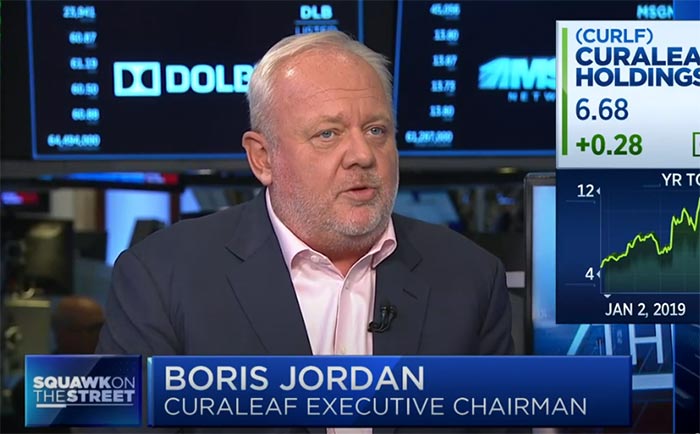
On August 16, 2024, Jordan added chief executive to chairman, succeeding Matt Darin. After years of helping shape Curaleaf’s direction, he assumed responsibility for its daily operations. His stated priorities included simplifying the organization, making decisions faster, pursuing growth and improving margins. The owner’s thesis now had an appointment with the operating calendar.
The scale was already substantial. At the announcement, Curaleaf reported 147 American dispensaries, a presence across 17 states and operations spanning 15 countries. Those figures describe the company at that moment, rather than a permanent scoreboard. They also explain why a change at the top concerned more than the name on an office door.
An employment agreement placed his work in Stamford, Connecticut, and Boca Raton, Florida, with travel elsewhere as needed. It is an appropriately divided base for someone whose business crosses jurisdictions. The distances are real, even when a corporate organization chart makes every operation look conveniently adjacent.
His role also brings a tension familiar to investors who become operators. Buying a business can be accomplished on a particular day. Integrating it cannot. A network assembled through acquisitions must eventually make decisions as a company, with all the awkward compromises that entails. Speed is an attractive promise until several inherited systems each have their own idea of the quickest route.
The people behind the balance sheet
There is another institution in Jordan’s life that links the American and Russian parts of his biography. In 2011, a gift from the family of Boris and Elizabeth Jordan established the Jordan Center for the Advanced Study of Russia at New York University. Both are NYU alumni. The center brings scholars together across disciplines to study Russia in a global context.
That commitment adds something the business timeline cannot quite convey. The country was a family inheritance, an intellectual subject and a place of work. Supporting a university center gives that long relationship a form outside a portfolio. Jordan also serves on NYU’s board of trustees and is a member of the Council on Foreign Relations.
His public manner can be much less institutional. During a 2020 conversation about a product he had tried on the golf course, he volunteered an unflattering assessment of his own golf. The admission cuts through the usual executive choreography. Here was a businessman discussing a vast commercial ambition while conceding that his swing needed assistance.
He also created Measure 8, founded in 2018 to invest in cannabis businesses. The interest extends beyond a single company, although Curaleaf remains the public stage on which his operating argument is tested. Investment vehicles can spread a thesis across several bets. A chief executive still has to answer for one company’s results.
“We’re building Curaleaf not to sell, we’re building it to compete.”
Boris Jordan · March 2024
Another board says no
By October 2026, Jordan was making his case in an unusually public negotiation. Curaleaf was pursuing Aurora Cannabis through an unsolicited takeover offer. It amended the bid in early October. Aurora’s board continued to recommend rejection, arguing that the proposal undervalued its business. Curaleaf argued for engagement and challenged that assessment.
On October 19, Curaleaf issued another response to Aurora’s board. The disagreement was still a disagreement, rather than a completed acquisition. Its presence in Jordan’s story is instructive: the strategy he described when Curaleaf listed in 2018 was still visible eight years later. Public equity, an acquisition target and an argument about the value of a combined business had returned to the foreground.
The dispute also supplies a useful counterweight to his own account. Jordan can explain why he believes scale will improve the business. Another board can disagree about the price, the terms and who should benefit. Conviction gets a proposal into the room. It does not settle the vote.
For someone whose first Russian journey began with curiosity, Jordan has spent much of his working life trying to turn a view of the future into an organization capable of reaching it. The interesting question now is how his taste for entering early holds up under the demands of running what he has assembled. At Curaleaf, the next chapter has to be delivered through the business he already owns.