To understand Booshan Rengachari’s complaint about banking, consider how little you want to know about a payment. You want it to arrive. You might care about its price. You probably have no wish to become acquainted with the machinery carrying it there. Yet banking software has often asked customers to begin with the machinery: choose a wire, choose ACH, choose another system with another set of instructions. Somewhere, an ordinary intention has become a small administrative qualification.
Rengachari, the founder and CEO of Finzly, has spent much of his working life concerned with that translation. His proposition sounds almost impertinently modest: let people say what they need, then make the software do the complicated part. The difficulty is that he sells to banks, where the complicated part has had decades to settle in, acquire dependencies and become indispensable.
The wrong kind of waiting
Before starting his company, Rengachari worked in international banking technology at Wells Fargo. He knew the problem from inside an institution. Sales, trading and operational systems were part of his professional territory. That background matters: his eventual business would need to understand the daily obligations of a bank as well as the possibilities of new software.
In 2012 he founded the business that became Finzly, initially known as SwapsTech. The contrast that bothered him was visible outside work. Consumer apps and messaging services were becoming easy to use. Banking could feel like a visit to a different technological decade. He began building with friends who believed in the idea.
There was a household behind the venture. Looking back in 2020, he credited his wife’s support, including work at the company, and described how difficult it had become to stop thinking about business. His attempted weekend rule was admirably clear: “No more work, but only family!” A founder seeking simpler systems had discovered a scheduling problem of his own.
A bank in a coffee break
The early work concentrated on foreign exchange and international banking. Over time, Finzly developed a broader proposition: software capabilities that a financial institution could add without rebuilding its entire foundation. The company describes BankOS as an operating system for banks, with applications that share underlying infrastructure. The familiar app-store idea supplies an accessible explanation for an unfamiliar purchase.
At FinovateWest in 2020, Finzly demonstrated digital account opening powered by BankOS. Its presenter profile listed 55 employees and described the business as self-funded. Those details give the demonstration some scale. This was already a working company with a team, putting an argument about infrastructure in front of an audience that could inspect the experience.
By FinovateSpring 2022, Rengachari and product executive Vijay Vardhan had a particularly tidy framing device: a coffee break could be enough time to launch a modern digital bank on Finzly’s platform. Their demonstration described ready-made payment connections, a ledger, onboarding forms and online experiences. It was a product demonstration, with the compressed timetable that the format invites. The provocation was still clear. A bank’s technology should be easier to assemble. Coffee, ordinarily a means of surviving a project meeting, had become the proposed unit of implementation.
An engineer writes to the Fed
Rengachari also took his ideas beyond the product stage. In a 2019 public comment to the Federal Reserve about faster-payment settlement, he set out a short list of demands. He wanted an alias directory available from the beginning. Businesses and individuals should be able to send payment requests with bills or invoices. He urged attention to features of India’s payment system.
The comment is revealing for its specificity. A new network, in his telling, needed useful capabilities around the transfer itself. Knowing whom to pay and being able to ask for payment belong in the same conversation as settlement speed. The questions are recognizably those of a product builder: what will somebody do with this, and what else must exist before it works comfortably?
In June 2023, the U.S. Faster Payments Council announced his election to its board, representing technology providers for a three-year term beginning that July. The board brought financial institutions, payment networks, business users and consumer organizations into the same governance structure. His engineering argument now had another setting, one in which other constituencies could press their own requirements. Interoperability begins to look rather more social when everyone has a seat.
The room where the plumbing matters
That same June, Finzly held its finzpire 2.0 user conference at the Hilton Charlotte Airport. The gathering ran for three days. Advisers Gene Neyer, Steve Ledford and Inder Koul were among the participants, alongside speakers from the Federal Reserve, The Clearing House and financial institutions. Rengachari spoke about considering the customer’s whole experience when developing services.
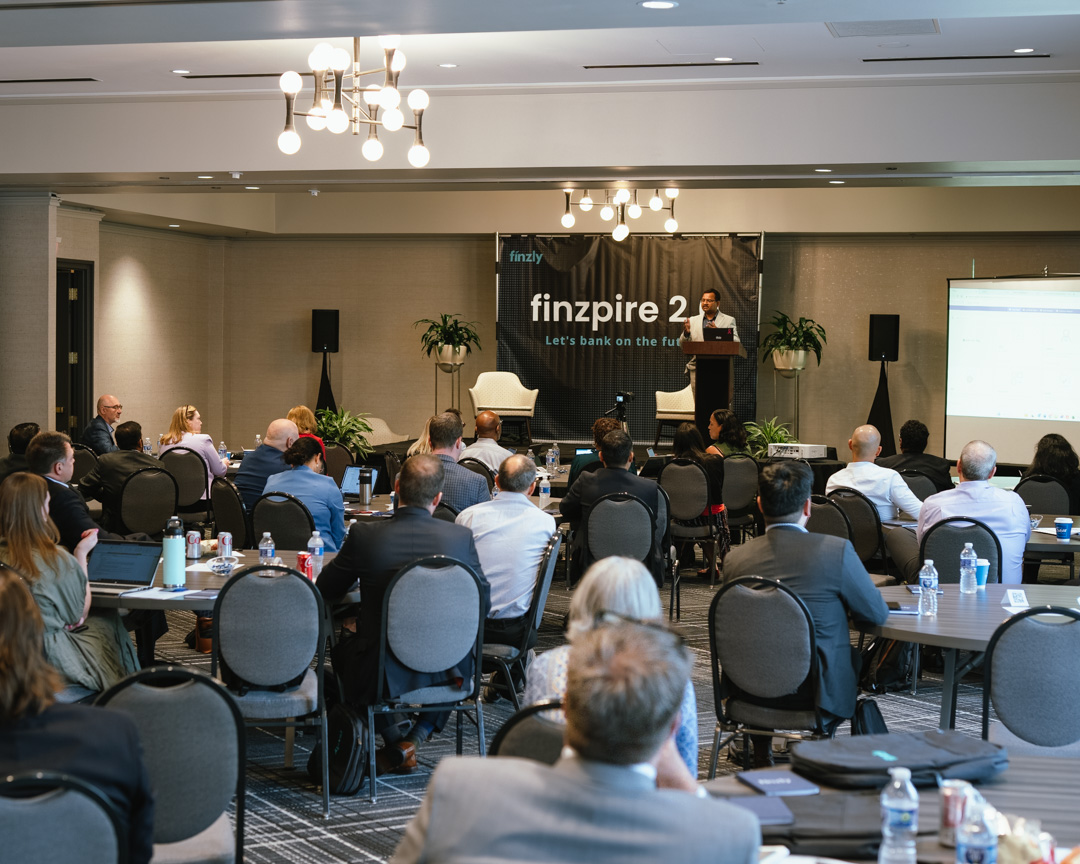
The setting offers a useful corrective to the solitary-founder picture. A bank technology company operates among customers with existing systems, advisers with institutional memories and networks with their own requirements. The conference’s agenda ranged from international banking to instant payments and cloud migration. Making those concerns fit together requires conversations as well as code. Rengachari’s work sits in the middle of that crowded room.
Eleven years to a Series A
In October 2023, TZP Growth Equity announced its investment in Finzly. The $10 million Series A arrived eleven years after the company’s founding. TZP partner Shamit Mehta joined the board as part of the transaction. Rengachari welcomed the investor’s experience and industry connections as well as the financial backing.
Put the dates beside each other and the usual startup shorthand becomes less useful. A Series A can sound like an opening chapter. Here it followed years of product development, customers and demonstrations. Financing gave the business another means of expanding work already underway. The long interval is part of the company’s history, without needing to become a universal lesson about how other founders ought to fund theirs.
That month also brought a banking customer announcement. Metropolitan Commercial Bank selected Finzly for payment processing across ACH, Fedwire and FedNow, with plans for customized business banking experiences. It was the sort of engagement that made the architecture argument tangible: several kinds of money movement, one institution, and customers who would eventually encounter the result.
The post office test
In 2024, Rengachari offered a pleasantly ordinary analogy for the experience he wanted. At the post office, a customer can choose a delivery speed without encountering an entirely different service counter for every transportation method. He wanted a similar consistency in payments. The bank should take responsibility for the route while the customer expresses the destination and urgency.
One intention. Several possible routes.
His descriptions can become more zoological, too. In a January 2025 conversation, he compared different payment systems to a dinosaur, an elephant and a collection of other animals. Putting them together, he explained, is an engineering problem. The menagerie is funny because the systems are so often presented as if they were interchangeable boxes on a diagram. Each arrives with its own habits.
There is a consistent preference underneath those comparisons. Rengachari talks about the person trying to complete a task before talking about the network that carries it. That order puts a practical burden on the builder. Explaining the system clearly is useful. Removing the customer’s need to understand it is a more demanding design goal.
Give the developers a door
His writing extends the argument to the people building the next service. In a 2024 article about open banking, he made a commercial case for APIs, the software interfaces through which systems exchange information and capabilities. Banks, he argued, could develop new offerings around access to their services. Consent and identity needed attention alongside the technical connection.
In another published explanation, he used Lego blocks to describe separating banking functions into smaller services. Common work, such as generating documents or maintaining an audit trail, need not be rebuilt inside every application. The modular approach is intended to let developers combine capabilities and concentrate on the parts that distinguish their products.
It is an engineer’s answer to a business constraint. If changing one thing requires disturbing everything else, even an attractive idea becomes a difficult decision. Smaller, reusable components are his proposed way to give institutions more freedom to act. The pleasure of the Lego comparison is that everybody understands the desire to build something new without first melting down the previous model.
Software with something to answer for
Finzly announced Agentic Galaxy in October 2025, extending its platform into AI-assisted payment operations. The company described agents working within workflows, with people retaining oversight. By 2026, Rengachari was discussing software that could investigate an exception, assemble its context and recommend an action, while leaving sensitive judgment with a person.
“Banking runs on trust and accountability.”
Booshan Rengachari, 2026 interview
His longer-term ambitions include predictive liquidity management and payments that respond to specified conditions. He presents these as directions for development. The distinction matters because an aspiration tells us where a founder wants to go; operating software has to answer for what it does today.
In September 2026, Finzly announced technical certification for Request for Payment on the RTP network following a bank customer’s go-live. In October, BankOS became a finalist in the Money20/20 Money Awards. The quieter connection is to that earlier list sent to the Fed: make it easier for people to ask for money and receive it. Fourteen years after founding his company, Rengachari is still working on the gap between a simple intention and all the machinery it sets in motion. A successful payment gives its user very little to remember. For its engineer, that is a satisfying outcome.