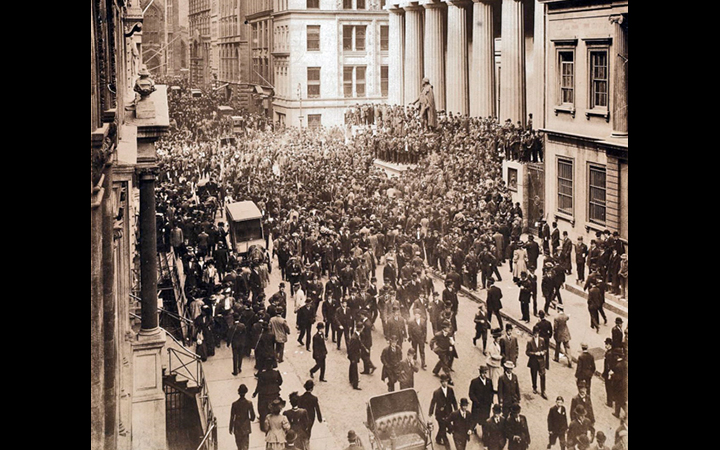
In October 1907, a crowd on Wall Street was a financial instrument. People wanted their money back. Banks and trust companies needed cash. Confidence, which had seemed plentiful, suddenly became scarce. The United States had no central bank to organize a nationwide response. Private financiers, including J. P. Morgan, helped assemble the rescue. It was an awkward arrangement for a country growing accustomed to doing business at industrial scale.
- The Fed sets monetary policy and supplies the plumbing behind everyday banking.
- Twelve regional Reserve Banks feed local information into national decisions.
- FedNow moves payments around the clock. Policy works on a slower clock.
The panic that drew the blueprint
The panic helped change the argument for monetary reform. A rescue dependent on private coordination could struggle when trouble spread beyond established banking networks. Trust companies, central to the 1907 crisis, sat outside the New York Clearing House’s membership. The boundary mattered: a network can look dependable until the institution needing help sits outside it.
Congress answered in 1913. President Woodrow Wilson signed the Federal Reserve Act on December 23, following work by legislators including Carter Glass and Robert Owen. The design distributed authority between Washington and regional institutions. America wanted a central bank, but the compromise gave it a system. The distinction still explains much of its behavior.
One mandate, twelve listening posts
Today, the Federal Reserve System combines the Board of Governors, twelve Reserve Banks, and the Federal Open Market Committee. Seven governors, the New York Fed president, and four rotating regional presidents make up the FOMC’s voting membership. Other regional presidents join the discussions. The arrangement gives national policy a recurring encounter with conditions outside the capital.
Its expertise spans economics, bank examination, financial markets, and payment operations. Its monetary-policy mandate includes maximum employment and stable prices. The Fed influences borrowing conditions through policy rates and other tools; it does not individually price your mortgage. Changes travel through markets and lenders before reaching household budgets. That journey creates delays and uneven effects.
It also supervises certain financial institutions, monitors systemwide risks, and supports consumer protection and community development. Regional intelligence matters here. The Beige Book gathers accounts of economic conditions across districts. A national average can hide a local shortage, a hiring freeze, or a business discovering that customers have become much more price-sensitive.
Money moves on a different clock
The less theatrical Fed handles banking infrastructure. Fedwire supports funds transfers; FedACH processes automated clearinghouse payments; FedCash distributes and processes currency and coin. Reserve Banks provide collateralized liquidity through the discount window and act as fiscal agents for the Treasury. Banks and credit unions are direct service users. Households and businesses encounter the results through their financial institutions.
FedNow, launched on July 20, 2023, makes that relationship especially clear. It allows participating institutions to move payments instantly, any hour, any day. At launch, 35 banks and credit unions had instant-payment capabilities, alongside the Treasury’s Bureau of the Fiscal Service. A December 2025 update reported more than 1,500 participating financial institutions across all fifty states.
Your bank supplies the customer experience. The Fed supplies the interbank rail.
The useful feature is access to funds when timing matters: a paycheck received immediately, or an invoice paid without a processing wait. Participation alone does not guarantee every customer can send every kind of payment. Ask your bank what it actually offers. FedNow is infrastructure, and the last mile belongs to the institution serving you.
There are private alternatives. The Clearing House’s RTP network has offered instant payments since 2017. The Fed has a statutory monetary-policy role that a competitor cannot simply take over; its payment services occupy a market where private networks also operate. Calling the whole institution a bank obscures these different jobs.
Per originated customer credit transfer. FedNow’s published 2026 base fee, before discounts. The first 2,500 qualifying transfers per month are discounted; the general monthly participation fee is waived in 2026. These are institution fees, not a promise about your bank’s charges.
The price of being wrong
The Fed’s history includes serious failures. During the Great Depression, shortcomings in its structure and response helped deepen the disaster. A century of experience did not eliminate judgment errors. In 2021, policymakers initially expected pandemic inflation to fade as disruptions eased. Then prices rose more broadly, including in services. The diagnosis stopped fitting the evidence.
“Beginning in October, the data turned hard against the transitory hypothesis.”
Jerome H. Powell / August 2024 retrospective
The FOMC removed “transitory” from its statement in December 2021 and began raising rates in March 2022. Another uncomfortable lesson arrived with Silicon Valley Bank’s collapse in 2023. The Fed’s review found failures in bank management, risk recognition, and supervisory action. Spotting a weakness and getting it corrected are separate achievements. The report is useful precisely because it examines that gap.
Costs appear on the Fed’s own books, too. The Reserve Banks’ audited 2025 accounts reported $155.299 billion in interest income, $167.381 billion in interest expense, and $9.800 billion in operating expenses. Their loss before Treasury remittances was $18.761 billion. Higher interest costs can outrun earnings on securities acquired earlier. Losses defer future Treasury remittances rather than mechanically shutting down central-bank operations.
Borrow the method. Use the tools.
The practical lesson is to combine numbers with observations, and decide what evidence would change your forecast before defending it. Give risk findings an owner and a deadline. These are habits a business can copy without possessing a central bank’s powers. FRED, the St. Louis Fed’s public data service, and the Beige Book offer useful starting points for checking economic assumptions.
The tools have boundaries. Interest rates cannot manufacture missing components. Liquidity cannot make an insolvent institution healthy. Instant settlement needs participating institutions and usable customer services. On September 16, 2026, the FOMC raised its target range to 3.75-4.00 percent, citing elevated inflation. The original problem survives in another form: deciding when waiting becomes more dangerous than acting.