Obiaku Ohiaeri had a problem with money that was already hers. At a previous employer, claiming reimbursement meant doing the paperwork herself. There was no card to make the transaction easy. The purchase and the refund were separate jobs, and she had been appointed administrator of the second one. Few people wake up hoping to become the unpaid accounts department of their own lives.
She understood complicated organizations for a living. That made the experience particularly revealing. Professional familiarity had not spared her the consumer’s chore. In her later account of Binkey’s beginnings, the irritation was plain: recovering money took more effort than it should. After leaving McKinsey in 2021, she wanted to build a business that addressed those barriers. She founded Binkey in 2022.
That is a useful place to begin her story. A résumé can make a founder’s arrival look inevitable, each position a carefully placed stepping stone. An annoying form restores some human scale. Here was someone with experience of large institutions, encountering a small process that remained stubbornly inconvenient. She decided the inconvenience deserved a company.
The fragrance laboratory before the fintech
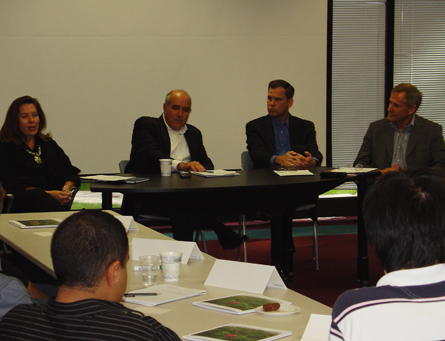
Go back to October 22, 2010, and the setting is rather different. Ohiaeri was a junior biochemistry major at Rider University, taking part in a leadership visit to Firmenich’s facilities in Plainsboro, New Jersey. The business made fragrances and flavors. Students toured laboratories, learned about its operations and met executives for questions and answers.
The outing brought together students from different subjects, including business, communications and chemistry. Ohiaeri’s name appears among the participants. It is a pleasingly specific early detail: a future payments founder, still a student, inside a business whose products people might encounter without knowing the company behind them.
There is no need to turn that visit into a prophecy. A laboratory tour does not come with a sealed envelope containing one’s future startup. What it does offer is a glimpse of the distance between a finished product and the organization required to make it. Fragrance has laboratories. A checkout has payment infrastructure. The customer encounters the result; someone else must understand the machinery.
In November 2010, she received a Bristol Myers-Squibb Chemist Fellowship Award. Her education eventually included a bachelor’s in biochemistry from Rider and a master’s from Georgetown. The sequence supplies something more concrete than the usual claim that a founder has always been curious. There was a subject she studied, research work she undertook and an early award recorded under her name.
A résumé that kept changing its vantage point
Her working life moved through research roles at Rider and Bristol-Myers Squibb, then a scientist position at Johnson & Johnson in 2012. By 2015 she had joined McKinsey, where her roles included Expert and Engagement Manager. In 2021 she became Vice President of Products and Applications at ConcertoCare. The following year brought Binkey.
Read those titles slowly and the change becomes clearer. Research, consulting and product leadership ask different questions. What can be established? How does an organization work? What should a product do? A founder must eventually bring those questions into the same room, where they can disagree at some length before anything gets built.
Her career offers a way to understand the kind of business she chose. Binkey works on payments and reimbursement processes, where the experience of an individual depends on arrangements made by institutions. There are rules to follow, systems to connect and a person at the end who would prefer to finish shopping. The work crosses the boundary between an organizational problem and an ordinary transaction.
Johnson & Johnson
McKinsey & Company
ConcertoCare
Binkey
The reimbursement episode makes that boundary personal. Ohiaeri had encountered a process from the position of the user, even while her professional experience gave her other ways to examine it. The resulting business has a recognizable starting point: the system may make sense to its administrators while still asking too much of the person using it.
That tension gives the career its narrative thread. The titles change, but the founder’s chosen problem sits among all those perspectives. It involves an individual’s money, a merchant’s checkout, the rules attached to a payment and the software connecting them. A solution has to survive contact with each.
The work hidden inside an ordinary checkout
Binkey’s name expands to Benefits and Incentives Key. It is an acronym with a reasonably hospitable front door. Anyone who has met a corporate abbreviation that sounds like a printer malfunction can appreciate the effort. The idea of a key is also apt: something of value already exists, while access still requires help.
The business applies that idea to restricted spending accounts. Its starting point was payment processing. Ohiaeri’s ambition was to reduce the work between a customer’s available funds and an eligible purchase. Reimbursement automation addresses another part of the same journey, after a transaction has happened.
Consider the distinction from the founder’s point of view. At checkout, a customer wants a purchase to go through. Later, someone seeking reimbursement wants to recover money without reconstructing the whole transaction. These are different moments in a person’s day. A business built around both has to recognize that the paperwork problem does not end when the shopping bag is closed.
A conceptual map of the transaction, rather than a promise that every purchase follows the same route.
This is where the original annoyance becomes useful as a product question. Which work belongs to the shopper, and which work could be handled by the service? Each extra action needs a reason. If recovering money requires a separate administrative performance, convenience is measured partly in how much of that performance can disappear.
There is a certain comedy in the ambition. Building a company requires meetings, documents and decisions; the customer’s desired outcome may be that there is less to do. The founder accepts the complicated assignment so the person at checkout has a shorter one. For Ohiaeri, that bargain began with firsthand experience of the longer version.
Two dates that made the business public
In July 2023, Binkey announced its selection for Mastercard Start Path. The program gives participating technology companies access to Mastercard’s expertise and network. For a young payments business, the significance is practical: the product operates in a world of established systems, and working relationships matter alongside software.
The selection also placed Ohiaeri in a wider company-building conversation. A founder can identify a problem alone, but a payments product must work with other organizations. Start Path belongs to that collaborative part of the story. It is a milestone in developing the business, rather than a claim that the underlying problem has already been solved.
Led by Wellington Access Ventures, with SpringTide Ventures, Third Culture Capital and Plug and Play participating.
The funding announcement followed in December: $3.3 million in seed capital. Wellington Access Ventures led the round. SpringTide Ventures, Third Culture Capital and Plug and Play participated. A round has an amount and a roster, but the founder’s own announcement carried another detail: she thanked her team, family, customers, partners and supporters as well as investors.
That gratitude helps keep the story proportionate. Financing is an organizational event made possible by people occupying different roles. The announcement recognized that fact. It also returned to the reimbursement frustration behind the business, connecting a public milestone with the original experience rather than allowing the number to swallow the story.
In August 2025, Ohiaeri appeared in a feature on female fintech founders assembled through peer recommendations. The recognition came later than the launch and the seed round. It adds another dated point to the record: other people in the industry were putting her name into the conversation about founders to watch.
A little pop music in the payment machinery
There is another version of Ohiaeri in her public posts, with fewer financing nouns. Introducing a Binkey checkout post, she invoked BTS’s song Butter and imagined herself singing. It was a playful way of expressing the product ambition: a transaction that feels easy. A technical explanation can have a tune, apparently.
The choice is revealing as communication. She could have stayed with the vocabulary of processing and integration. Instead, she borrowed a familiar cultural reference to describe an experience. The humor does not require a claim about her private tastes or personality. It is right there in the public post, doing the modest job of making a payments message more approachable.
Elsewhere, in a testimonial for speaker Dan Chuparkoff, she praised his ability to make organizational challenges practical. The phrase she used was “tangible, practical, and actionable.” Read beside the reimbursement story, that language gives the profile a useful closing note. An explanation earns its keep when someone can do something with it.
“Tangible, practical, and actionable.”
Obiaku Ohiaeri, describing the value of clear business guidance
For the person trying to get money back, the desired action is wonderfully unceremonious. Complete the purchase. Recover the funds. Get on with the day. Ohiaeri’s route to addressing that experience took years, several organizations and a change of professional vantage point. The customer, with luck, should not have to think about any of them.
That is what makes her story worth following. The scientist’s training, the consulting roles, the product title and the funding round are part of the record. At the center is an experience simple enough to recognize immediately: having to do extra work for money you already had a claim to. Her company began where that ordinary irritation stopped being acceptable to her.