A pair of smart glasses is an awkward place to put a computer. There is little room, limited computing capacity, and a person waiting for the device to do something useful. Bongjin Jun’s early work at STRADVISION belonged to that awkward space. The software could find text in the world and help turn it into words a wearer could read. A sign, for instance, could become a translation. Useful, provided somebody wanted to wear the glasses.
The company would eventually put its perception software into production cars. Between those two applications sits the interesting part of Jun’s story: how expertise developed for one device found a use in another. The spectacles and the automobile make an unlikely pair. Their chips, however, shared a demand for software that could work within limits. A road to automotive AI began with something small enough to sit beside an eye.
Jun is a computer-vision researcher, a POSTECH PhD and one of STRADVISION’s founders. He served as its early CEO and subsequently held research leadership responsibilities. Current records also identify him as CISO and a director. Those changing titles sketch a career inside the same business, while his publications preserve another record: the problems he continued to tackle with colleagues.
A second company, built on first-name terms
Before STRADVISION, there was Olaworks. The Korean company worked on face recognition, taking image-analysis technology into products. Jun’s connection with its team developed through POSTECH and industry research. Researchers from that university joined the business, bringing computer-vision expertise into a commercial setting. In 2012, Intel acquired Olaworks. Jun then worked as a senior research engineer at Intel Korea from 2012 to 2014.
A sale can end one company’s independent life without ending the relationships formed there. Junhwan Kim, who later became STRADVISION’s CEO, recalled an agreement among former colleagues to start another company. Jun made the first move; Kim joined afterward. The detail gives the founding a human scale. These people had already worked together. Their next undertaking drew on that experience, rather than requiring strangers to discover whether they could build anything in the same room.
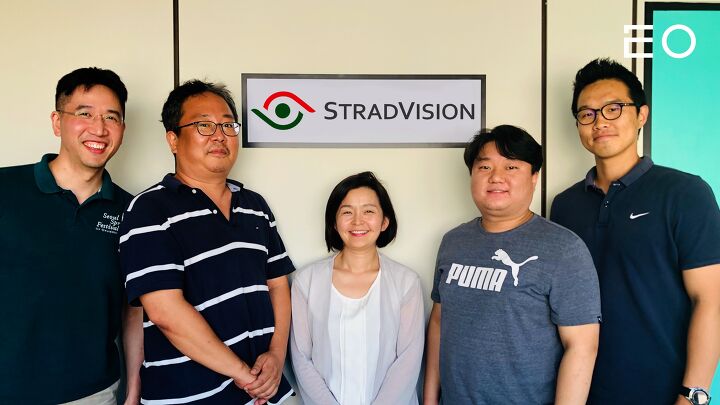
STRADVISION’s history places its establishment in October 2014 and names four founders: Jun, Unhyeon Nam, Hojin Cho and Myungchul Sung. The list matters. So does POSTECH’s Intelligent Media Lab, led by Daijin Kim, which appears repeatedly in the early research. Jun’s biography is threaded through collaborators. The algorithms had authors; the company had a team. Keeping their names in the picture makes the beginning more intelligible.
Glasses with a reading habit
The early application was unusually easy to explain. Point smart glasses at text, detect the words and translate them. Accomplishing it was considerably less tidy. Printed characters encountered outdoors arrive inside complicated pictures, surrounded by edges, objects and other things a computer might mistake for writing. A useful system must locate the text before it can recognize it. The wearer supplies neither a flatbed scanner nor a politely arranged document.
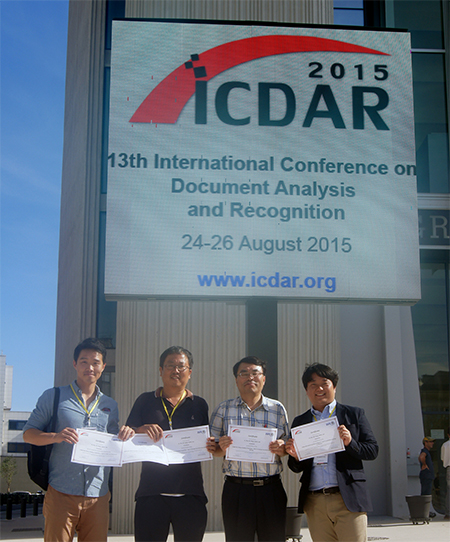
In 2015, the joint POSTECH-STRADVISION team entered the robust-reading competitions at the International Conference on Document Analysis and Recognition in France. It finished first in five categories. Jun also co-authored a presentation on extracting character candidates from natural scenes with Sung, Cho and Daijin Kim. The work gave the young company a public demonstration of its technical capabilities, with results attached to specific tasks rather than a general promise about artificial intelligence.
POSTECH described the smart-glasses work under Jun’s leadership as CEO. Its account also set out plans to extend detection and recognition into smart-car applications, including lanes, vehicles, pedestrians and road signs. The automotive connection was already visible. In September 2015, Jun put commercial use among his priorities: “We plan to focus on commercialization.” The short translated excerpt is a useful marker of his ambition at that point. Research was being asked to find customers.
“We plan to focus on commercialization.”
Bongjin Jun · September 2015 · translated excerpt
The chip kept the argument going
The wearable business did not develop as the team expected. Kim later described working technology inside a market that failed to expand enough. Automotive inquiries opened another direction. Early in 2016, the company explored the move into cars, and its own chronology dates the start of ADAS solutions to January that year. ADAS stands for advanced driver-assistance systems: software and hardware that support particular driving tasks.
The connection between glasses and cars lay partly in computing constraints. Wearable hardware required compact software. Automotive chips likewise limited the resources available for image analysis. A technique developed to make perception run efficiently could therefore matter in a different product. This helps explain the pivot without making it look like a complete abandonment of the team’s work. The application changed; relevant engineering experience traveled with it.
For Jun, that continuity is central. His colleagues associated him with text recognition and software compression. The company’s later product, SVNet, interprets camera images for automotive systems, identifying such features as lanes and objects. Perception supplies information to the rest of a driving system. Planning and control have their own work to do. A car has more room than a pair of spectacles, but the software still has to fit the hardware selected for the job.
Limited compute
vision software
Limited compute
The founder kept publishing
The business story did not swallow the research record. In 2016, Jun, Cho and Sung published Canny Text Detector at the Conference on Computer Vision and Pattern Recognition. Its title is rather less conversational than “glasses that read.” Its subject is recognizably related: finding text in a natural image. The method drew on similarities between image edges and the way characters form words, using shared properties to help locate writing.
Consider the distinction. Recognizing an isolated letter is one problem. Finding the letters worth recognizing in a photograph is another. Text can sit among countless unrelated shapes. The paper examined how neighboring characters share properties such as size, color and stroke width. Those relationships provide clues about which regions belong together. The method sought better localization by using information that becomes useful when characters are considered as part of a group.
In 2019, Jun co-authored face-recognition research with Bong-Nam Kang, Yonghyun Kim and Daijin Kim. Their work appeared at the CVPR Biometrics Workshop and at the International Conference on Computer Vision. STRADVISION announced a workshop best-paper award. The ICCV paper examined how relationships between local appearance features, weighted by attention, could improve recognition when faces changed pose, expression or lighting.
Faces and written words pose different questions, yet both ask an algorithm to extract meaning from visual variation. Jun’s authorship across these applications shows the breadth of his documented research. It also offers a way to understand his role beyond an executive title. Founding STRADVISION did not mark the end of the publication list. Years into the company’s life, he was still helping formulate technical answers with other researchers.
Five million is a team number
STRADVISION’s company name brings together Stradivarius and computer vision. The recruiting history offers that explanation, giving automotive software an unexpected association with string instruments. There is a little charm in it: a business making camera images useful carries the name of a craft famous for being heard. The early text-recognition company was acquiring a different audience.
By February 2026, STRADVISION reported that cumulative commercial deployments of SVNet were approaching five million units worldwide. In May, a joint announcement with aiMotive described more than five million cumulative production units. These are dated company figures, and they belong to the organization’s collective work. They put the initial experiments in perspective without turning every installation into a personal achievement for one founder.
The aiMotive collaboration addressed another practical question: how to turn recordings from real roads into scenarios useful for testing driver-assistance systems. STRADVISION supplied perception and scenario interpretation; aiMotive contributed reconstruction and simulation tools. Their proof of concept connected recorded driving scenes with synthetic environments. The task extends the company’s work beyond recognizing an object in an image to organizing information that can help evaluate a system.
The progression is worth following at ordinary speed. In 2014 there was a new company. In 2015 there were text-recognition results. In 2016 there was an automotive offering. A decade later, the discussion included millions of production units and simulation workflows. Each stage called for more than a prototype. For a reader trying to understand Jun’s career, the interval between those stages is as revealing as the headline number.
Cumulative production units worldwide.
A company milestone, built by a team.
- 2014Jun and three colleagues establish STRADVISION.
- 2015Joint POSTECH team wins five ICDAR categories.
- 2016Company begins offering ADAS solutions.
- 2026SVNet passes five million production units; company lists on KOSDAQ.
Still in the picture
On June 30, 2026, Jun stood with company and exchange representatives at STRADVISION’s KOSDAQ listing ceremony in Seoul. The photograph’s caption identified him as research director. After the listing, he joined an executive share purchase: the July announcement recorded 10,743 shares bought by Jun. It is a concrete detail of his continuing involvement in the business he helped establish, with a quantity and a date attached.
His public activity that September brought him into another room. At the sixth Korea-China Future Economic Cooperation Forum in Seoul, Jun shared experience from technology development during a session on autonomous driving and cooperation between the two countries. Xiaomi’s autonomous-driving and robotics representative also spoke in that session. The subject had expanded from a team’s algorithms to the work of companies operating across national automotive markets.
An October 8 shareholder meeting approved Jun’s appointment as an inside director for a three-year term. The appointment record identified his current role as chief information security officer. Alongside the research-director descriptions, it places him within the company’s continuing technical and governance responsibilities. His early CEO role belongs to the beginning of this chronology; Junhwan Kim leads the company today.
Return to the glasses. They offered a particular answer to a particular problem: let a small device recognize the writing in front of it. The market gave that idea a difficult reception. The team carried its work into another setting, where compact perception software could serve automotive customers. Jun’s story is held together by that movement and by the colleagues who made it possible. The first device was small. The subsequent life of the work has taken considerably more space.
Follow the work
- Bongjin Jun on LinkedIn
- STRADVISION · official website
- STRADVISION · company profile
- 2015 · POSTECH’s smart-glasses work
- 2016 · Canny Text Detector
- 2019 · face-recognition research
- EO video · Junhwan Kim on the company’s origins
- 2026 · production milestone
- 2026 · Korea-China mobility forum
- 2026 · director appointment