The first version of Blavity was not a media empire. It was an email newsletter assembled by four Washington University friends who believed young Black people were creating the internet's funniest, sharpest and most consequential conversations - then watching established media arrive late, sand off the context and call the result coverage. The proposition was intimate: here is a place designed specifically for you.
That sounds obvious now because Blavity helped make it obvious. In 2014, founder and CEO Morgan DeBaun was working at Intuit in the Bay Area. The killing of Michael Brown in Ferguson, near her St. Louis hometown, exposed a distribution failure. News and testimony were scattered across Twitter, Vine and emerging livestreams. Legacy Black outlets had not fully made the mobile-first turn; large millennial publications did not have the same urgency or fluency. DeBaun left her job and pushed a side project into a company.
Today, Los Angeles-based Blavity Inc. sits somewhere between a publisher, an audience company, an event operator, an ad network and a recruiting platform. The flagship Blavity covers news and culture. 21Ninety speaks to Black women about life and wellness. Travel Noire handles the passport. Home & Texture handles the living room. Shadow and Act watches Hollywood. AFROTECH covers careers, capital and technology, then gathers the audience in person. Blavity360° helps advertisers buy across minority-owned publishers. Talent Infusion sells enterprises access to a curated professional pipeline.
The product was specificity
Blavity's edge was not merely publishing stories about Black people. BET, ESSENCE, The Root, Black Enterprise, REVOLT and Urban One already occupied parts of that map. Its difference was product discipline borrowed from consumer technology: choose a user, observe what that person is already doing, and make the experience feel deliberately built for them. DeBaun has described learning that ruthlessness at Intuit. TurboTax succeeds by making a specific tedious task less painful. Blavity applied the same thinking to cultural discovery.
Community contribution mattered early. In a 2017 interview, DeBaun said roughly half the site's content came from its community. Blavity had moved off WordPress to a custom content system built to accept and organize those voices. The choice brought moderation and quality problems, but it also made the newsroom more permeable. Readers were not a focus group held after publication. They were a distribution system, a contributor pool and a minute-by-minute signal about what the publication should become.
“Before I could take anyone else's money, I wanted to not just tell the story about how Blavity could be a huge business, but also show the story.”Morgan DeBaun
The cleanest example is 21Ninety. Blavity first tested women's lifestyle material through a separate social account called Blavity Lifestyle. It grew faster than the parent account. The team added another channel, then original articles, then realized the tone and products it imagined did not fit neatly beneath Blavity's general-interest brand. Only then did it build a separate destination. The brand was not born in a positioning workshop. Audience behavior dragged it into existence.
What it cost - and what failed first
There is no tidy garage invoice. There is a better portrait of scarcity. Blavity bootstrapped for about a year in San Francisco. DeBaun described the conventional paid headcount as zero, with six or seven people working unpaid or receiving roughly $100 to $500 a month when she could manage it. The first outside money largely paid bills she had already been covering and hired people who were already doing the work. A later account says she kept consulting for years so business revenue could remain inside the company.
Before Blavity, her biggest product failure was a personal-finance calculator. The problem was real; the product was indistinguishable from thousands of alternatives. She also built Quad Connect, a college tool that scraped campus calendars to find free food. The first failure inside Blavity was less technical: the fundraising story. Investors saw an undercapitalized blog run by someone who was not a journalist. DeBaun saw brands, software, experiences and a commercial ecosystem she could not yet fully name. Her pitch flattened that ambition in an attempt to look focused.
What changed minds was not a better adjective. It was traction. The team retreated, built and returned with audience numbers investors found difficult to dismiss. Blavity raised more than $1.8 million before its Series A, using some of that capital to acquire Travel Noire and Shadow and Act. In July 2018, GV led a $6.5 million round with Comcast Ventures, Plexo Capital and Baron Davis Enterprises. The money funded engineers, data capability and the pipes for programmatic advertising.
AFROTECH made the network visible
selected years
One relationship, several invoices
The original editorial operation solves a representation and discovery problem for consumers. The rest of the company solves adjacent problems for people who want to reach, hire or work with those consumers. Advertisers buy direct campaigns, branded stories, social distribution, creator matches and programmatic inventory. Publishers use Blavity360° to make their audiences available to those advertisers. Employers subscribe to Talent Infusion and sponsor AFROTECH. Attendees buy conference and festival tickets. Brands sponsor the rooms.
The Blavity flywheel, without the consultant fog
This mix is not decorative diversification. Digital advertising is volatile, platform algorithms are landlords with mood swings, and journalism rarely throws off venture-style margins. In 2018, Blavity's largest non-advertising revenue stream was experiential, through sponsorships and tickets. The company then invested seriously in programmatic advertising. By 2023 it had formalized two main divisions: Blavity Media Group for content, advertising and publishers; Talent Infusion for careers and recruitment.
The customer list explains the bet. Public case studies and client materials name companies such as Walmart, OnStar, Amazon, Bank of America, Microsoft, Netflix, Nike, Toyota and others. These buyers can purchase raw reach almost anywhere. Blavity sells context: which story belongs on which brand, which creator can carry it, which gathering feels credible and which professional audience has reason to answer.
From feed to conference hall to television
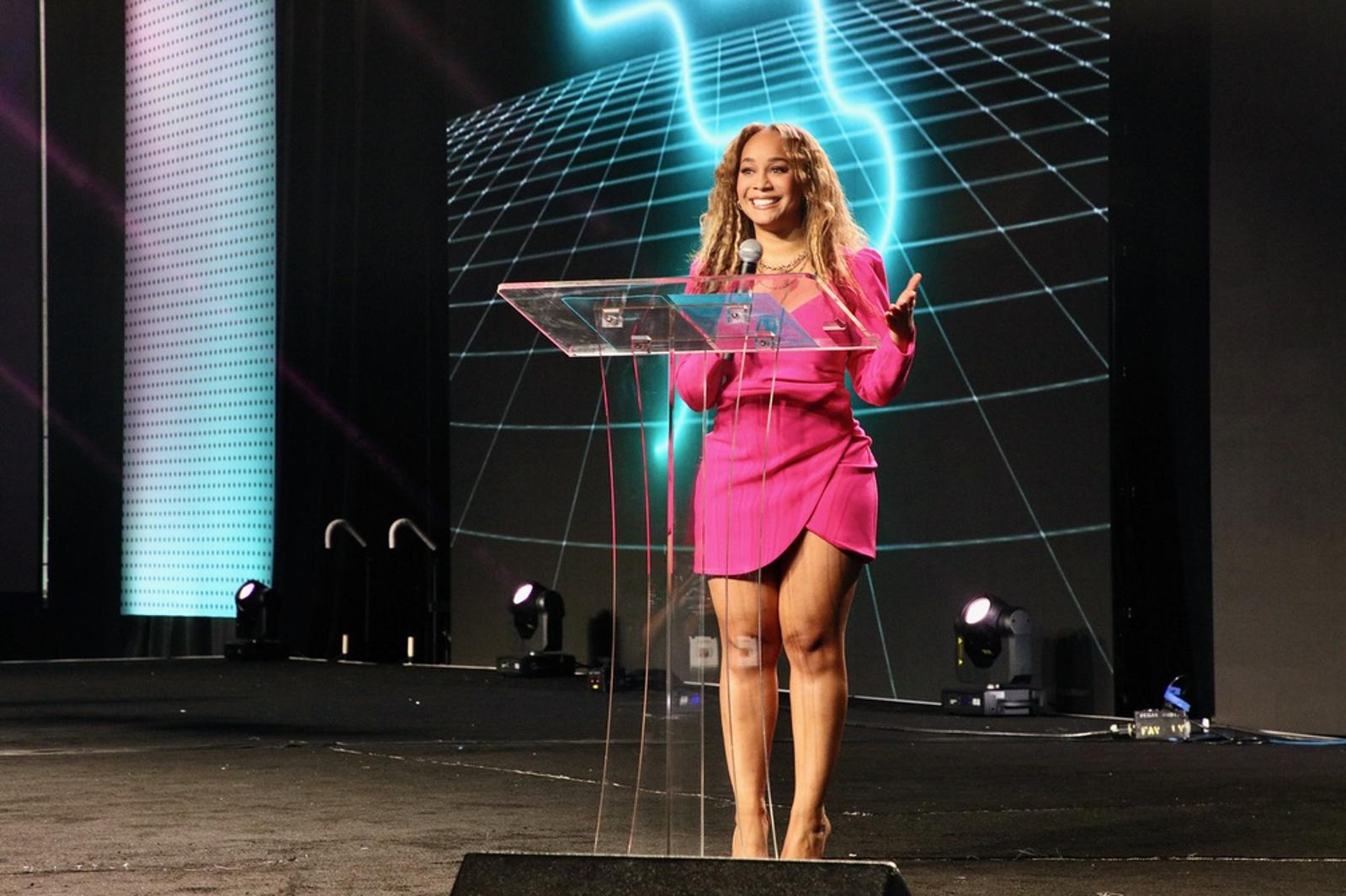
AFROTECH is the model at its most physical. The conference began with roughly 650 attendees in 2016. It drew more than 25,000 in Austin in 2022, more than 37,000 in its first Houston year in 2024 and more than 40,000 in 2025, according to the brand. A publication can describe a missing network. A conference lets the network hire, invest, teach, celebrate and take up space.
The portfolio keeps following its audience into new rooms. Blavity acquired the traveling RNB House Party in 2023 and turned it into Blavity House Party, including a Nashville festival. It launched a Creator Collective in 2024 to match brands with multicultural talent, then added a paid quarterly fellowship in 2025. The company said it had invested more than $1 million in Black creators through content partnerships during 2024.
In 2026, HealthStack, an AFROTECH initiative, formed an advisory board focused on digital health infrastructure, clinical-trial access, AI in care and measurable health equity. Blavity Media Group also signed a channel-sales partnership with OTTera, adding connected-TV and sports inventory. That move lets one campaign travel across articles, social posts, newsletters, events and living-room screens. It is the same strategy with a longer cable: meet the audience where its attention has gone, then bring enterprise demand along.
What to steal - and when it breaks
Use cheap distribution as product research. A social account or newsletter can prove a voice before a standalone brand earns a budget.
Build multiple products for one community, not one product for multiple imaginary audiences. Adjacency beats randomness.
Let traction repair a story investors misunderstand. Evidence carries a big vision better than pitch-deck taxonomy.
Turn soft trust into a hard transaction: a ticket, subscription, campaign, placement, introduction or useful tool.
But the playbook has conditions. It works when the founding team has authentic fluency, the audience recognizes itself as a community, and businesses have a costly reason to reach that group. It also requires editorial brands strong enough to survive separate identities without becoming generic vertical sites. A roll-up assembled only because ad inventory looks efficient will not reproduce the trust that made the inventory valuable.
Scale creates its own tension. The more Blavity becomes an access layer for corporate America, the more carefully it must protect the audience relationship that makes the layer matter. Recruiting campaigns, military partnerships, sponsored content and programmatic ads can be useful, but they are not neutral. Readers need to know who is speaking and why. Creators need fair terms. Publishers need revenue without surrendering identity. The moat has maintenance costs.
Blavity's best idea is ultimately modest: a community treated as a demographic is usually many markets hiding in plain sight. The company did not discover Black travel, Black women, Black technologists or Black homeowners. It noticed that these people deserved products with their own voice, then built a business that could charge for the connection without charging readers for belonging. The newsletter was the opening move. Access - to information, opportunity, audiences and one another - became the larger game.