The most revealing line in Black Diamond Radio's warranty is not about electronics. It is about a forklift. If a radio gets crushed at work, the Aurora, Colorado company says it will replace the unit during its two-year coverage window, provided the customer can return something recognizable with a legible serial number. A dog can chew it. Water can find it. Gravity can have a productive afternoon. Loss is not covered, but accidents are. In a category stuffed with power ratings, channel counts and acronyms, that promise tells you what the company believes it is actually selling: a communication system that remains somebody's problem after the invoice is paid.
Black Diamond Radio makes commercial two-way radios, earpieces, chargers, repeaters and packaged systems for teams that work in the same physical place. Its customers include dental offices, animal hospitals, hotels, retailers, restaurants, schools, security crews, event producers and manufacturers. These are environments where a message is often short, urgent and addressed to the room: bring an instrument, open another register, find the supervisor, send security, room 214 needs help.
A smartphone can do all of those things. It can also demand an unlock, an app, a contact, a notification and several seconds of attention. A radio reduces the interface to one button. That sounds almost quaint until five people need the same sentence now.
The first failure was the service
The story starts in 2002 with Custom Earpiece. Company president David Eames believed the two-way radio accessory market had a customer-service problem. The original wedge was practical: make clearer, tougher earpieces and answer the phone without making a buyer navigate a menu maze. The company says that business grew quickly. More important, it put the team close to the complaints that arrive only after hardware meets an eight-hour shift.
The earpiece cable snags. The plastic hurts after lunch. The wrong connector arrives. A replacement takes too long. The radio itself is difficult to service because the dealer and manufacturer point at one another. None of these complaints sounds like a venture pitch. Together, they describe why a generic product becomes expensive inside a workplace.
What changed the company's mind about its scope was success with the accessory. If Custom Earpiece could control service and product quality around the radio, manufacturing the radio became the logical next step. Black Diamond Radio moved upstream, eventually assembling a catalog of analog and digital handhelds, multi-user packages and repeaters. It did not abandon compatibility on the way. Its connector chart supports a comically long roster of Kenwood, Motorola, Hytera, RCA, Retevis and other models. The rival installed base is also a lead-generation surface.
“If You Can Break It We Will Replace It.”Black Diamond Radio's operating thesis, compressed into nine words
What the customer actually buys
The current handheld line begins with five models. The $199.95 Pryzm is a compact 2-watt DMR radio with digital private and group calls, voice prompts, optional AES-128 encryption and an analog mode for older systems. The D420 Hue raises digital power to four watts at the same listed price. The $259.95 D452 is the heavier-duty option: five watts, IP65 protection, a 2,600mAh battery, digital and analog zones, private calls and an all-call function that can reach every radio regardless of where its dial is set.
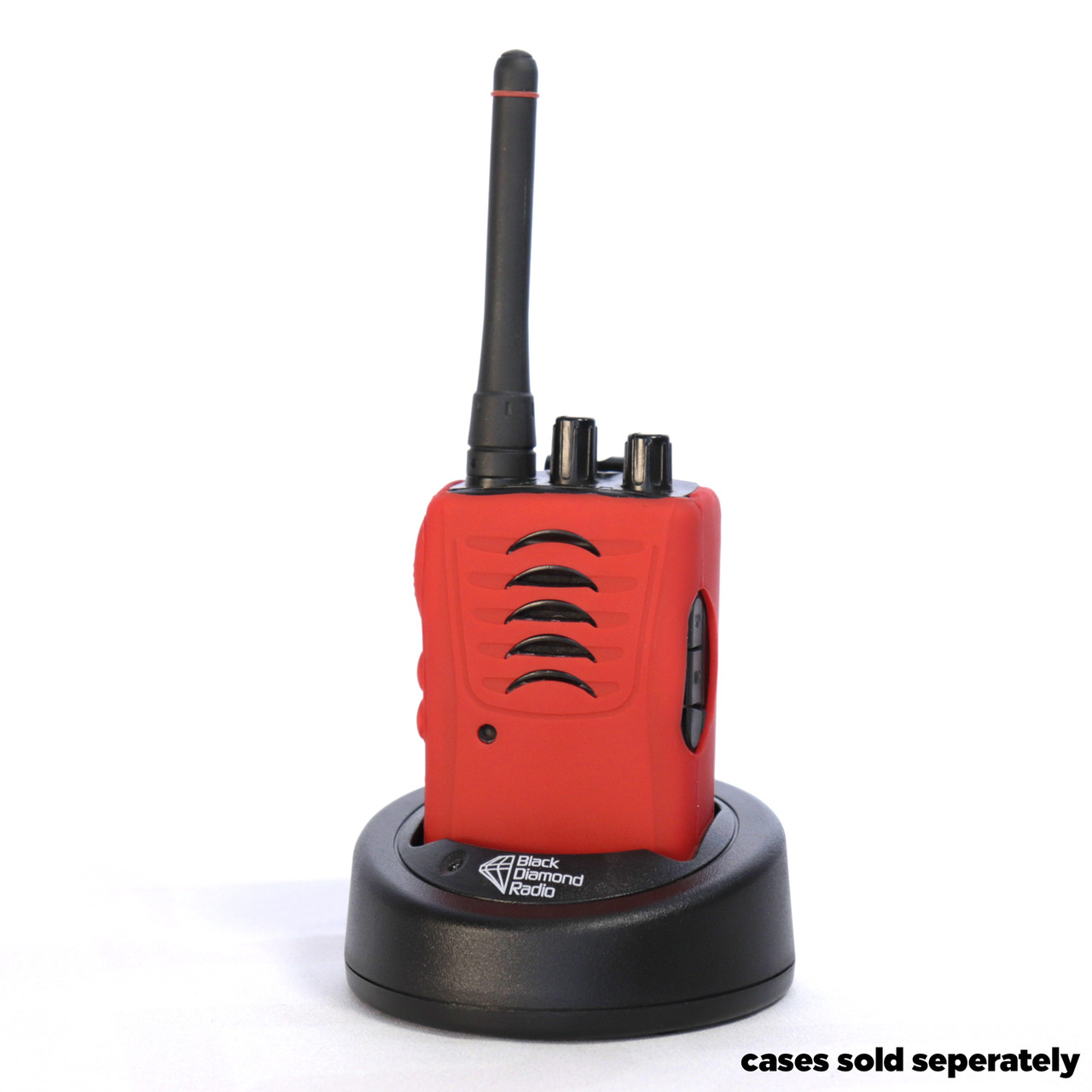
The analog CE240 and CE420 remain in the range for buyers who value simplicity or need to match an existing fleet. That coexistence matters. The company's digital radios can operate in analog mode, allowing a customer to replace hardware gradually instead of turning migration into a one-day cliff.
Then come the packages. At the August 2026 catalog snapshot, single-user kits start at $259.95, four-user systems at $899.95 and six-user systems at $1,299.95. The package is the real product: radios arrive with relevant earpieces and accessories, while a six-bank charger turns a nest of cords into one check-in point. The optional sleeves protect against drops, but their better trick is social. Give each person a color and a communal object acquires an owner.
A radio is only one-third of the system
Vertical pages, horizontal hardware
Black Diamond Radio uses largely the same radio platform across many industries, then changes the bundle and explanation. In a dental package, front-office staff can receive single-wire Concierge earpieces while clinical staff get Sentinel units whose push-to-talk button can be pressed with the inside of a wrist. That detail is designed around gloved hands. For high-noise settings, different earpieces and the D452's audio are emphasized. For security, privacy and discretion come forward. For a large facility, coverage leads toward the BD-6000 repeater, listed at $6,195.95, or a complete installation package listed at $9,995.95.
This is not bespoke hardware for every niche. It is something more repeatable: a standard platform translated into the physical grammar of each workplace. The National Dental Association's partner page says Black Diamond Radio systems are used in more than 7,000 dental practices nationwide. The same page offers members $200 off a qualifying six-user system. That partnership combines distribution, credibility and a bundle already shaped to the buyer.
A catalog that climbs with the building
The moat is a set of chores
Against Motorola Solutions, Kenwood, Hytera and a crowd of lower-cost radios, Black Diamond is not the obvious scale player. Against regional integrators, it is not the obvious local-service network. Its position is a stack of chores that larger competitors can perform but may not package with the same intimacy: configure the fleet, fit the ear, support rival connectors, pick up the phone, troubleshoot the perceived failure and own the warranty conversation.
The support policy is specific enough to be useful. Radios receive 24 months of coverage from shipment. Products carry one- or two-year warranties depending on type; earmolds get 30 days. Accidental damage can qualify, but loss cannot. A return authorization is required. Out-of-warranty troubleshooting costs $49.99, and that fee can be applied to a new radio if the old one cannot be repaired. This is generous, not magical.
The business model is equally plain. Black Diamond sells hardware directly online and by phone, earns more from complete systems and repeaters, and adds service, programming, installation and replacement parts. There is no public funding story to decorate it. The flywheel is installed hardware: once a team's channels, habits, connectors, chargers and support relationship orbit one supplier, the next radio is easier to buy from the same place.
The playbook worth stealing
First, begin with the aggravation adjacent to the obvious product. Custom Earpiece learned from ears, cables and support calls before Black Diamond Radio made the radio. Second, convert service into a named feature. “No phone menu” is operational policy turned into copy. Third, sell the whole job. The six-user dental bundle removes dozens of small decisions while still allowing the buyer to swap an earpiece or case color. Fourth, create a migration path. Analog compatibility lets customers move to digital without throwing away every old unit on Tuesday.
The dangerous lesson would be to copy the warranty without the math. Accident coverage works only if product margin, observed failure rates, fraud controls and replacement logistics can carry the promise. Direct-answer support works only while staffing matches call volume and the people answering are knowledgeable. Niche packages work only when the workflow differences are real; adding “for dentists” to a generic box is not vertical expertise.
When this approach is the wrong fit
- A dispersed fleet that needs citywide coverage, GPS dispatch or rich software integration may need a managed or trunked system.
- A team whose work is mostly asynchronous may get more value from messaging than a live shared channel.
- Complex buildings can defeat handheld range; a site survey or repeater may be necessary.
- Buyers must confirm frequency and licensing requirements for their location and use.
- The replacement promise does not help with a lost radio, an unreadable serial number or a product outside its coverage term.
The amusing thing about Black Diamond Radio is how little of its strategy depends on inventing the future. Its radios look like radios. Its customers still press a button and talk. The novelty is managerial: remove tiny points of friction from choosing, wearing, charging, fixing and replacing the device. In the workplaces it serves, that can be more valuable than one more screen.
A dead radio is a cheap object that can create an expensive ten minutes. Black Diamond Radio built its company around shortening those ten minutes. That is not a universal communications platform. It is a clear promise to a specific kind of team - and a reminder that mature markets still have room for whoever is willing to own the annoying part.