The most revealing number in Atlantic Radio Communications Corp.’s online store is not the price of a Motorola handset. It is 426 - the number of parts listed in its catalog when the site was reviewed. There were 81 portable radios. In other words, the little things that keep the big things working outnumbered the big things five to one. This is the quiet logic of a company that has survived every “the smartphone will replace it” prediction since 1990. A radio is a purchase. A working radio system is an accumulation: antenna, battery, charger, frequency, firmware, programming, coverage and a human who knows why Channel 3 has gone silent.
Atlantic Radio sits in that accumulation. The privately held Florida company distributes professional portable and vehicle-mounted radios, repeaters, base stations, callboxes, software and accessories. It also programs radios, evaluates problems remotely, handles repair intake, installs equipment and helps customers navigate FCC licensing. LinkedIn lists eight employees. The live store advertised more than 2,400 products. That ratio - a tiny team standing behind a very long shelf - is less a curiosity than the business model.
A radio dealer that sells the verbs
The nouns are familiar: Motorola, Hytera, Icom and BK Technologies. Atlantic Radio is a channel partner or authorized dealer for those manufacturers, with RCA also named in its company profile. The verbs are where it earns its place: choose, program, install, extend, repair. A buyer may know that a crew needs 20 radios. The harder questions arrive immediately. UHF or VHF? Analog or digital? Is a repeater required? Does the site need intrinsically safe hardware? Should a fleet use GPS? Can LTE push-to-talk cover several states? Will the old chargers fit the new batteries?
Atlantic Radio’s answer is a hybrid of ecommerce and service bench. New OEM products sit beside certified pre-owned gear and house-brand accessories. A customer can buy a radio like any other Shopify product, then attach configuration. Programming for a radio purchased from the store was listed at $10 per unit for up to 16 channels. Basic programming for other eligible equipment was $29 per unit. A 45-minute remote evaluation, discounted at the time of review, was $129. The services turn expertise into a visible SKU instead of burying it in a salesperson’s inbox.
What it can cost / public listings
Those numbers are examples, not a system quote. A real deployment can add chargers, spare batteries, antennas, software licenses, repeaters and labor. Returns can also bite: Atlantic Radio’s published policy applies a 20 percent restocking fee to eligible consumer returns and 30 percent to wholesale orders, while programming, software, licenses and several hygiene-sensitive accessories are nonreturnable. The practical lesson is blunt. In radio, compatibility homework is part of the price.
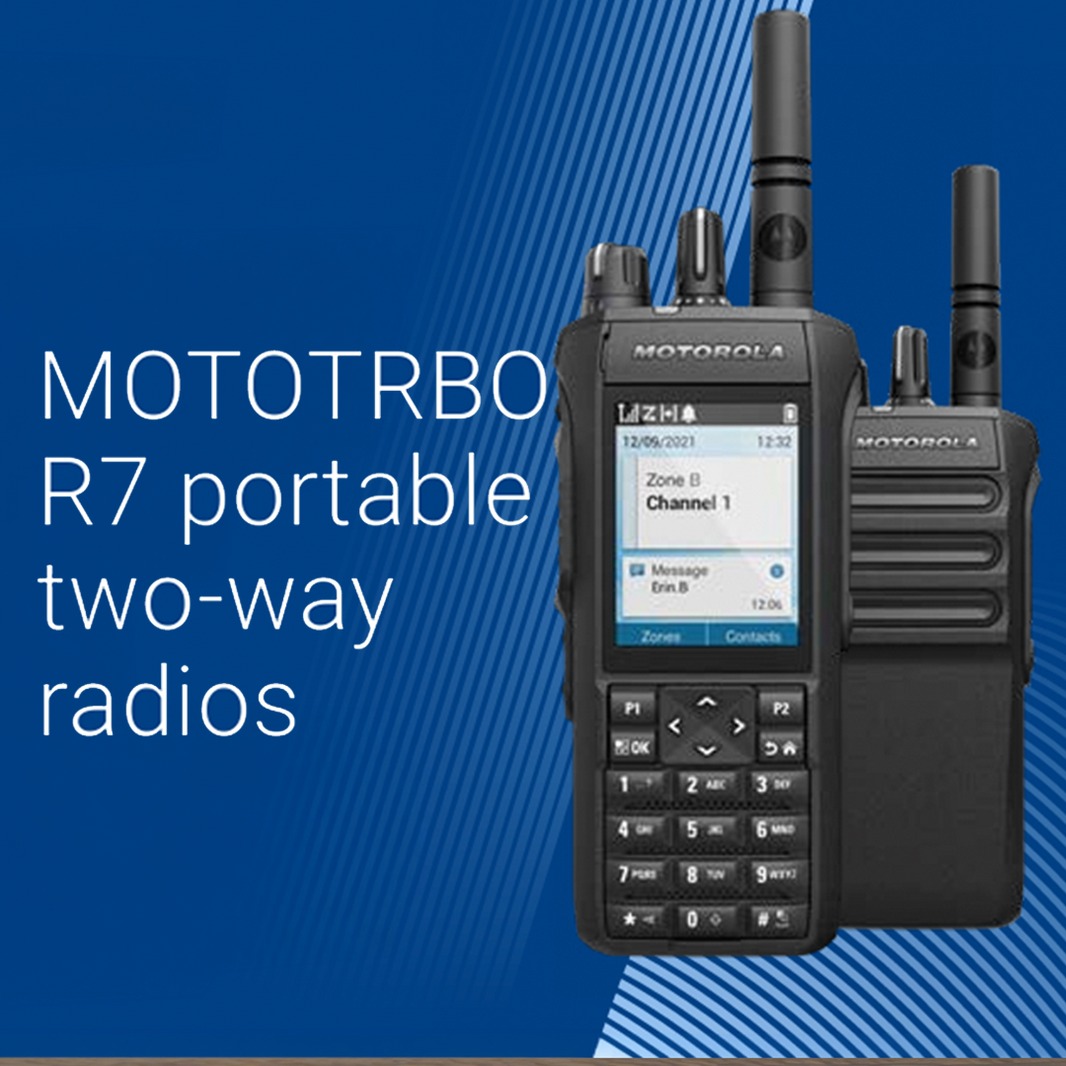
The first thing to fail is the fantasy about range
Walkie-talkie packaging loves an open horizon. Work happens inside concrete, behind machinery, between floors and around corners. Atlantic Radio’s own guides point to terrain, buildings and even weather as reception problems. That suggests the first failure in many purchases is not the device but the buyer’s mental model: a maximum-range claim is mistaken for a site survey.
This is where repeaters and system design enter. A repeater receives a signal and retransmits it, extending practical coverage. Frequency choice matters too. VHF can suit open outdoor spaces; UHF is commonly selected for buildings and urban environments, though the right answer depends on the actual site. Digital systems can add clearer edge-of-coverage audio, talk groups, encryption or location features. Push-to-talk over cellular can span wide areas using LTE and Wi-Fi. Each option repairs one weakness and introduces another condition.
One button, three kinds of reach
Conceptual, not to scale. Direct radio avoids carrier dependence; repeaters need infrastructure; PoC reach follows network coverage and service.
What changes a buyer’s mind is usually not a specification but the operating condition. A hotel manager who starts by asking for “long range” may really need dependable room-to-basement coverage. A contractor comparing handset prices may discover that an intrinsically safe rating is mandatory around hazardous material. A delivery operation may care less about a local repeater than nationwide dispatch and GPS. The company’s broad catalog - analog, DMR, NXDN, P25, satellite, LTE and Wi-Fi - is evidence that the walkie-talkie did not resist software. It absorbed it.
“A broken radio shouldn’t grind your operations to a halt.”Atlantic Radio’s case for the unglamorous service layer
Who still needs a dedicated radio?
Atlantic Radio names construction sites, factories, schools and hospitality teams. Its collections and editorial guides reach government, public safety, security, fleets, marine crews, aviation, racing, disaster response and outdoor users. The common customer is not anti-phone. The customer simply has a coordination problem that a phone handles awkwardly: one speaker needs to reach a group at once; hands may be gloved; the room may be loud; devices may be shared by shifts; dialing is too slow; cellular service may be weak; or a supervisor needs durable hardware with replaceable batteries.
The distinction from a big-box walkie-talkie seller is not that every product is exotic. Some listed Icom portables cost a little over $100. It is the ability to move up the complexity ladder without changing vendors: from a pair of handhelds to programmed fleets, mobile units, repeaters, callboxes and dispatch software. Manufacturer relationships matter because genuine accessories, warranties and software entitlement are not decorative details in a managed fleet.
The repair process makes that operational mindset visible. Atlantic Radio asks customers to submit one form for each radio, including the manufacturer, serial number and a description of the fault, and says a support representative will respond with next steps within 24 to 48 hours. That is not instant replacement theater. It is triage. In a mixed fleet, two handsets that look identical can carry different programming, firmware or warranty status. Treating each unit as its own case protects the system from a lazy fix that creates a second problem.
Where it does not work
Traditional direct radio is a poor fit when teams need effortless nationwide reach without building infrastructure. PoC is a poor fit where LTE and Wi-Fi are unreliable or where recurring network dependence is unacceptable. A specialist dealer may also be unnecessary for casual, short-range consumer use. And no configuration service can rescue the wrong frequency band, an unlicensed setup or a radio whose safety rating does not match the workplace.
The small-company playbook hiding in plain sight
Atlantic Radio does not disclose revenue, outside funding or valuation. There is no venture-capital plot twist here. Florida records show an active corporation founded on February 7, 1990; the company’s schema names Joey Gabriel as founder and president, while current state filings list Joseph A. Gabriel as president and Ashley M. Gabriel as vice president. The more useful story is how a small specialist keeps a mature category commercially alive.
Turn expert labor into a priced product. A $10 programming SKU makes “ready to use” concrete.
Batteries, clips, cables and 400-plus parts keep old fleets running and customers returning.
More than 100 practical posts answer the search queries buyers type before asking for a quote.
Repair, licensing and firmware help extend the relationship beyond checkout.
The first move to copy is productized expertise. If customers repeatedly ask for the same setup, audit or troubleshooting call, give it a name, boundary and price. The second is long-tail inventory with educational navigation. Atlantic Radio organizes not only by brand but by radio type, band, protocol and feature. The third is content that answers operational questions - battery life, reception, frequencies, privacy, emergencies - rather than merely announcing products. Marketing director Jesus Moraga’s byline appears across a steady stream of such guides in 2025 and 2026.
The model breaks when expertise cannot travel with the catalog. Thousands of SKUs become a liability if data is wrong, parts are unavailable or technicians cannot support what marketing attracts. It also struggles when buyers only compare the sticker price, when manufacturers sell direct with equivalent support, or when a platform shift makes the dealer’s installed knowledge obsolete. Atlantic Radio’s hedge is breadth: it sells the analog past, the digital present and the cellular hybrid on the same storefront.
That breadth makes the company easy to underestimate. From the outside it looks like a radio store. From the customer’s side it is closer to a translator between the job and a fragmented hardware market. The phone remains the computer in everyone’s pocket. But on a wet dock, a noisy plant floor or a school hallway during an emergency, the relevant interface may still be one oversized button. Atlantic Radio has spent 36 years making sure something useful happens when it is pressed.