A customer needed help connecting her printer. Bjorn Borstelmann was on the telephone, talking her through it. His colleague Jonas Franke came into the next room and found the co-founder of a shipping-software business doing a job that most software companies would happily leave to somebody else. The label, after all, was not much use if it never emerged from the printer.
It is a small scene, and a useful place to begin. Pirate Ship has a skull on its flag, a taste for nautical puns and a chief executive who has called himself Cap’n. Beneath the costume is a decidedly practical ambition: let somebody running a small business get a package out the door without losing the afternoon.
Borstelmann’s career has room for attached neckties, subscription boxes, postal partnerships and a Wyoming office with a powder-day policy. The connecting thread is an interest in making ordinary commerce feel less stiff. Even the paperwork is permitted a personality.
A necktie with fewer obligations
Before the shipping labels came the shirts. Borstelmann worked as creative director at Formalitees, a clothing venture whose proposition was almost a joke told in cotton: a T-shirt with a real tie attached at the neck. Formality could now travel with its own escape clause.
A design patent naming Bjorn Borstelmann as inventor was issued on October 26, 2010, for a “T-shirt with attached tie.” The application had been filed in March 2009. Here was an idea with enough cheek to be amusing and enough physical specificity to acquire a patent drawing.
In a June 2011 piece published under his name, the shirts were described as sewn in Los Angeles from organic cotton grown by Texas family farmers. The pitch mixed a product specification with a complaint about the conventional business suit and the authority it advertised. Clothes could be comfortable and still make a point.
There is an early hint of Pirate Ship in that combination. A familiar commercial ritual gets a sideways look; the result is a usable product with a grin attached. The tie stays, but the solemnity has been politely shown the door.
The boxes behind the business
Borstelmann’s next chapter brought him much closer to the problem that would occupy his working life. He joined Jesse Richardson and Jameson Morris at Conscious Box, a subscription business sending customers selections of natural products. Richardson recalls thousands of recurring customers within a year, followed by venture funding and a move to Portland.
A subscription box is an appealing object at the receiving end. At the sending end, it is a recurring appointment with logistics. Every new subscriber adds an address, a label and a parcel that must actually leave the building. Success can arrive looking remarkably like a larger administrative problem.
Borstelmann and Morris learned that problem through batches of thousands of shipments. Creating labels took too much time and money. Pirate Ship grew out of that experience and launched in 2014, carrying a very specific brief: make bulk shipping easier for the people doing it.
The early proposition was closely tied to subscription merchants. Its ambition was to let entrepreneurs handle their own shipping rather than surrender the task to cumbersome software or outside fulfillment operations. The pirate voice arrived with the practical solution. Apparently, a shipping label could be issued without demanding a funeral for the customer’s good spirits.
A pirate needs respectable partners
In June 2019, Pitney Bowes announced that Pirate Ship had integrated its Pure Post service. The arrangement gave customers access to USPS shipping services from inside their Pirate Ship accounts. An irreverent name was being supported by quite conventional infrastructure.
Borstelmann described the partnership in terms of small merchants getting access to discounts they needed to compete. He also acknowledged the dependency plainly: “We couldn’t do it without Pitney Bowes.” The announcement described the new arrangement as making it possible to serve hundreds of thousands of small shippers across the country.
That distinction matters. The announcement concerned the capacity to serve that audience, rather than a claim that every one of those customers had already signed up. It also showed what the company was trying to assemble: an approachable interface on top of a shipping network that small sellers could not reproduce themselves.
Today the product offers discounted UPS and USPS labels, with no monthly software fee. Customers can import orders, compare available services and print labels. The package still travels with the carrier. Borstelmann’s business sits at the point where the seller needs to choose, pay and get on with the rest of the day.
The costume has a job to do
There is a temptation to treat the pirates as decorative. Borstelmann’s comments suggest a more deliberate design decision. The industry felt dull to him, and he saw an opportunity to make an unavoidable chore enjoyable. The name supplies both a character and a description of the task.
The commitment travels beyond the logo. Customer-service employees have been trained in pirate speech. Job titles and recruitment copy join the joke. A fraud role has been advertised as Senior Dubloon Defender; the brand’s custom typeface is called ARRrrrial. Somewhere, a very serious brand committee is missing an enjoyable afternoon.
Those details make the experience recognisable across encounters. A recruitment listing and a support conversation sound as though they belong to the same business. The customer who arrives for a lower postage bill encounters people who have been given permission to be amusing.
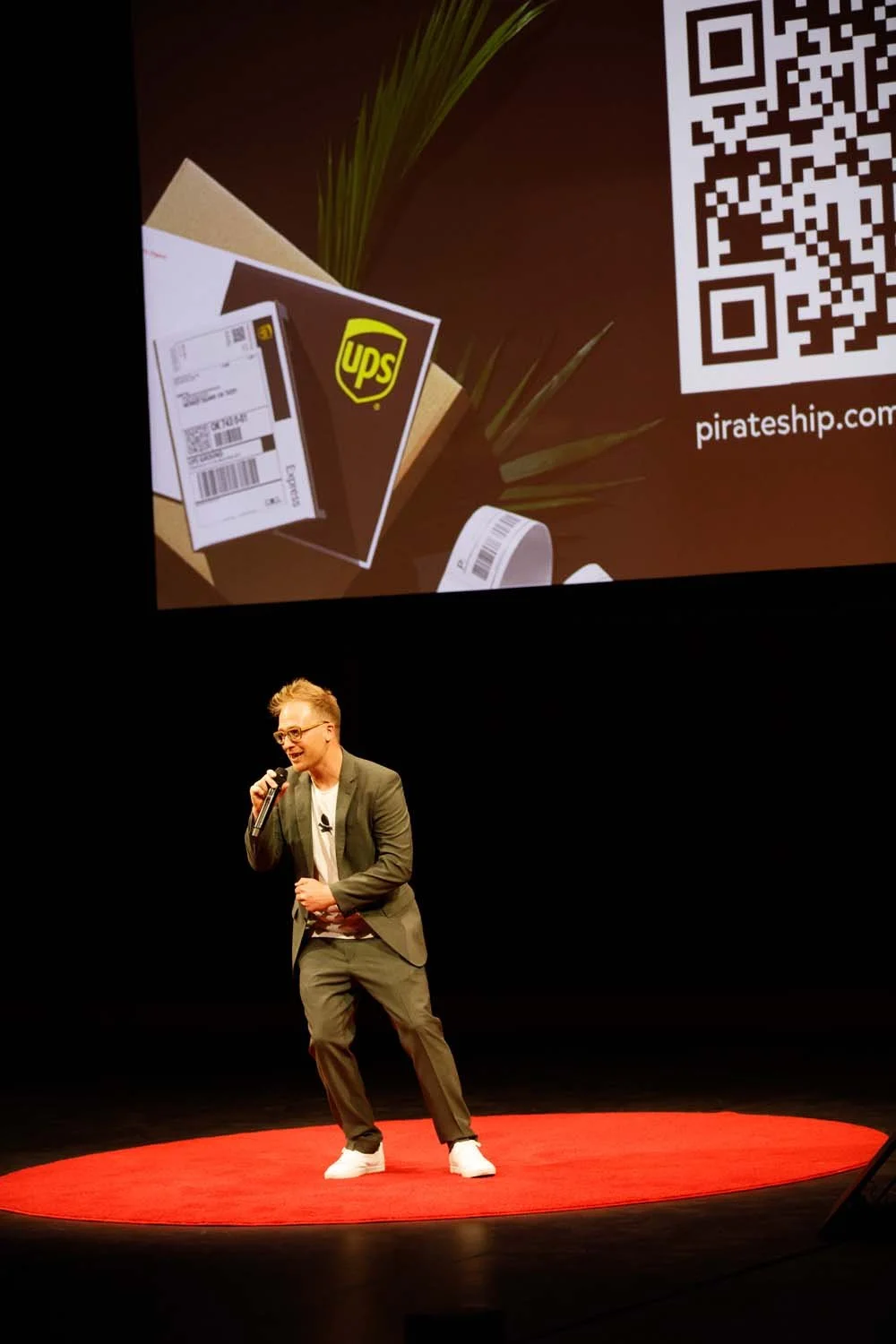
Humour, of course, cannot carry a parcel. The useful tension in Pirate Ship is that the joke must be backed by a functioning service. Its published values include fairness, empathy and reliability. The last of those supplies the necessary discipline: customers still need their labels, however entertaining the greeting.
What happens after the customer clicks?
In 2020, Borstelmann set out his view of digital experience in unusually everyday terms. Teams should consider whether someone unfamiliar with the business can understand it, whether the process produces frustration, and where unexpected obstacles appear. Measurement helps reveal patterns, but the customer’s experience remains the object of the exercise.
His test was whether a customer stops midway to wonder, “I wonder what I need to do next.” It is a modest-sounding standard with demanding consequences. Every screen has to explain the next action. Every policy can either help the person finish or introduce another hesitation.
“I wonder what I need to do next.”
The customer question Borstelmann wants a digital experience to prevent
Read alongside the printer story, that view becomes rather concrete. A business can produce software that works within its own boundaries while the customer remains stuck outside them. Helping with the printer extends the definition of a successful transaction all the way to the printed label.
Friends, two countries and a growing crew
Franke’s account of the early company adds another detail: music helped bring the collaborators together. Friendship and shared projects preceded the shipping business. Work crossed the Atlantic, with engineering in Hamburg and business responsibilities in the United States.
That arrangement depended on trust and clear responsibilities. It also developed gradually, with the project running alongside other work in its early years. This was a business people grew into, rather than an organisation that arrived fully equipped with departments on its first morning.
In April 2026, Franke described a company of more than 150 people, with six product teams in Hamburg and millions of active users. He also described the challenge of changing the organisation as it grew. Close coordination among a few founders had to give way to ways of working that more people could understand and use.
There is a less cheerful chapter in the ownership history. In 2024, Morris sued Borstelmann over the sale of his stake in 2019. He alleged that information had been withheld and that he had sold under duress. Attorneys for the defendants challenged his claims in a motion to dismiss, describing them as vague and as seller’s remorse. Those were contested positions, rather than established findings. The dispute belongs alongside the origin story, which involved more people than its best-known captain.
Six inches of snow changes the morning
Borstelmann was born and raised in Alta, Wyoming, and is based in Jackson. Pirate Ship’s headquarters embraces its mountain setting as enthusiastically as its seafaring theme. The company has a powder clause: after more than six inches of snowfall, employees are encouraged to ski before beginning work.
A shipping-software company headquartered far from the sea can afford a little geographical independence. Its Jackson office has a ship-themed setting and a tiki bar; colleagues greet one another with “Ahoy!” The published culture makes space for play while asking employees to look after customers.
The local connection also has a practical expression. Pirate Ship supports community organisations and events, including Silicon Couloir, Old Bill’s Fun Run and the Tin Cup Challenge. Its staff have volunteered with Hole Food Rescue. Creating opportunities in the Teton region is part of the company’s stated commitment.
The eighth attempt
At Silicon Couloir’s 2024 Pitch Day, Borstelmann offered aspiring founders a useful correction to the tidy success story. Pirate Ship, he said, was his eighth attempt at a business. Mistakes and uncertainty had accompanied the journey.
“It feels like every failure that I made led me to where I am today.”
Bjorn Borstelmann, at Pitch Day in 2024
The remark leaves room for the ventures that did not become the main event. An attached tie, a recurring box and a difficult batch of labels can each teach something different. Looking back, a career acquires continuity that may have been considerably harder to spot while living it.
Borstelmann’s stated aim remains easy to understand: make shipping affordable, understandable and fun for small businesses. The pirate vocabulary gives the company its voice. The customer with the uncooperative printer gives it a test. Somewhere between the two is the work.