An offer to buy your company is a flattering interruption. Someone has examined the work, the customers, the people and the prospects, and decided to put a price on the lot. For Bin Yu, founder of Houston utility technology consultancy Utegration, an unsolicited approach brought precisely that moment. He and his fellow owners declined it. A buyer had arrived; they still had questions about the future.
Working with advisers at GulfStar, Yu and co-owners David Head, Eric Polnau and Alan Tan weighed their options. They wanted to retain an interest in the business and protect a culture they had spent years developing. Employee opportunity mattered in the deliberations. After a pause, the company went to market in May 2016 and completed a majority recapitalization with RLH that October.
That sequence offers an unusually useful introduction to a founder. Building a business demands decisions about what to pursue. A transaction demands decisions about what to carry forward. A company can survive a change in ownership while becoming a very different place to work. The fine print, in other words, includes people.
A grandmother, a mirror, a question
Long before the transaction, there was a boy in Beijing whose ideas about his future changed frequently. His grandmother asked him to look in a mirror and consider what he expected of the person looking back. His answer concerned honesty, integrity and being trustworthy. It was a modest set of ambitions, if measured by the number of job titles involved. Measured by the difficulty of keeping them, rather less modest.
When he started Utegration, Yu returned to the idea of a company as a reflection of its founder. The childhood anecdote is appealing because it gives an otherwise abstract word, values, a physical object. A mirror is harder to delegate than a presentation.
The question also travels well. In a consulting firm, customers encounter the company through the judgment of individual employees. A founder’s convictions acquire practical meaning through recruitment, responsibility and the way colleagues treat one another. The reflection becomes collective. That is an editorial reading of Yu’s story, but it explains why his early lesson belongs alongside the later ownership decisions.
The apprenticeship before the letterhead
Yu’s education crossed two countries. He completed his undergraduate degree at Beijing Polytechnic University in 1991 and earned a master’s in management information systems at Texas A&M’s Mays Business School in 1997. Before establishing Utegration in August 2008, he worked at Deloitte Consulting and SAP America, where he led the US utilities professional services practice.
The order matters. His company grew out of experience inside the field it would serve. Utilities need technology that can accommodate their operations, customers and obligations. Knowing the software is one qualification; understanding the customer’s business is another. Yu’s professional background brought those concerns into the same room.
His move from China to the United States also involved learning how to operate in another business culture. In 2016, he described adaptation and practical communication as challenges for immigrants. His observation was specific: communication extends beyond speaking a language. The remark makes room for a less theatrical account of entrepreneurship, one that includes learning how other people expect work to get done.
A business behind the bill
Utegration’s territory was the machinery behind utility service: consulting and implementing SAP systems for electricity, gas and water providers. At the time of the 2016 transaction, its work included customer and billing systems, business intelligence, advanced metering and enterprise asset management. These are subjects that rarely acquire a glamorous wardrobe. They do, however, have a habit of appearing in everyday life.
A bill is a small document carrying a considerable amount of organizational effort. Customer records, consumption information and financial processes have to meet somewhere. Utegration worked in that territory, helping utilities with the technology underlying service and operations. Yu’s commercial choice was to build expertise around an industry with particular requirements.
“Our clients are our first priority,” he said when the recapitalization was announced. He described a changing power grid and the need to help utilities respond. The proposition placed the firm within a longer transition in how energy providers use information. A specialist consultancy sells expertise, but its customer ultimately needs something more concrete: work that helps the business function.
The setting helps explain the value of continuity. A utility technology project connects specialists who understand software with people who understand the operation it serves. Relationships carry working knowledge: which questions to ask, where decisions sit, what a customer means by a successful result. For a consultancy, the team is part of the service being purchased. Keeping room for people to develop has a commercial logic as well as a human one.
Growth, with the dates attached
The company’s progress appeared in several different kinds of recognition. Utegration received Aggie 100 awards in 2014 and 2015. The Texas A&M alumni publication’s 2015 table places it at number 80. Beside the company’s name sits Yu’s class year, ’97, connecting a Houston employer to the university where its founder studied.
An alumni list is a particular sort of business portrait. It records the enterprise and the person in adjacent columns. That arrangement suits this story: the company grew beyond its founder, while remaining connected to the educational and professional relationships that helped form him.
Later recognition broadened the picture. The Asian Chamber’s 2024 account of Yu’s career noted CenterPoint Energy’s Supplier of the Year award in 2016 and workplace recognition in 2016, 2019 and 2020. Commercial work and the experience of employees were being noticed in different places. Neither category tells the whole story of a company. Together, they ask more useful questions than size alone.
“We will continue to keep our strong company culture.”
Bin Yu, announcing the CEO transition, 2018
A founder changes his chair
On October 12, 2018, Yu announced to employees gathered in San Antonio that Bart Thielbar would become CEO, effective immediately. Yu would serve as chairman and concentrate on company strategy. The distinction matters in his biography: he was chief executive during the 2016 recapitalization, and the leadership arrangement changed two years later.
“We will continue to keep our strong company culture,” Yu said in the announcement. His explanation connected the leadership change to the company’s next phase of growth. Thielbar, he said, understood its culture, capabilities and approach to the market.
A founder’s name can become so closely attached to a business that every subsequent event is told as a solo performance. This handover deserves its own place in the account. Strategy and daily leadership became separate responsibilities. The company had another executive leading it, and Yu had chosen a role focused on its direction.
The public announcement also made the transition visible to employees at a company meeting. That detail gives an organizational event a human scale. There was a gathering, a new allocation of responsibilities and a statement about the culture the leaders intended to keep. Corporate histories often race from founding to acquisition. Taking a moment over the handover lets the people inside the organization enter the frame.
Houston puts it on the calendar
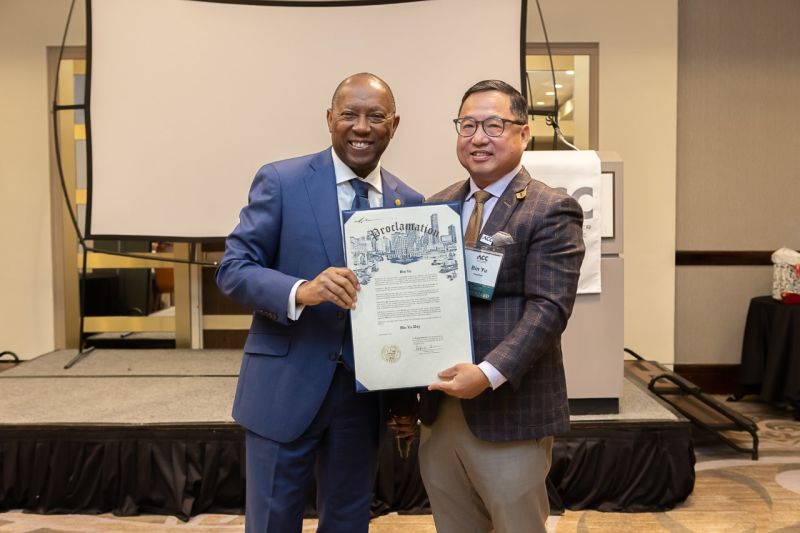
On December 2, 2021, Houston recognized Bin Yu Day. In a company post celebrating the proclamation by Mayor Sylvester Turner, Utegration connected the honor to Yu’s contribution to the local business community and his interest in opening entrepreneurial opportunities for young professionals. A day bearing your name is a pleasingly literal addition to a busy calendar.
His civic work had an institutional home as well. Yu chaired Houston’s Asian Chamber of Commerce from 2019 to 2021. The chamber had named him Entrepreneur of the Year in 2013. Those roles place him within a community of businesses and founders, beyond the clients of his own firm.
In 2021, the International Leadership Foundation also recognized him with an enterprise leadership award for efforts to create opportunities for young Asian professionals. The theme recurs across his business and civic biography: helping people at the beginning of their working lives find a way forward.
The company carries on
Cognizant announced its agreement to acquire Utegration on December 7, 2022. At that point, the consultancy served more than 50 energy and utility clients in North America. Its portfolio included Utility4U, MeterData4U, Finance4U and LoadPlanning4U. Thielbar, then president and CEO, spoke for Utegration about the combination.
The acquisition became effective on December 19, 2022, with completion announced on January 4, 2023. Approximately 350 employees across North America and India joined Cognizant through the purchase. The business Yu had founded in Houston was entering a larger organization, carrying its industry specialization with it.
That later sale gives the earlier decision to wait a clear place in the chronology. There were six years between the recapitalization and the Cognizant acquisition, with a CEO succession in between. Ownership, leadership and scale changed at different moments. Treating them as separate events helps preserve the actual shape of the story.
Yu’s public work continued beyond those corporate milestones. In September 2024, Houston’s Asian Chamber announced him as the inaugural speaker for its Executive Business Program, with strategic planning as his subject. The invitation brought an experienced founder back before people working on their own business decisions.
It is a fitting subject for him. His career contains technical apprenticeship, company formation, outside investment, succession and civic service. The interesting thread is the set of choices running through them. A grandmother’s question concerned the person in the mirror. Years later, the consequences extended to colleagues, customers and a city’s next generation of entrepreneurs.
Follow the connections
Explore the company, Yu’s public profile and the milestones behind this story.
- Bin Yu on LinkedIn ↗
- National ACE Foundation biography ↗
- The childhood mirror anecdote ↗
- The 2016 recapitalization ↗
- The 2018 leadership handover ↗
- Houston’s Bin Yu Day proclamation ↗
- Cognizant’s acquisition announcement ↗
- The Asian Chamber’s Executive Business Program ↗
- Utegration ↗
- Watch: 2021 ILF Leadership and Business Conference ↗ (conference replay)