The company existed for about two weeks before it legally existed. Siavash Mahmoudian had been building community software as a side project in Toronto when two of his oldest friends, Mohsen Malayeri and Soheil Alavi, landed in Canada around the same time he did. They looked at what he had made, started showing it to people, and came back with a problem most founders would trade a kidney for: customers wanted to pay roughly $300 a month, and there was no bank account to put the money in.
That was 2018. The company was called Tribe then. Eight years later it is called Bettermode, it runs customer communities for IBM, Lenovo, Webflow, HubSpot, DeepL and Logitech, and its entry price is $399 a month - which is to say, almost exactly what those first customers offered, except now it is the floor rather than the ceiling.
Bettermode sells one thing, and it is a thing most companies do not realise they are already buying in pieces. If you run a software business, you probably have a help center from one vendor, a feedback board from another, a Slack or Discord where your power users hang out, a changelog stapled onto your marketing site, and a support inbox absorbing the questions all of those failed to answer. Bettermode's argument is that these are not five products. They are five views of the same thing - your customers talking, to you and to each other - and they belong on one domain that you own.
The Product
Spaces, not modules
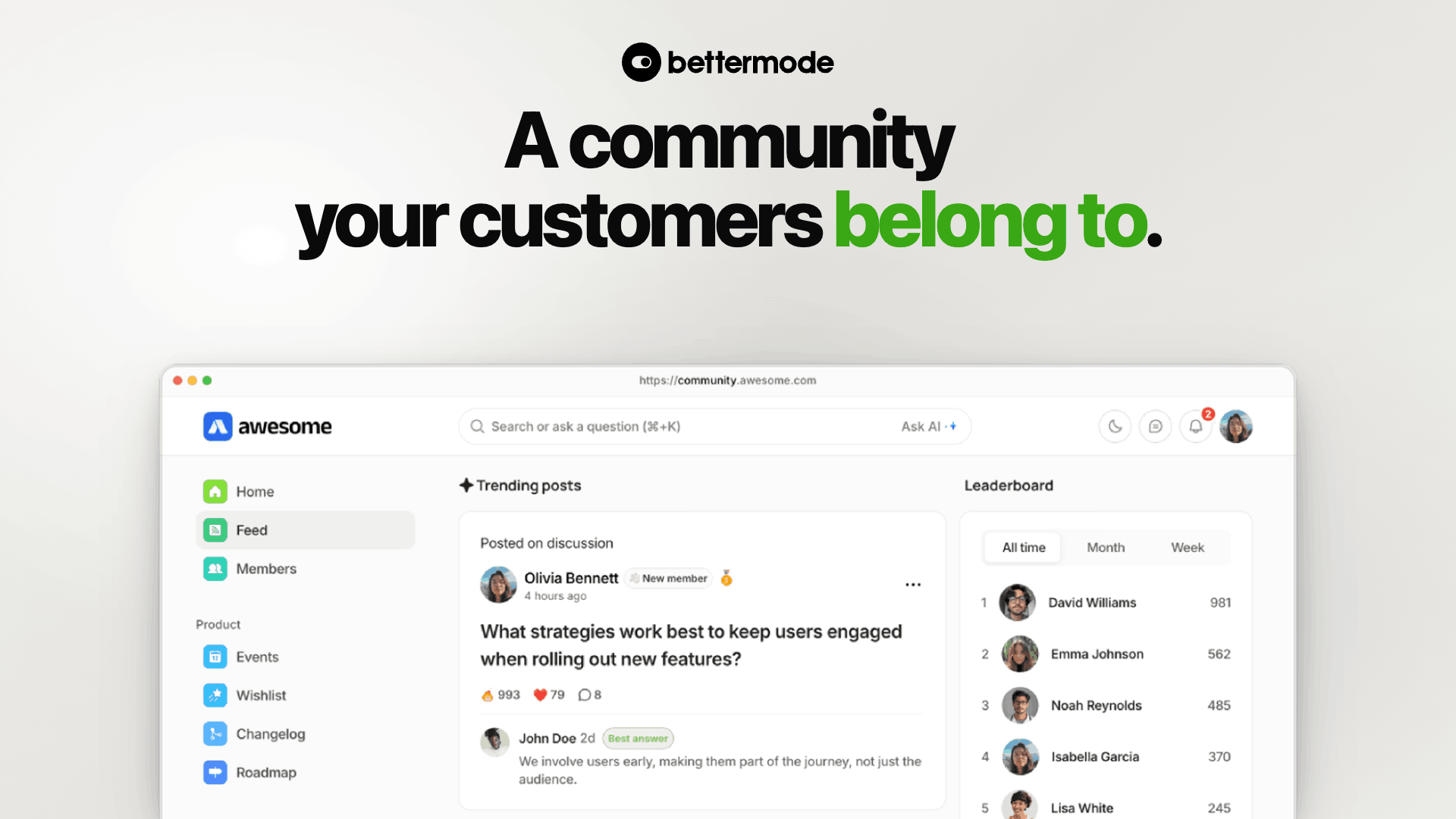
The unit of construction in Bettermode is a "space." A space can be a discussion forum, a Q&A board, an events calendar, a knowledge base article set, a poll, a wishlist where customers vote on features, or a changelog. Twenty-plus templates ship in the box, including some that stretch the definition of community software - job boards, landing pages, document pages. You assemble spaces the way you would assemble slides, and the whole thing lives at community.yourbrand.com with your typography, your colours, and no vendor badge in the corner if you are paying enough.
The building happens in Design Studio, a block-based visual editor. This is where the "no code" claim earns or loses its keep, and Bettermode's version is more generous than most: layouts, themes, dark mode, custom blocks, and a CMS for teams that want structured content types. A marketing manager can genuinely stand up a working community in an afternoon.
Underneath the drag-and-drop is a stack that does not condescend to engineers. There is a GraphQL API, webhooks, a React SDK, a Liquid templating layer, a CLI and a developer portal for building custom apps. Bettermode also open-sourced its integration apps - Slack, Discord, Mailchimp, Microsoft Teams, Google Analytics, Mixpanel, Google Tag Manager - along with a starter app template covering database, frontend, backend and webhooks. The org on GitHub is still called tribeplatform, a small artefact of the old name that nobody has bothered to fix.
We believe any business should be able to build something similar to Facebook, LinkedIn, or Clubhouse for their brand in a few clicks. Siavash Mahmoudian, co-founder
The Buyer
Who actually signs the cheque
Bettermode's customers are mid-market and enterprise software companies, and the buyer is usually one of three people: a customer success leader watching ticket volume outrun headcount, a marketing lead who has been told to build "advocacy" and does not want to do it on a Facebook Group, or a product manager drowning in feature requests scattered across six inboxes.
The published case studies read like a cross-section of modern SaaS - ConvertKit, CoachHub, Proposify, Klaus, Runna, FlutterFlow, Protegrity, plus the children's audio player company Yoto, which is a pleasant reminder that not everything is B2B software. In the Tribe era the logo wall included Pipedrive, ASUS and Prudential Financial. Customer count grew roughly 400% year over year around 2020; the company has not published an aggregate figure since.
The economics they sell on are unglamorous and durable. A customer posts a question at eleven at night. Another customer - one who solved that exact problem last month - answers it, better than the support macro would have. Nobody was paid, no ticket was opened, and the answer is now indexed and searchable for the next person. Multiply that by a few thousand and you have the case for community, which is less about belonging than about compounding documentation written by the people who actually use your product.
Pricing, 2026
Bettermode retired its Free / Pro / Advanced / Enterprise lineup in early 2026. Bars are scaled to member ceilings; the labels carry the price.
Annual billing saves up to 16%. Growth unlocks AI search, API and webhooks, and removes Bettermode branding. Premium adds SOC 2, SAML, JWT, a 99.9% uptime SLA, 90-day audit logs and a dedicated CSM.
That pricing table is itself a statement. Killing a free plan is the kind of decision that makes founders flinch - free tiers feel like growth. Often they are a tax paid in support hours and roadmap pressure from people who will never buy. Setting the floor at $399 says, plainly, that this is a tool for companies with a budget line for customer experience, not for hobbyists running a Discord. The 2026 announcement handled the transition the way you would want: existing Pro customers grandfathered as "Pro - Legacy," nothing changing until renewal.
Your community will continue to work exactly as it does today. You'll keep access to all the features you currently use, and nothing changes until your next renewal. Mo Malayeri, co-founder & CEO, on the 2026 repricing
The Market
The seam nobody wanted
Community software splits neatly into two unhappy halves. On one side sit the enterprise incumbents - Khoros, Higher Logic, Vanilla Forums, Gainsight's customer community product - which are powerful, expensive, and generally require a services engagement and a couple of quarters before anyone posts anything. On the other side sit the fast, cheap, consumer-flavoured tools - Circle, Mighty Networks, Discourse, and the perennial defaults of Discord and Slack - which get you live before lunch and leave you looking like every other community on the internet, on infrastructure you do not control.
| Approach | Time to launch | The catch |
|---|---|---|
| Enterprise suites | Months, with services | Cost and inertia; the platform outlives the champion who bought it |
| Slack / Discord | Minutes | Nothing is indexed, nothing is owned, answers vanish upward |
| Consumer community tools | Hours | Limited branding, limited API, awkward under a security review |
| Bettermode | A day, no code | Priced for companies, not individuals |
Bettermode parked itself in the seam: launch in a day, look like your own product, survive a SOC 2 review. That last part matters more than it sounds. SOC 2 Type II, SAML, JWT, OAuth2, audit logs and an uptime SLA are what let a company of roughly thirty people put IBM and Lenovo on its homepage. Enterprise readiness is not a feature; it is a permission slip.
The Technology
The AI decision that costs money
In March 2025 Bettermode shipped AI-powered search and an "Ask AI" mode - multilingual, permission-aware, so it will not surface a private space to someone who should not see it. The interesting part is not the feature. It is what is running underneath.
Bettermode does not call OpenAI, Google or Anthropic. It runs open-source models on its own infrastructure, and it said so publicly and specifically, framing the choice around GDPR and data privacy. For a thirty-person company, this is an expensive posture. Self-hosting inference means GPUs, evaluation work, and owning your own quality problems instead of inheriting a frontier lab's.
It also makes the enterprise conversation shorter. When your customers include a European translation company and a global hardware manufacturer, "where does our members' data go" is not a curiosity - it is the question that stalls the deal. Bettermode answered it by making the expensive engineering choice the cheap sales choice. Whether that holds as frontier models pull further ahead is a genuinely open question, and one worth watching.
The People
Three immigrations, one company
The founding team is worth a paragraph on its own. All three are Iranian immigrants to Canada, and all three had built things before. Mahmoudian started his first company at seventeen - an AI-powered expert-matching chatbot - and later co-founded Breezio, community software used by NASA and the State of Maryland. Malayeri founded Avatech, a startup accelerator in the Middle East, and co-founded Anetwork, the largest digital advertising network in the Farsi-speaking world. Alavi, the product designer of the three, had previously built Reyhoon, an online food-ordering service in Tehran.
They were friends first and colleagues second, which is either the best or worst way to start a company and in this case appears to have been the former. In 2021 they acqui-hired the founders of pe•ple, a New York community startup, and put its engineers on rebuilding the platform experience. In late 2022 they rebranded from Tribe to Bettermode - a change that looked cosmetic and was not. Tribe sold "build a community." Bettermode sells "consolidate your forum, help center, feedback board and changelog into one hub." Same codebase, different buyer, different budget.
Then in 2023, Mahmoudian stepped away and Malayeri took the CEO seat. There was no thread about it. No press release. The company kept shipping. In an industry that treats founder transitions as either scandal or coronation, the absence of noise reads as its own kind of signal.
Tribe is foundedA side project becomes a company after paying customers appear within two weeks.
$7.5M seedBessemer Venture Partners and CRV co-lead, with Inovia Capital, Golden Ventures and Path Ventures.
Acqui-hire and developer platformThe pe•ple founding engineers join; GraphQL API, webhooks and open-source apps ship.
Tribe becomes BettermodeA full rebrand repositions the product as an all-in-one customer community platform.
Founder-to-founder handoffMo Malayeri takes over as CEO from co-founder Siavash Mahmoudian.
Ask AI arrivesPermission-aware conversational search launches on self-hosted open-source models.
Pricing resetStarter, Growth and Premium replace the old four-tier lineup; the dashboard is rebuilt.
The Verdict
What you can take from it
Bettermode has raised $7.5 million, once, in 2020. There has been no Series A, no acquisition, no layoff announcement. In a cohort where most seed-stage companies from 2020 have either raised three more rounds or quietly disappeared, staying roughly thirty people and selling $18,000 annual contracts to IBM is a third path that gets discussed less than it should.
The reviews suggest customers notice. G2 puts it at 4.6 out of 5 across 118 reviews with a 9.2 quality-of-support score, and the badges it displays - "Easiest to Use," "Best Support" - are the ones a small team can actually win against larger incumbents. Bettermode also runs its own public community, the Bettermode Hub, on its own product, and posts product updates and pricing announcements there rather than on a blog. It is the kind of dogfooding that is easy to claim and awkward to fake.
Building an online community is less about technology and more about creating a network and sense of belonging. Siavash Mahmoudian, co-founder
For anyone evaluating the category, the useful takeaway is not which vendor wins. It is the framing. If your customers' questions, answers, feature requests and enthusiasm currently live on a platform you do not control, you do not own that relationship - you are renting it, and the landlord changes the terms without asking. Bettermode built a business on that sentence. The sentence is true whether or not you buy the software.
Bettermode: where to look next
- Website — bettermode.com
- Pricing & plans
- Product overview
- Customer case studies
- Bettermode Hub (their own community)
- X / Twitter
- YouTube
- GitHub — tribeplatform
- Product Hunt
- G2 reviews
- Crunchbase
- BetaKit — the $7.5M seed round
- Inovia Capital — portfolio page