Bettermode Wants Your Customers to Belong, Not Just Log In
Toronto's Bettermode - the platform once known as Tribe - is betting that the answer to churn isn't another support ticket, but a place where customers actually want to hang around.
Ask a SaaS company why customers leave and you'll get a dashboard. Seat count down here, usage flat there, an NPS survey nobody read. Bettermode, a Toronto company that spent its first four years as Tribe, starts from a less tidy premise: people rarely abandon a place where they feel they belong. Build that place, the argument goes, and the churn metric fixes itself as a side effect.
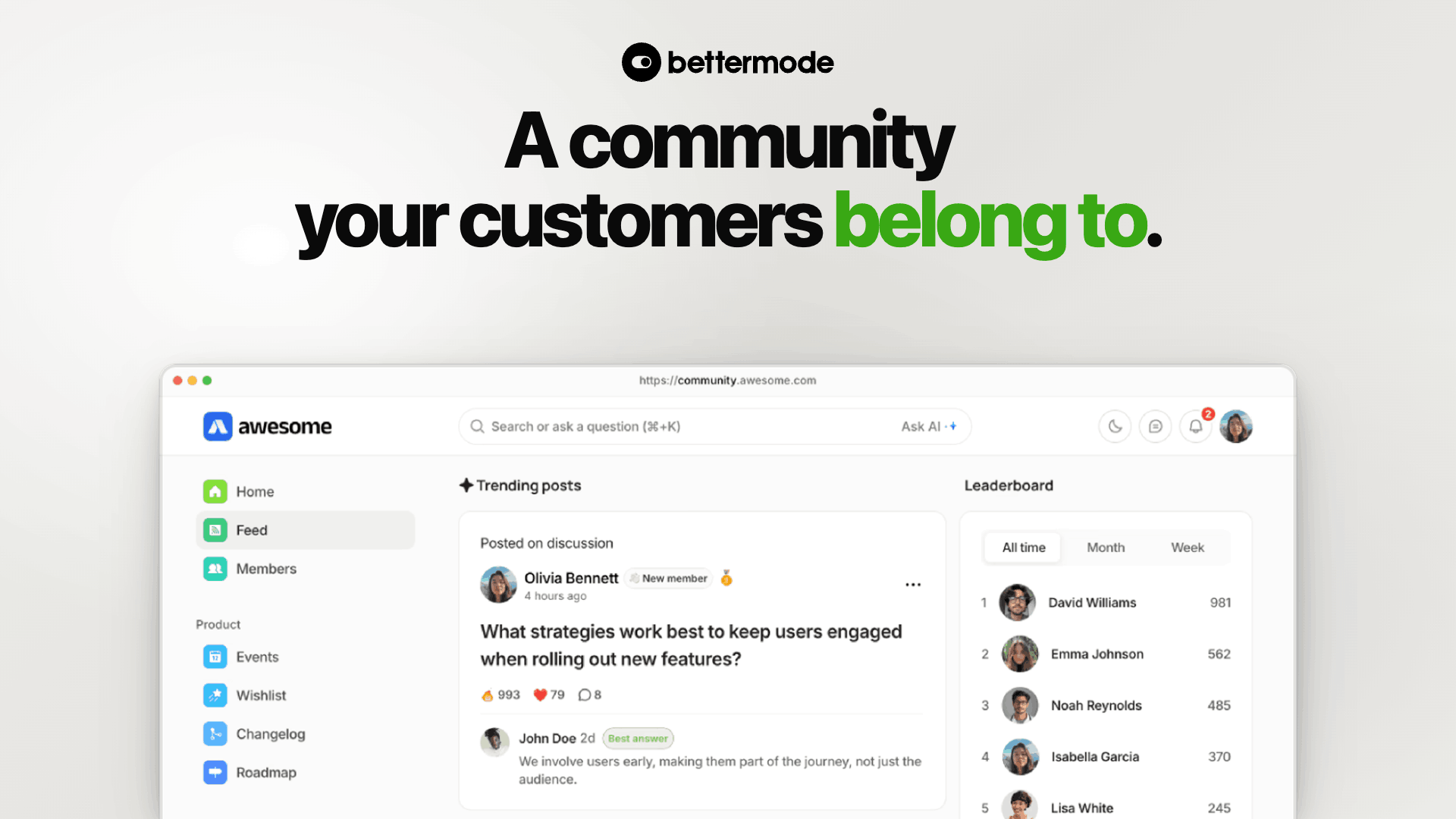
That's the whole thesis behind Bettermode, an all-in-one customer community platform. It gives a brand the pieces to stand up a branded space - discussions, a Q&A board, a help center, events, member groups - and stitch them into the product customers already use. The pitch to the buyer is blunt: turn engagement into measurable retention and growth, and do it without booking an engineering sprint to get there.
From Tribe to Bettermode
The company was founded in 2018 as Tribe Technologies by three co-founders - Siavash Mahmoudian, Soheil Alavi, and Mohsen Malayeri. Mahmoudian, the CEO, started programming young and had already co-founded another community tool, Breezio, before this one. Alavi's route was stranger: he had built Reyhoon, an online food-ordering service in Tehran, before landing in community software. Malayeri had spent years seeding the startup scene across the MENA region, including the Avatech accelerator. Three different on-ramps, one shared interest in how groups of people organize themselves online.
In late 2020 the company - still Tribe - raised a $7.5 million seed round co-led by Bessemer Venture Partners and CRV, with Inovia Capital and a long list of others along for it. Two years later came the rename. On paper a rebrand from "Tribe" to "Bettermode" looks cosmetic. Read it more closely and it's a correction. A tribe names the crowd. Belonging describes what the crowd is supposed to feel. The new name pointed the product at the outcome instead of the container.
Launch fast with no code and turn engagement into measurable retention and growth. Bettermode's own framing of the product
The no-code wedge
Community software is not a new category. Khoros, AnswerHub, and Personify have sold enterprise communities for years, and there's a reason big companies bought them. But that generation of tools carried a hidden tax: they were resource-heavy, often requiring a dedicated engineering budget just to customize a page or wire up an integration. G2 reviewers report legacy suites can run well past $100,000 a year once you count the people needed to run them.
Bettermode's wedge is subtraction. Its no-code Design Studio lets a marketer or a customer-success lead assemble and brand a community by dragging blocks around, not filing tickets. Native integrations with Salesforce, HubSpot, Intercom, and Segment come out of the box. There's a mobile app, dark mode, a reputation system, and SOC 2 Type II plus GDPR compliance for the security review that inevitably follows. The point is not that Bettermode does more than the old guard. It's that a small team can ship something on Friday that used to require a quarter.
The pricing gap Bettermode is aiming at
Why the logos matter
A no-code tool is easy to dismiss as a toy until you look at who's using it. Bettermode reports customers including IBM, HubSpot, Webflow, Lenovo, DeepL, ASUS, and ConvertKit. IBM and HubSpot do not adopt community software casually; both have procurement processes designed to say no. When companies like that put a customer community on a lighter platform, it suggests the trade-off - less bespoke engineering, faster to run - is one enterprises are increasingly willing to make.
There's a strategic reason those relationships tend to stick, too. Once a community lives inside your product - years of threads, answers, member reputation, and events - migrating it somewhere else is miserable. The switching cost isn't a contract clause. It's the accumulated history nobody wants to abandon. For Bettermode, every community that grows is a moat that grows with it.
The best support ticket is the one a community answered before your team ever saw it. The deflection logic behind customer communities
What you can actually do with it
Strip away the category talk and the practical use is straightforward. A software company can take its most repetitive support questions and turn them into a public Q&A space, then let power users answer them - which quietly lowers the volume hitting the support queue. A product team can run a feedback and roadmap space where customers argue about what to build next, instead of that conversation happening on someone else's platform. A marketing team can host events and launches in a branded home rather than renting attention on social media.
The steal-this version, for anyone not buying Bettermode: your busiest support tickets are a content strategy in disguise. Publish them, let your best customers answer, and reward the answerers with visible status. Deflection goes up, and the people who help become more loyal, not less. Bettermode simply productized that loop and made it launchable in an afternoon.
The road so far
The honest caveats
None of this makes community a magic retention switch. A branded space with no one in it is worse than no space at all, and the hard part of any community isn't the software - it's the first few months of showing up, seeding conversations, and answering into a room that feels empty. Bettermode sells the tooling; the belonging still has to be earned. And the category is crowded, with newer, lighter entrants like Gradual and event-first tools circling the same buyers from different angles.
Still, the underlying bet is a sturdy one. Retention compounds. A community you stand up this year keeps deflecting tickets and renewing customers for years, without the ongoing spend that ads and outbound demand. In a market where every SaaS company is staring at the same churn dashboard, "build a place people want to come back to" is an old idea that keeps paying. Bettermode's contribution is making that place cheap and fast enough that a marketing team, not just an engineering org, can build it.
FAQs
What is Bettermode?
Bettermode is an all-in-one customer community platform that lets brands build branded discussion, Q&A, help center, event, and group spaces without writing code, aimed at driving engagement and retention.
Was Bettermode called something else before?
Yes. It launched in 2018 as Tribe (Tribe Technologies) and rebranded to Bettermode in 2022.
Who founded Bettermode?
It was co-founded in Toronto by Siavash Mahmoudian (CEO), Soheil Alavi, and Mohsen Malayeri.
How is Bettermode different from Khoros or AnswerHub?
Bettermode positions itself as a no-code, lower-cost alternative that marketing and customer success teams can run without dedicated engineering resources, whereas legacy platforms often require significant technical investment.
Which companies use Bettermode?
Reported customers include IBM, HubSpot, Webflow, Lenovo, DeepL, ASUS, and ConvertKit.