Most software that promises you a "community" is really selling you a bigger megaphone. You post, everyone else scrolls, and the room stays quiet until you post again. Mighty Networks was built on the opposite instinct. Its whole design points at the second person in the room - the member who shows up, finds three people like them, and stays. The company likes to cite one number to prove the point: on a typical Mighty Network, 84 percent of the activity comes from members, not the host. On the tools it competes with, that figure is closer to 20.
That distinction is the business. Founded in 2017 in Palo Alto, Mighty Networks gives creators, coaches, and brands a single place to run a paid community - discussions, memberships, online courses, and live events - on the web and inside native iOS and Android apps. In 2025, the company says, people who build on the platform earned a combined $500 million. The pitch is not "grow your audience." It is "own the room where your audience talks to each other."
01 / THE FOUNDERThe woman who already did this once
To understand Mighty Networks you have to rewind to 2004, when Gina Bianchini co-founded Ning with Marc Andreessen. Ning let anyone spin up their own social network, and it worked - roughly 100 million people passed through some three million Ning networks. Then Facebook happened, and the "make your own social network" idea got swallowed by the one social network that ate everything.
Bianchini did not let go of the idea. She became the first entrepreneur-in-residence at Andreessen Horowitz, and it was there that Mighty Networks was born. This time the bet is narrower and, arguably, sturdier: not a free social network for everyone, but a paid, member-owned community for the person willing to organize it. She has since written Purpose, a Wall Street Journal bestseller, and turned her method into a named framework the product is built around - Community Design.
"Easier engagement, faster growth, and less work will unlock a massive renaissance in community building - and strengthen human relationships in the age of AI."
Gina Bianchini, CEO & Co-FounderShe did not build it alone. Tim Herby, the co-founder and CTO, came from Microsoft and runs an infrastructure the company says handles around 75 million web requests a day. Thomas Aaron, co-founder and CPO, led the native mobile and live-streaming work that gives Mighty its most obvious edge over browser-first rivals.
02 / THE PRODUCTCommunity, courses, events - in one box
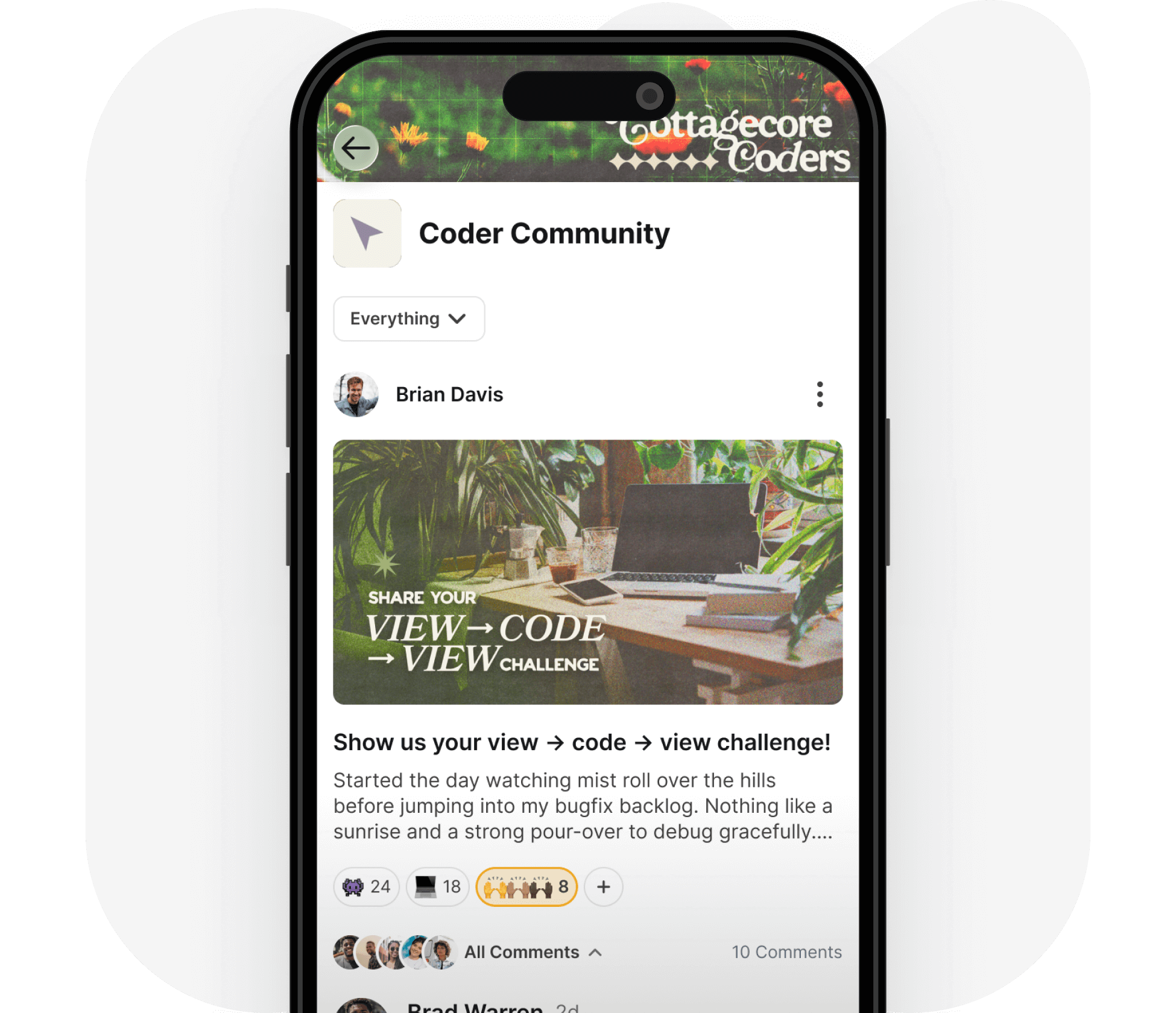
The core product folds four things most creators buy separately into one subscription. There is the community layer - feeds, spaces, direct messaging, member profiles. There are courses, so a host can teach as well as gather. There are events, including live cohorts and workshops, treated as a first-class feature rather than an afterthought. And there is money: payments, memberships, and analytics baked in, so a host can charge for access without stitching together three other tools.
Two extensions sit on top. Mighty Pro gives a host a fully branded, standalone app in the App Store and Google Play - your name on a member's home screen, not Mighty's - plus a dedicated strategy team. And the AI layer, marketed as People Magic, is pointed at the least glamorous, most valuable job in any community: connection. Rather than writing your posts, the AI Cohost helps onboard new members, suggests who should meet whom, drafts conversation starters, and restarts stalled threads. In 2026 the company added per-community MCPs, letting assistants like ChatGPT, Claude, and Gemini plug into an individual network.
03 / THE CUSTOMERFrom the 30-member host to the arena
Who actually pays for this? Two very different kinds of people, at opposite ends of the same curve. At the small end is the solo host - a coach, a teacher, a niche expert - whom Mighty describes with a deliberately modest figure: about $14,400 a year from roughly 30 members paying $48 a month. It is not a viral-launch fantasy. It is a small business.
At the other end are brands running communities at scale. The company points to a Tony Robbins "arena" with more than 30,000 members and live events drawing well over a thousand simultaneous viewers, and a parenting community reported at 102,000 members and over $5 million in two years. The same product has to serve both, which is why the analytics and mobile infrastructure matter as much as the pretty feed.
The small-business math
- Members~30
- Price / month$48
- Avg host / year~$14,400
- Weekly returning members59%
- Revenue retention80%+
04 / THE PROBLEMThe thing Facebook Groups can't sell you
The problem Mighty solves is ownership. Build your community on Facebook Groups, Discord, or an Instagram following and you are renting a house you will never own - no member list you control, no reliable way to charge, an algorithm deciding who sees what. Move it to a course platform and you get lessons but no living room. Mighty's answer is to give the host the member relationship, the payment rail, and the room, all in one place, with no ads and no algorithm renting the audience back to them.
There is a subtler problem underneath: most communities die of silence. A host cannot personally welcome every member, remember who does what, or nudge the quiet ones. That is the exact gap the People Magic features are built to close - which is why Bianchini frames AI here as pro-human rather than a replacement for it.
The goal is not more content from you. It is the moment two of your members find each other.
The Mighty Networks premise, in one line05 / THE MARKETPick your fighter
Community software became a real, crowded market, and each player planted a different flag. Skool leans on gamification - points and levels that pull members back daily. Circle wins on branded flexibility and deep theming. Kajabi is the course-and-funnel powerhouse for creators whose business is really about selling evergreen programs. Mighty Networks' flag is mobile-first, member-generated community, with native apps and live events as the differentiators. If your model needs people opening an app on their phone to talk to each other, that is the lane Mighty is built for.
06 / THE BUSINESSSelling the room, not the seat
The model is straightforward SaaS with a twist. Hosts pay a monthly or annual plan - the entry Launch plan runs around $79 a month, roughly $950 a year - with higher tiers and Mighty Pro branded-app add-ons above it. On top of subscriptions, the platform takes a small transaction fee, in the range of 1 to 3 percent, on member payments. Revenue scales with the number of paying hosts and, indirectly, with how much money those hosts make.
That alignment is the interesting part. Because Mighty earns a slice of what hosts earn, it has a direct incentive to make communities that actually retain and pay - which loops right back to the member-led design. The company's stated five-year ambition is deliberately large: $50 billion earned by the people who build on it. In 2025 that number was $500 million. Whether the gap is bridgeable is the open question, but the shape of the bet is clear.
07 / THE MONEY BEHIND ITBacked, but not bloated
Mighty has raised roughly $67 million across its life. Early backers included First Round Capital and Floodgate. Intel Capital and Sierra Wasatch led an $11 million Series A. The headline round came in April 2021: a $50 million Series B led by Owl Ventures, with Ziff Capital Partners, LionTree, Intel Capital, and a notable bench of individuals - Reid Hoffman, Marie Forleo, Gretchen Rubin, and Dan Rosensweig among them. For a company nine years in, it is a relatively lean raise, which fits the durable-small-business ethos it sells to its own customers.
The culture reads as product-obsessed and fast. The company publishes a weekly changelog, ships frequently, and talks about "people magic" more than feature counts - though it will happily tell you it shipped 124 features in 2026. The team is globally distributed, headquartered in Palo Alto.
"Passionate believer in people magic. Technologist. Entrepreneur. Human."
Gina Bianchini's own bio, uneditedTwenty years after Ning, Bianchini is still arguing the same thing: that ordinary people should be able to build and own the communities they gather. The difference now is that the tools finally charge money, run in your pocket, and - if the AI bet lands - help members find each other faster than any single host ever could. It is a narrow, patient idea. It has also, quietly, become a half-billion-dollar one.