The first pair of pants was a joke with a waist size. Chris Lindland’s Cordarounds were corduroys with their ridges turned sideways, accompanied by mock science about cooling the wearer’s crotch. It was 2005, and he was working elsewhere. The joke was supposed to prove he could market something. People bought the pants. Betabrand, the company that followed, spent years asking a peculiar question: what other clothes would people buy if someone gave the idea permission to be a little ridiculous?
The answer turned out to be remarkably sober. Women wanted dress pants that did not feel like dress pants. A stretchy pair that could pass in an office became Betabrand’s defining product. The brand kept its comic voice, but the product settled into a daily job: getting women through work, travel and everything between without treating a waistband as a test of character.
- Betabrand grew from an experiment in novelty menswear into a women’s workwear seller.
- Its Dress Pant Yoga Pants pair trouser styling with stretch-ponte fabric.
- Customer input led to more cuts, lengths and pocket options, including a seven-pocket pair.
- The pandemic hit both officewear demand and the company’s air-shipping model.
The customer picked the serious product
Lindland’s early catalog reveled in improbable combinations: corduroy worn sideways, sweatpants disguised as dress pants, garments built to travel through a joke before they reached a checkout. Betabrand used its site as a public workshop. Designs could be shown before a full production run; customers could react, vote or preorder. A product did not need an old-fashioned buyer’s approval before it found an audience. It needed an audience willing to put money down.
That distinction matters. A “like” costs nothing. A presale makes someone wait and pay. Betabrand’s method let a small clothing company gauge demand while avoiding the full inventory risk of guessing a season’s winners in private. It also made the comment section part of product development. The company was selling clothes, but it was gathering a remarkably detailed record of what people disliked about the clothes they already owned.
After roughly three years, the company was still unprofitable, according to Lindland. That changed how he thought about the market: a large clothing brand needed women as customers. The men’s Dress Pant Sweat Pant was an early signal: polished appearance, forgiving fabric. Then came the larger audience. Betabrand’s first major women’s product, Dress Pant Yoga Pants, put the same contradiction in a sharper place. Workwear had always asked women to choose between looking ready for a meeting and feeling ready to move. The company did not invent stretchy fabric. It gave stretch a work address.
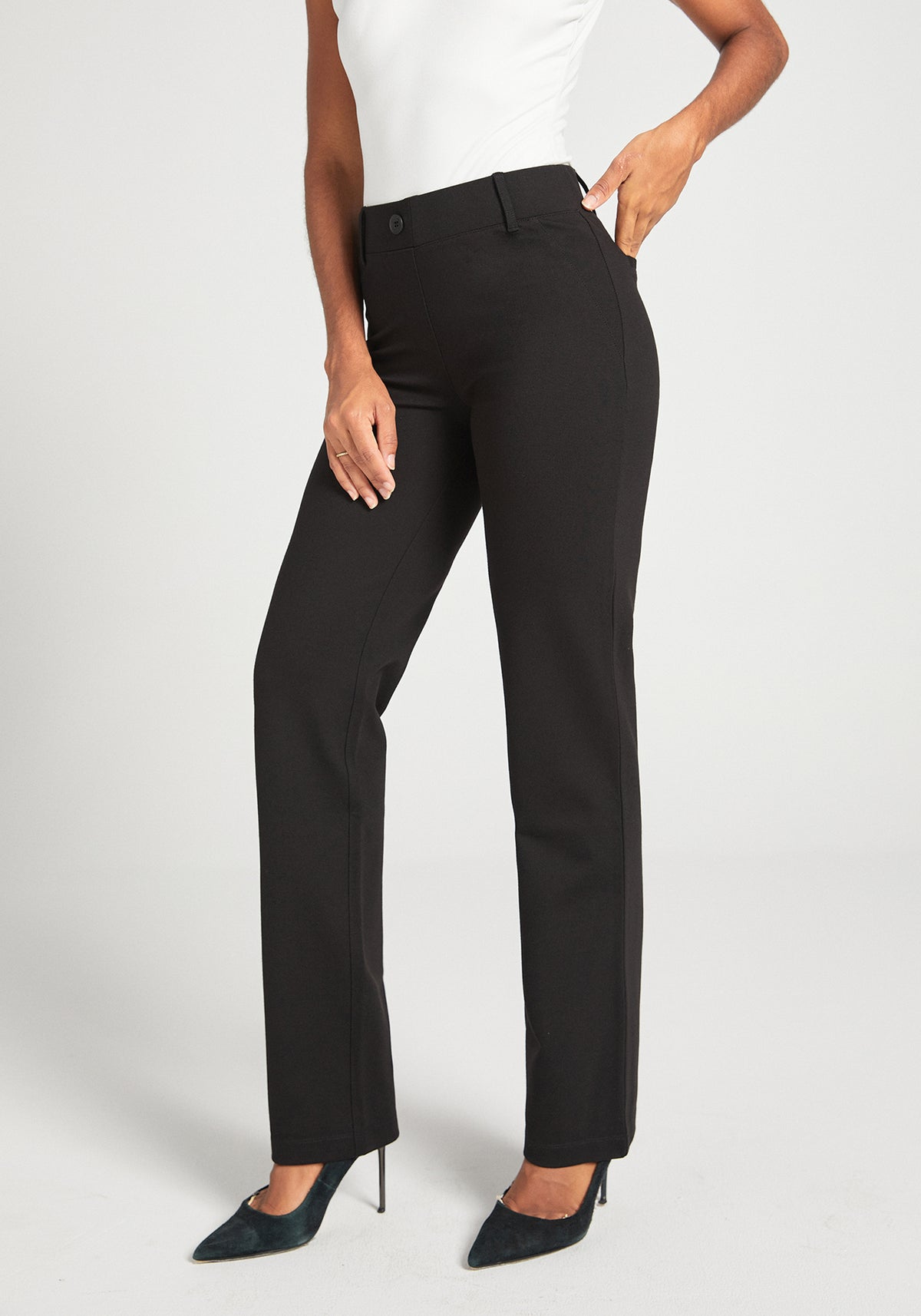
The idea was public by 2013, and the 2014 publicity was hard to miss. Betabrand photographed women with PhDs or PhD candidacies modeling a spring collection. It was a provocation dressed as a catalog: the people inside the clothes had résumés as interesting as the clothes’ stitching. The campaign also drew criticism for retaining conventional beauty standards. Even a clever casting stunt could not resolve every contradiction in fashion.
“They’re either a miracle of creation . . . or the end of Western civilization.”Chris Lindland on Dress Pant Yoga Pants, 2014
The pockets are the plot
Look at the current pant range and the customer conversation becomes visible. The Classic has trouser styling and faux pockets, preserving clean lines. The Two-Pocket adds functional back pockets. The 7-Pocket version has seven usable pockets, three hidden. Betabrand says early versions had no pockets and customers asked for them. The request did more than add storage; it created a product family.
This is the part a smaller brand could copy. Begin with a specific discomfort, build one comprehensible fix, and ask for a signal stronger than applause. Then examine the requests that recur after purchase. A pocket complaint is more useful than a generic call for “innovation.” Betabrand’s current guide offers petite, regular and long inseams, and cuts from skinny to wide leg. Those options answer the dull, consequential questions that determine whether someone wears a pair twice or six times.
There is a financial side, too. The current catalog lists many Classic pairs at $78 and seven-pocket pairs around $88, with patterns and promotions changing the price. Betabrand raised venture money as it grew; databases disagree on the precise aggregate, but report major rounds in 2015 and 2017, and the supplied company profile records a $10 million raise in June 2017. The exact cost of developing any one pant is not public. What is visible is the trade: a presale can reduce the wager on inventory, but repeatable fabric, fit and fulfillment still require capital.
Then the office went home
In 2020, the customer’s workplace changed overnight. Lindland said online sales fell as much as 40 percent in March before stabilizing. Betabrand had found a product that made office clothes more comfortable; now the office itself was no longer required for millions of people. The company staged an interactive work-from-home fashion show with customers, live chat and polls. It was exactly the sort of quick, public improvisation the brand knew how to do.
But the shock ran deeper than a new dress code. Lindland later described the company’s top products as overwhelmingly office yoga pants. He said pandemic restrictions hurt demand just as flight cancellations disrupted a Hong Kong-based shipping setup that depended on air travel. The product had become so successful that the company was exposed to the fate of one use case. Lindland eventually sold the business. The brand continued.
That does not make the original insight false. It makes it conditional. Customer voting works best when customers can imagine and commit to a garment before it exists; it is weaker against a sudden change in where and how people work. A presale reduces one kind of uncertainty. It cannot reopen an office or create cargo capacity. Betabrand’s history is a useful warning about mistaking a very clear customer need for a permanent setting.
What remains after the laugh
Today Betabrand is an online women’s clothing seller built around the Dress Pant Yoga Pant. Its site also lists blazers, tops, denim and other pieces for a flexible wardrobe. There are wholesale and affiliate programs alongside direct online sales. Customers can still find style guidance and a prompt to vote on colors, features and future releases. The experimental machinery remains in the background; the reliable pant is in the window.
That places Betabrand between conventional workwear and athleisure. A yoga brand can sell comfort. A trouser brand can sell office polish. Betabrand’s claim is the awkward overlap, where a woman wants both in one item and cares exactly how many pockets it has. The company’s expertise is less a proprietary fabric than a practiced ability to spot an irritation, explain it plainly and let customers push the design toward use.
For a shopper, the practical use is straightforward: compare the cut, rise, pocket count and inseam, then choose the level of polish and utility required for the day. For a founder, the copyable lesson is narrower and more valuable: jokes can attract attention, but a recurring complaint makes a business. The sideways corduroy got people to look. The women asking for comfortable office pants told Betabrand where to stay.