The trouble with a paint chip is that it asks a tiny rectangle to speak for an entire room. Under a store’s fluorescent lights, the rectangle looks obliging. At home, beside a sofa and an east-facing window, it may begin to tell a different story. Interior designer Nicole Gibbons had watched people struggle with precisely this problem. Her clients, oddly enough, did not seem to struggle as much. They had her.
When Gibbons recommended a color, clients tended to accept it. In a 2019 interview with Architectural Digest, she said they never sent her back for another ten choices. That difference became the business case for Clare. The expensive part of selecting paint was not the paint. It was the uncertainty before the can was opened.
- Clare sells curated interior paint, peel-and-stick samples and painting supplies directly online.
- A color quiz and portable swatches help shoppers decide without a designer or a store visit.
- Founder Nicole Gibbons reported 550% revenue growth in 2020; Clare raised an $8 million Series A in 2022.
- Gibbons says she sold the company and exited in 2024. Clare still operates its online store.
A designer with a very small paint wall
Gibbons came to paint by way of design, media and a decade in public relations. She had built an audience talking about interiors, then a design practice that gave her a close view of how people actually choose colors. Private clients could hire her judgment; most people standing in a hardware store could not. In 2018 she launched Clare to package that judgment as a shopping experience.
The first assortment held 55 colors, chosen after she considered more than 500. This was an act of editing, not an inability to mix more paint. Clare also dispensed with much of the technical vocabulary that makes a color chart sound like an engineering manual. It offered names such as Avocado Toast, Dirty Martini and Nairobi Blue. A shade could be approached as a feeling, or as the memory of a dress, rather than as a code.

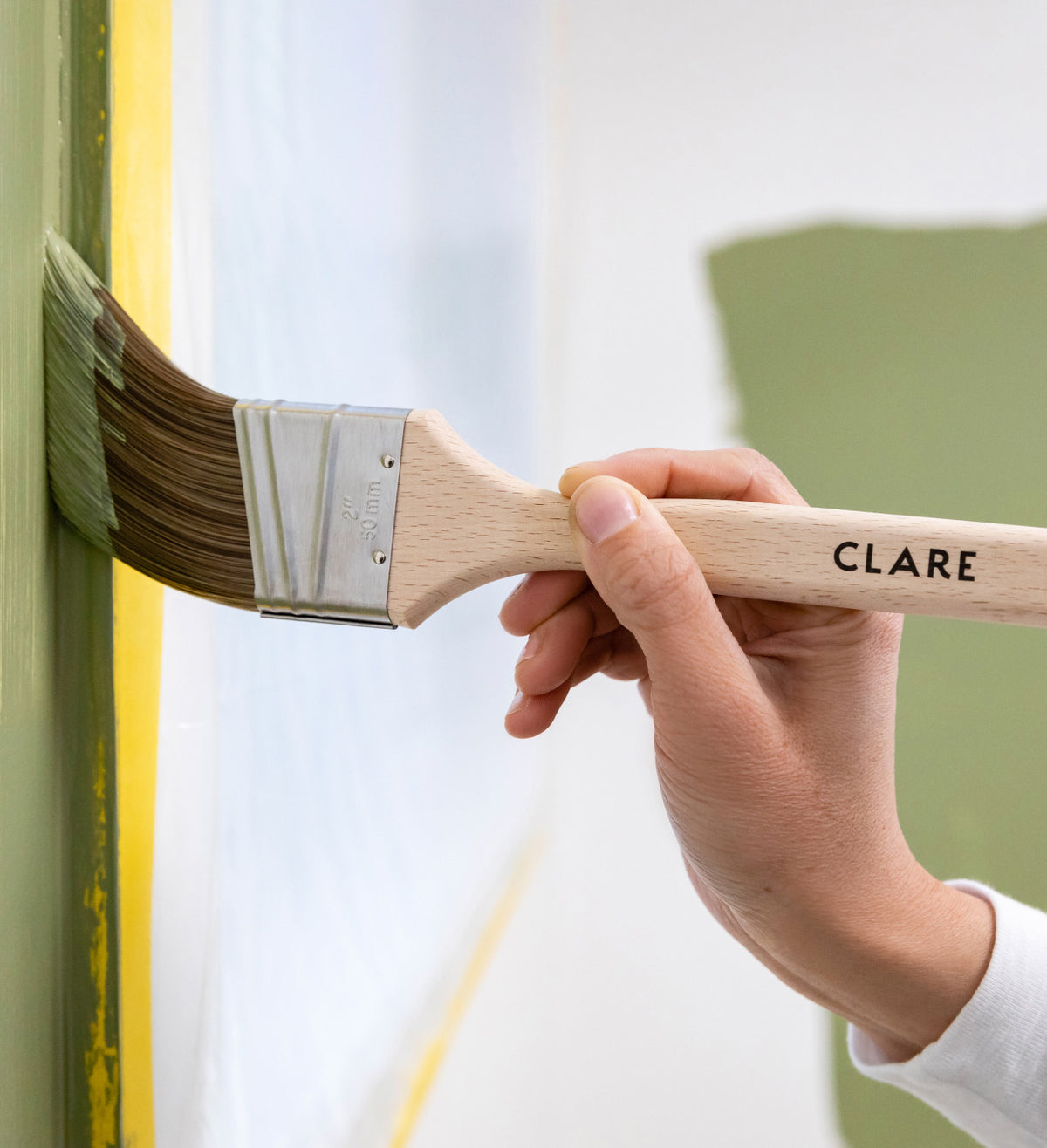
The visual system helped. Clare’s yellow cans and boxes look difficult to lose in a utility closet. Gibbons told Architectural Digest that she chose yellow partly because blue was already everywhere in startup branding. The joke works because it makes a serious point: even packaging can tell a novice which brand is trying to speak plainly.
The quiz, the sticker and the room
A shopper can begin with Clare Color Genius, a nine-question quiz that asks about a space and recommends shades. It is a scaled version of a designer’s first conversation, though it cannot see what a room sees. So Clare sends a second tool: the Perfect Color Swatch, a removable sample that can be placed on the wall, moved near the window and checked again at dusk. The sequence admits something honest about online shopping: a screen is a poor judge of light.
The current store sells wall paint in eggshell and trim paint in semi-gloss, along with ceiling paint, primer, rollers, brushes, tape and kits. Clare says its interior wall and trim paint is zero VOC and GREENGUARD Gold certified. It makes a performance claim as well as a health and emissions claim: the finish must cover, withstand cleaning and survive the ordinary indignities of a lived-in room. Good Housekeeping gave Clare a 2023 Home Renovation Award after testing coverage and durability.
Those prices give the story its useful friction. A $3 swatch is cheap insurance against buying the wrong $77 gallon. A homeowner can test a few contenders without taking home several little cans, then order what the project needs. Clare’s paint calculator estimates coverage; its FAQ puts wall-paint coverage at roughly 375 to 425 square feet per gallon. That estimate is a starting point, not a promise about a rough wall or a dark color.
A fortunate year, and a harder question
Clare’s model was ready for a year when people suddenly spent far more time staring at their walls. Gibbons told Business of Home that revenue grew 550% in 2020. A percentage like that is dramatic and incomplete: it says nothing by itself about the starting base or the profits left after shipping heavy cans. Still, the fit between home delivery and a stay-at-home year was unmistakable.
By February 2022, Clare announced an $8 million Series A led by Pendulum. Gibbons said the round brought total funding to $12.2 million. She wanted to spend on marketing, more staff and more products; she also saw potential in retail distribution. The logic was practical. People do not repaint the bedroom every month, and an online paint company must earn each rare purchase. A broader catalog and professional customers could make the relationship last longer.
Raising that money had not been easy. Gibbons described investor skepticism compounded by bias against Black women founders. After talking with Partake founder Denise Woodard, she deliberately sought investors of color. Pendulum, an investment and advisory platform focused on diverse entrepreneurs, led the round. The lesson here is concrete: once the customer journey and supply chain were working, Clare could test paid acquisition with capital; before that, it had relied heavily on organic growth.
The company after its founder
The paint aisle kept changing. Clare began as a direct seller to do-it-yourself shoppers, while established brands could offer enormous ranges through dealers and hardware stores. Backdrop arrived with a similarly edited online paint proposition. Clare’s answer was not to claim that every imaginable hue was available. It claimed that enough good choices, paired with useful guidance, could produce a better decision.
There is also a professional side now. Clare’s Design Trade Program offers eligible designers, architects, painters and contractors discounts, project help and custom colors. Custom orders require at least six gallons. Testimonials on the program page describe uses in Havenly projects and at hospitality spaces such as Dye House and Ethel’s Club. The expert whose advice Gibbons once tried to put online is also a customer.
“My clients never doubted us.”Nicole Gibbons, on giving clients color advice
Gibbons says she sold Clare and left its ownership and operations in 2024. The buyer and terms are not disclosed in the material she has published, so the more revealing evidence is on the storefront. It remains live. In March 2025, Clare says it reformulated the paint to improve stain, scrub and burnish resistance while keeping the colors. The company cautions that the sheen can differ enough to make mixing old and new formula in the same space unwise. A brand built on the anxiety of choosing a color still has to answer the less glamorous question of how the painted wall behaves.
What can another company borrow? Begin by watching where an expert makes customers confident. Cut the menu to a set a buyer can understand. Give people a cheap way to test the decision in the place where it matters. Then make the order easy to complete. The method suits a category with too many choices, visible outcomes and costly mistakes. It is less persuasive where customers need precise custom matching, where samples cannot stand in for the finished product, or where shipping erases the convenience. Clare’s lasting idea is not a particular shade of green. It is that good commerce sometimes begins with an editor.