The easiest way to misunderstand KashKick is to think it pays people for playing games. The money actually begins on the other side of the screen. A mobile-game studio wants a new player. A retailer wants a purchase. A research firm wants a survey response. They pay Besitos when somebody completes a defined action, and Besitos passes part of that payment to the person doing it. KashKick is where the person sees the deal; Besitos is the machinery that makes the deal measurable.
That distinction turns a cheerful side-hustle app into a serious marketplace. One group brings attention and time. Another brings acquisition budgets. Besitos supplies tracking, matching, fraud controls, customer support, and a user experience simple enough to make an unfamiliar exchange feel legible. In 2025, the company said KashKick paid members $12,749,486. It reports 3.5 million active members, and Apple’s U.S. App Store showed a 4.7 rating across more than 100,000 ratings in August 2026.
The purple app is only the shop window
KashKick is free to join. Members choose games, surveys, shopping deals, product trials, or service signups. Each listing states what must happen and what it pays. Reach a game level inside the allotted time, finish the survey, or complete the purchase and the reward moves through verification. Once available balance reaches $10, members can cash out through options including PayPal, Venmo, gift cards, or a charity donation, depending on country.
The cash denomination matters. Reward programs often invent a currency, then make users perform airport-miles algebra at checkout. KashKick says one Kash equals one dollar. The interface tells you the target and its value in a unit already understood at the grocery store. Some offers are free; others require a purchase, subscription, or in-app spending. The conditions appear before the member starts. The actual cost to a consumer is therefore either zero or the explicitly stated action - plus time, which is the scarce ingredient the company is pricing.
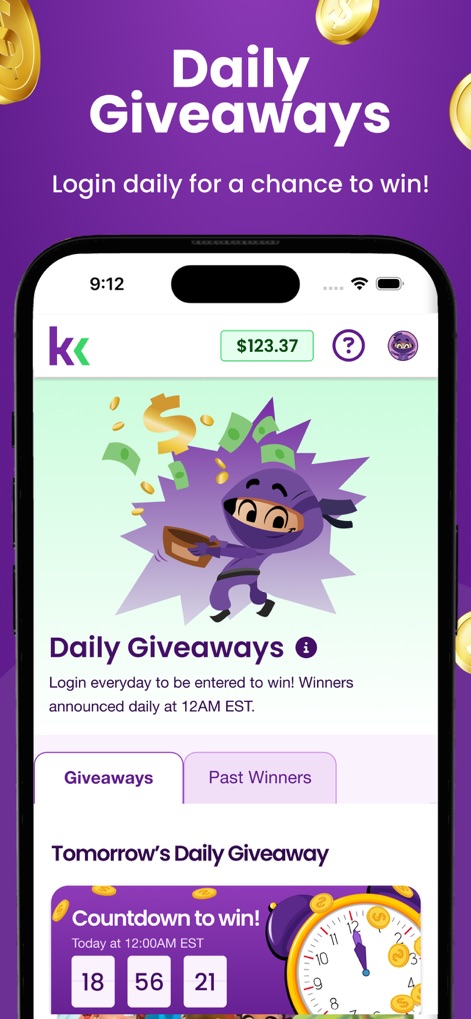
A purple balance, a cheerful ninja, and a cash-out button. The color is playful; the accounting is pointedly ordinary. Dollars are easier to trust than dragon gems.
Games, brands, retailers, and researchers define an action worth buying.
People select an offer, complete its terms, and receive a cash reward.
Performance data improves matching, timing, and the next campaign.
What changed the trajectory
Vishal Mahtani and Jacob Shemesh launched KashKick in Tampa in 2017 after building several internet businesses together. Their complaint about the existing rewards category was opacity: people could spend meaningful time chasing an offer without a clear sense of its value or finish line. Their answer was not a grand financial instrument. It was plainer language, real cash, and visible rules.
The early menu leaned on surveys and fintech offers. In summer 2022, games became a much larger part of the earning mix. That was a consequential change because games arrive with their own ladder of behaviors - install, return, reach a level, make progress. A studio can price those milestones, and a player can see a sequence of small finish lines. Rewarded acquisition feels less like an ad pasted onto play and more like another mission inside it.
“Show the terms. Respect the time. Pay real cash.”
By January 2023, KashKick had paid its first $1 million to members. It crossed one million members that May and arrived in app stores later in the year. Cumulative payouts passed $10 million in July 2024. Then came a startling public score: #11 on the 2024 Inc. 5000. In 2025 it returned at #22, reporting roughly 8,151 percent revenue growth from 2021 through 2024. Besitos also debuted at #15 on Deloitte’s 2025 Technology Fast 500.
What failed first: generic engagement
Scale made the old problem harder. A game enthusiast, a survey regular, and a bargain hunter should not receive the same nudge at the same moment. KashKick wanted to understand behavior in real time and personalize onboarding, messages, and offers. Building the customer-data and messaging layer internally was estimated to delay go-to-market by 18 months. The company’s public cost is best expressed in that lost time, not a dollar figure.
So it integrated CleverTap rather than building the entire layer. The system combined first- and third-party data, segmented users, orchestrated lifecycle journeys, and tested timing and channels. A published case study reported a 3.7-times increase in returning users, 2.3-times total-user growth, four-times monthly engagement growth, and a 36 percent uplift in engaged sessions in one month. Those are vendor case-study figures, but they reveal what changed the team’s mind: owning every component mattered less than learning while the market was moving.
The next move was to sell the engine beyond KashKick. Besitos Marketplace offers a white-label game, survey, and offer catalog that can sit inside a partner app through an iframe or API. The partner gets a new revenue stream and another reason for users to return. Besitos gets distribution without persuading every consumer to download KashKick. Advertisers get access to more high-intent actions. It is the same inventory with a different front door.
That packaging also widens the company’s market. It can compete with consumer reward apps for members, with performance networks for advertiser budgets, with survey panels for research spend, and with loyalty vendors for space inside partner products. The categories overlap because the underlying asset is the same: a measurable audience willing to act when the value exchange is clear.
One engine, two customer sets
The consumer is easy to picture: an adult with spare time, a phone, and a practical reason to turn play or opinions into extra cash. The business customer is broader. Mobile-game publishers want attributable players. Researchers want a U.S. gaming panel. Retailers and service companies want trials or purchases. Fintech and loyalty apps want engagement without designing a reward marketplace from scratch.
Bolt Earn shows the B2B thesis neatly. Launched inside Bolt’s SuperApp in February 2026, the experience lets members complete games, surveys, and offers without leaving the app, then places earnings in their Bolt account. Bolt adds utility and revenue; Besitos supplies the market. The integration avoids asking a financial app to become a game-discovery company on weekends.
There is also a social-impact variation. Through Play It Forward, eligible KashKick game activity can trigger a matching Besitos donation to the American Cancer Society while the member keeps the earned reward. It is a clever partnership design because it does not require a separate charitable behavior. The same completed action creates value in two directions.
The fragile part is the promise
Rewarded marketplaces have an awkward interval between “I did it” and “I got paid.” A partner must confirm the correct install, level, purchase, or response. Fraud checks protect advertiser budgets and keep fake activity from swallowing the margin. But pending periods can feel to a member like the platform is holding money already earned. Tracking failures and disputed completions are not edge cases in this model; they are the moment when three parties disagree about reality.
Besitos addresses that with visible terms, pending verification, fraud detection, and a customer-operations team it says numbers 25 people. The design goal is tension management. Verify too lightly and buyers leave. Verify too slowly and earners leave. The company’s differentiation rests partly on analytics and inventory, but also on whether it can repeatedly referee that argument without making either side feel cheated.
When this model stops working
Rewarded acquisition needs four conditions: a partner action valuable enough to fund a meaningful payout; clean attribution; fraud low enough to preserve margin; and users willing to trade time for the stated reward. Weak economics produce insulting payouts. Weak tracking produces disputes. Long delays turn “cash” into an IOU. And in products where paid offers feel alien, the marketplace becomes clutter rather than loyalty.
What operators can copy
First, price value in a unit customers already understand. Second, write the finish line before asking for effort. Third, reward an action the buyer can measure, not vague attention. Fourth, separate the engine from the storefront so the same capability can travel through direct and partner distribution. Fifth, buy infrastructure when building it would postpone the learning that actually creates an advantage.
The final lesson is less tidy: do not treat support as a cost center when your product is a promise to pay. KashKick’s mascot can jump, the app can sparkle, and the rankings can climb. The durable product is the confidence that a tracked action will become available cash. Besitos has built an unusually fast-growing business around that conversion. Its next test is whether the promise remains clear when the purple marketplace appears inside somebody else’s app, in somebody else’s country, under somebody else’s name.
Keep clicking
- Besitos company website and KashKick consumer platform
- Besitos | KashKick on LinkedIn
- KashKick on the Apple App Store
- KashKick on Google Play
- The KashKick Guide for product explainers and team profiles
- Company news and announcements
- Bolt Earn partnership announcement
- Play It Forward with the American Cancer Society