The first clue in Bernardo Herzer's working life is not a patent number or a product launch. It is a broken engine, somewhere at sea, with a teenager staring into the machinery. Herzer grew up sailing with his family. By 17, he was skippering a yacht and joining a voyage around the world. In his mid-teens, when one of the family's gasoline engines failed, he helped improvise a conversion to propane. The repair worked. More important, the idea stayed aboard.
He would spend much of his life on water, eventually owning and commanding oceanographic research vessels and logging more than 40,000 nautical miles. Some expeditions took him into the North Sea. Long passages give small irritations time to become large questions, and gasoline offered plenty of both: the smell, the storage, the stale fuel, the occasional sheen on the water. Herzer began to wonder whether the propane already used for cooking and heat could carry more of the boat's burden.
“The great thing about propane is it's a closed system.”Bernardo Herzer
That sentence contains the practical heart of his career. A sealed bottle does not need an open fuel tank. There is no carburetor bowl left to gum up during months of disuse. Around water, a fuel that dissipates rather than forming a floating slick has an obvious appeal. Herzer was not beginning with an abstract category called clean technology. He was beginning with a mariner's dislike of mess, waste and unreliable gear.
Coming ashore
The sea supplied the problem. Family life changed the venue. After his wife became pregnant, Herzer stepped away from a life of constant voyaging and looked for a land-based application of what he had learned. Lawn tools were an unexpectedly neat fit. String trimmers, leaf blowers and mowers used small engines similar to those he had modified on boats. The customer also faced familiar fuel trouble, only now in a garage rather than a marina.
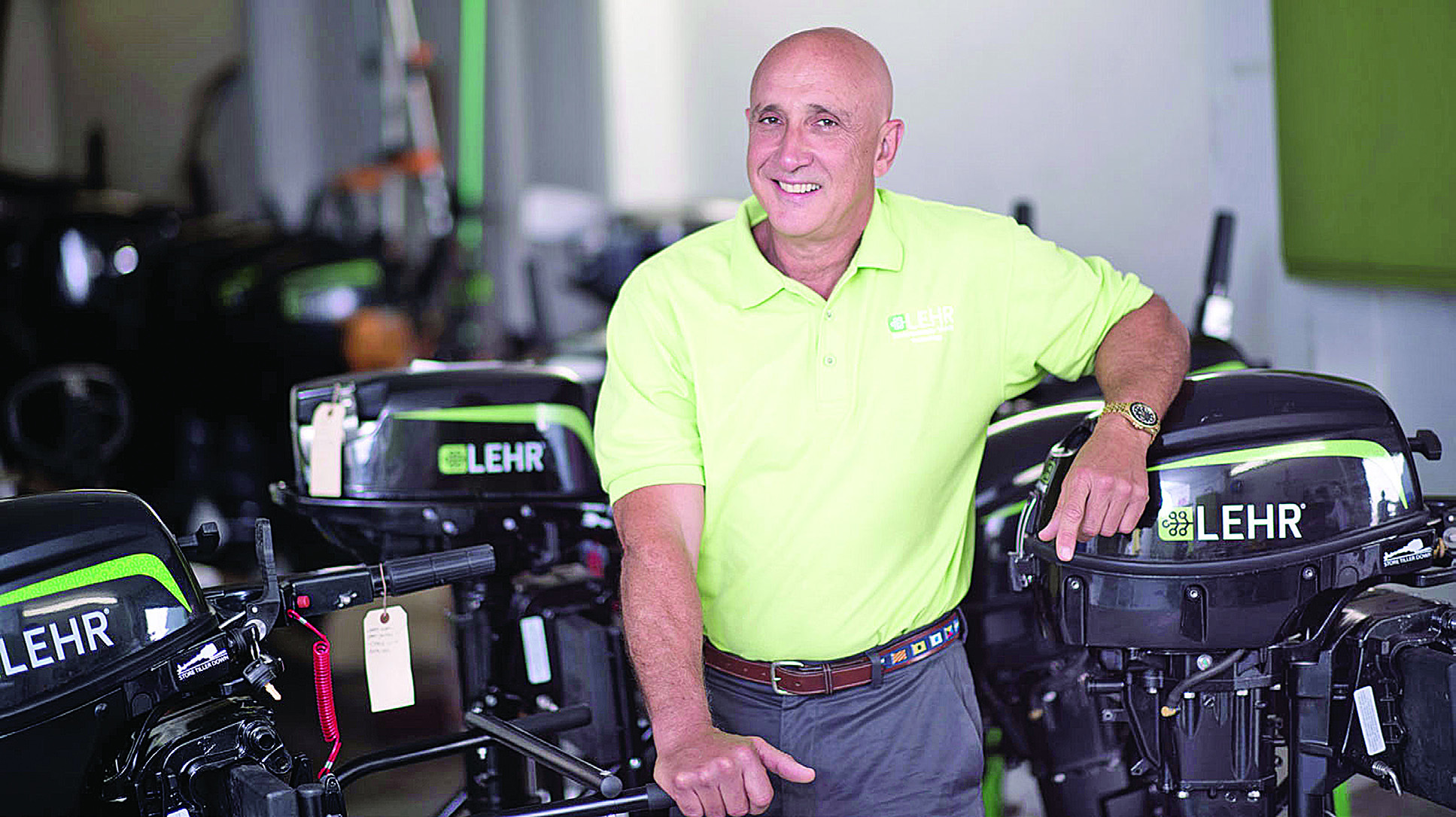
LEHR began in the Los Angeles area with Herzer tinkering among engines and propane tanks. By 2009, its propane string trimmers were on shelves at Ace Hardware and Sears. The headquarters, a two-story industrial building in Culver City, was painted green. Inside, Herzer's office had the happy clutter of a workshop that had wandered into an archive: prototypes, company logos, old maritime clippings and articles about hydrogen aircraft and alternative-fuel cars.
Near his door hung a sign: “Do not disturb, meditating.” A visitor might have expected the machines to be his favored display. Instead, when he was asked about the important things in the room, Herzer pointed to photographs of his wife and young son. It is a small scene, but it rescues the inventor from the usual mythology of pure obsession. The work mattered. So did knowing why he had come ashore.
Herzer spent a couple of years developing the propane engine for a hand-held trimmer. That pace reveals something unfashionable and useful about hardware: patience is part of the mechanism. Pressure must be reduced. Fuel and air must mix. A portable bottle has to sit at the proper angle while heat and vibration change its behavior. A product still needs to start on a cold morning after sitting untouched in a shed. The pitch may be clean fuel; the verdict arrives when someone pulls the starter cord.
The retail challenge was almost comic in its familiarity. People who happily cooked over propane could become nervous when the same bottle appeared on a mower. Herzer did not dismiss the caution. He argued that customers should be careful with every fuel, then returned to the prosaic case for the product: no mixing oil and gasoline, no open refilling, less trouble after storage. LEHR also had to explain value without pretending fuel cost alone settled the matter. Infrequent-use machines waste gasoline through spills, evaporation and stale leftovers. The small bottle made that waste visible, measurable and, in Herzer's design, removable. A cleaner tool still had to earn its square foot of retail shelf.
“Being green is making improvements over what the state of the art is.”Bernardo Herzer
The lawn was a launchpad
Once the small-engine fuel system worked on land, returning it to the water felt less like a pivot than a homecoming. LEHR introduced 2.5-horsepower and 5-horsepower propane outboards in 2012, followed by a 9.9-horsepower model in 2013. Small shore dinghies and sailboats using an auxiliary motor were natural early customers. Many owners already carried propane, knew how to handle it and could find it without installing a dockside gasoline pump.
In its first year in the marine market, the first two outboards generated a reported $3 million. Herzer's definition of the customer remained admirably free of demographic fog: “Any person looking for an ease-of-use, price-point competitive, more reliable engine is our customer.” Environmental performance opened the door, but convenience and reliability had to walk through it.
Propane outboards gained muscle
Launch years and rated horsepower for the early LEHR marine line.
The hidden machinery of adoption
An engine is never only an engine. It is certification, service, distribution, spare parts, retailer confidence and a regulator's vocabulary. Herzer's public patent catalog lists more than 70 U.S. and international patents. The portfolio includes carburetor arrangements, regulators and portable gas-powered engine systems designed to manage the exact physical quirks that a brochure can ignore. The patents show invention at screw-thread scale: pressure stages, heat transfer, bottle position and the choreography between fuel and vibration.
Recognition arrived from several directions. LEHR's Eco Trimmer received a U.S. EPA Clean Air Excellence Award in 2008. A 15-horsepower propane outboard earned a Special Mention at the 2014 DAME marine equipment awards. In 2017, the International Green Industry Hall of Fame inducted Herzer and presented him with a lifetime achievement award. Each honor marked a different hurdle: credible environmental performance, credible marine engineering and a career sustained beyond a single product.
The company also widened its reach. LEHR acquired EnviroGard in 2015, adding conversion kits, larger equipment applications and established relationships with original equipment manufacturers. The move made Herzer's fuel-system ideas less dependent on customers buying a complete LEHR-branded machine. A technology could travel inside someone else's product.
Then came the slower work of changing a market's assumptions. Appointed chairman of the World LPG Association's Marine Group in 2014, Herzer helped convene manufacturers, fuel suppliers and policymakers around marine applications. He spoke at industry forums, including a 2017 gathering in Morocco, and argued for standards that could accommodate vessels ranging from fishing boats to ferries and cargo ships.
The scale changed, but his argument kept the shape of that first small engine. Fuel has to be available. Storage has to make sense aboard the vessel. Regulators and classification societies need rules that match the technology, while operators need a reason to retrain crews and change equipment. At the 2017 forum, Herzer introduced a propane-fueled two-stroke outboard aimed at smaller boats and discussed LPG concepts for much larger ships. In 2021, his foreword to an industry report called wider marine adoption his maritime mission. The teenage repair had become a campaign involving standards committees, international partners and ports, yet the image behind it remained plain: keep the fuel contained and keep the water clear.
“We face the challenge of getting industry leaders to ‘un-learn’ a few assumptions and re-learn what they need to know.”Bernardo Herzer
That may be a quieter line in the story, but it travels well. Building the thing is one task. Teaching an industry how to see it is another. New hardware has to cross a chain of permissions, habits and old mental models. Herzer became not only an inventor but a translator between engine rooms, retail aisles, fuel distributors and meeting rooms.
When the label disappears
In 2009, when green products were still often treated as their own peculiar aisle, Herzer offered a prediction: “Today, we talk about companies and products in terms of whether they're green or not. Tomorrow, we won't talk about it. It will just be the reality.” His own machines reveal the hard condition hidden inside that optimistic sentence. A cleaner choice becomes ordinary only when it also behaves like an ordinary choice.
The useful lesson from Herzer's career is not that every engine should run on the same fuel. It is that firsthand irritation can be unusually fertile ground for invention. He saw a sheen on the water, remembered a teenage repair, noticed the propane bottles already aboard and followed the logic into lawns, workshops and marinas. The constraint was physical. The ambition became industrial.
More than a decade after LEHR's first marine launch, the image that lingers is still basic: a captain studying a small engine while the ocean refuses to care about his business plan. At sea, the machine either works or it does not. Herzer brought that standard ashore, painted the workshop green and kept tinkering.