Kevin Krausert began his energy career in 2004 on oil rigs in northern Alberta. His first job at Beaver Drilling was roughneck. By 2017, he was the company’s CEO. There is a whole apprenticeship between those two titles, and it matters to the business he runs today. Avatar Innovations, the venture studio he co-founded in November 2020, starts with a proposition that would make sense to someone who has worked both ends of that ladder: the people inside an industry may have something useful to say about changing it.
Before the rigs came McGill University, where he earned a bachelor’s degree in neuroscience. Later came a Global Energy Executive MBA at the University of Calgary’s Haskayne School of Business, completed in 2013. The educational itinerary is pleasingly untidy. A science graduate goes into drilling, then studies the business of energy. His working life refuses to fit neatly into the box marked financier, even though financing now occupies a considerable part of it.
His Beaver years included jobs as motorhand and derrickhand, followed by training and development and business development. These are distinct kinds of responsibility: working with equipment, helping people learn, finding business. Seen together, they give his later interest in leadership and commercialization a practical history. Avatar did not arrive fully formed as an elegant diagram. Krausert had spent years moving through the parts of a company that such diagrams tend to compress into arrows.
- 2004Roughneck
Beaver Drilling - 2013Energy MBA
Haskayne - 2017CEO
Beaver Drilling - 2020Co-founder
Avatar
A downturn with homework
In 2015, while president of Beaver, Krausert enrolled in Haskayne Executive Education’s Entrepreneurial Thinking program. It lasted two days. A short course is an unusually modest turning point for a business story; nobody needs a garage, a midnight revelation or a conveniently prophetic napkin. He was looking for new options in a changing market, and the program helped him develop a plan for Beaver’s future.
The resulting work included accelerating a technology strategy and identifying a new international project. In a 2017 account of that period, Beaver was described as maintaining profitability in difficult conditions, with rig utilization twice the industry average. Those figures belong to that historical account, rather than a claim about the drilling market today. They help explain why Krausert’s interest in entrepreneurial thinking was more than an extracurricular enthusiasm.
“What makes success today does not guarantee success tomorrow,” he said. It is a useful sentence for an executive to keep around, preferably somewhere more conspicuous than a framed certificate. The course offered him a way to examine an established company as something that could still be redesigned. The next job would apply that habit to the arrangements through which new energy businesses get made.
Kevin Krausert / 2017“What makes success today does not guarantee success tomorrow.”
Old equipment, new possibilities
Krausert’s earlier innovation work involved physical machinery and difficult geography. His leadership helped bring about a fully computerized drilling rig in Canada and a long-reach horizontal well in the Canadian Arctic. He also worked on joint ventures with Indigenous peoples in remote communities. These projects put technology alongside capital planning, partnerships and execution. A useful idea had to survive contact with the people and places expected to use it.
His public career also reaches beyond the rig fleet. Previous governance roles include serving as drilling executive chair at the Canadian Association of Oilwell Drilling Contractors and chair of development at Alberta Ballet. Ballet is a welcome interruption in a biography otherwise crowded with drilling, investment and technology. It documents a second institutional world without requiring an invented tale about his taste in choreography.
That range makes the move to Avatar less abrupt than it first appears. By the time he left Beaver, he had been an operator, a business leader and a participant in governance. The new venture would need connections among all three. Energy technology comes with equipment, organizations and people attached; his career had already introduced him to each of those complications.
The company starts before the company
Krausert co-founded Avatar with Bryan Trudel, whose background was in capital markets, including CIBC’s energy desk. Their professional histories met at a useful junction. Krausert brought experience running an industrial company through disruption. Trudel brought experience with the money that companies need. The partnership gave Avatar both an operating perspective and a financial one.
In his first-year letter, Krausert recalled senior figures from energy, finance and academia gathering at the Calgary Petroleum Club shortly before Christmas in 2020. They had been managing a disrupted market and were confronting a shortage of risk capital, difficulty moving carbon technology to market and questions about the workforce’s future. His account framed Avatar as an answer to those connected problems. Leadership development belonged in the same conversation as technology development.
The first-year numbers in that letter were specific: 600 applications, 270 participants and 44 proposed carbon technology solutions, involving 17 companies and four countries. They describe activity, rather than proving commercial success or emissions reductions. Still, they show what the founders had assembled: a setting in which people from established businesses could work on ideas beyond the ordinary boundaries of their jobs.
Today, the program has three connected stages. Ignite puts industry professionals to work on energy technology challenges. Studio develops promising concepts with customers and experts, including prototypes and business models. Ventures supplies a route toward early funding. Participants who form a new company own its intellectual property. For a worker accustomed to developing ideas inside somebody else’s organization, that last detail gives the exercise a rather different ending.
Teams forming a new venture own the intellectual property.
A room near the customer
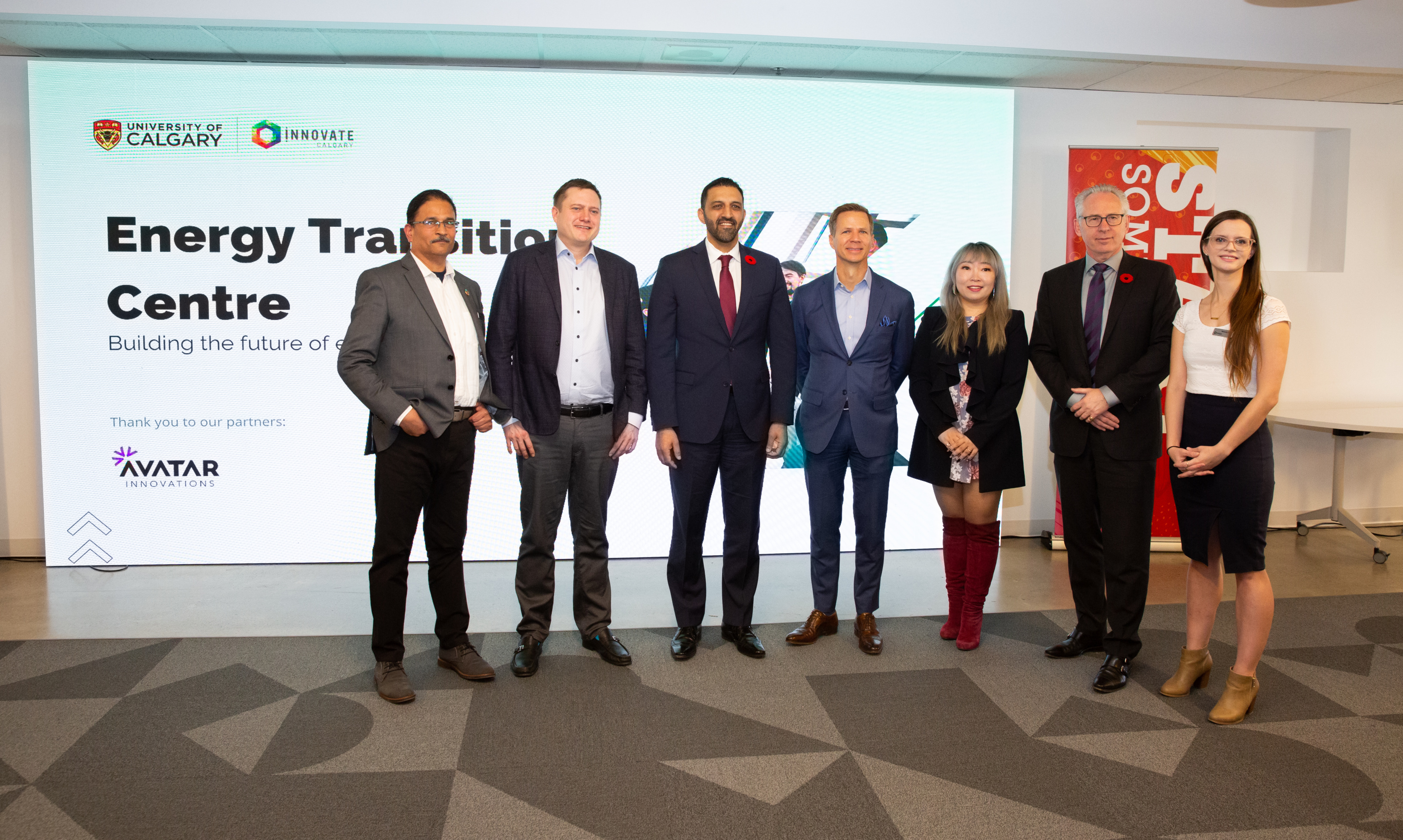
In November 2022, Calgary’s Energy Transition Centre opened its downtown space. The collaboration brought together the University of Calgary, Innovate Calgary and Avatar, with investment announced earlier that year by PrairiesCan and CIBC. Krausert joined the opening announcement alongside university, financial, political and technology representatives. The group photograph is a small lesson in how many kinds of people an energy project can require.
The centre was designed to connect industry with university research and support new companies. Its location beside major energy businesses made proximity part of the plan. Researchers, startup teams and potential customers would have a place to meet. For Krausert, that geography suited the ambition to turn Calgary’s existing industrial knowledge into new ventures. Sometimes the distance between an idea and its buyer can begin with an actual street.
His network extends into technical validation. Between 2022 and 2024, ten startups collaborated with SAIT’s Applied Research and Innovation Services through its partnership with Avatar. They gained lab testing and expert guidance to refine their technologies. Nanostrip, originally called Golden Bubble, was one of the 2024 startups named in that work. This is the less photogenic portion of company building: testing, revising and finding out whether a promising result travels beyond its first experiment.
Krausert’s case for collaboration therefore has identifiable institutions behind it. A university helps connect research to industry. An applied research partner helps teams examine technologies. The customer brings the conditions under which a solution must work. His venture studio sits among those participants, trying to make the handoffs more useful. The meeting room is only the beginning; eventually somebody has to bring the prototype.
The money has a job to do
On September 26, 2023, Avatar announced a first close of $2.5 million for Avatar Leadership Fund I. Cenovus Energy anchored it with a $750,000 investment. The announcement set a $3 million target and a $5 million cap. Those were fundraising parameters at the time, rather than interchangeable measures of money already raised. Keeping them separate is particularly helpful in a business where the future tense gets plenty of exercise.
The fund was intended to provide early risk capital for energy transition technologies coming through Avatar’s program. Trudel would lead Avatar Ventures as partner, supported by principal David Pratt. The announcement described due diligence on a possible first investment in an environmental and emissions monitoring platform with a midstream pilot already in place. It was a picture of the intended sequence: customer contact, development, assessment and then a financing decision.
Krausert continues to discuss how those pieces fit. A June 2024 appearance on Emissions Reduction Alberta’s Carbon Copy podcast covered funding for emissions reduction projects, collaboration and the distinction between invention and innovation. In October 2025, The Climate Cycle returned to the structure of risk and return in energy technology, including how founders approach corporate customers. These conversations keep circling the work between having an idea and getting it used.
He has also entered the policy argument. In a June 2024 opinion article, he criticized proposed anti-greenwashing legislation, arguing that regulatory uncertainty could impede clean technology investment. That is his position in a contested debate. It belongs to the same concern visible in the fund and the program: the conditions under which an organization decides to commit money to a technology. Krausert’s career now includes arguing about those conditions as well as trying to construct them.
First close, including a $750,000 anchor investment from Cenovus Energy. Canadian dollars.
Breakfast with the organization
By October 2025, Krausert was speaking with Tisha Schuller about the hazards of assuming energy could be transformed through disruption alone. Avatar was operating in Calgary and Houston. He emphasized developing leaders alongside technologies, with a memorable warning: “culture will eat technology for breakfast every day of the week.” It is a brisk way of giving the organizational chart a seat at the laboratory bench.
His board work puts him close to companies facing those practical questions. Mbrace Energy lists him as chair of its board of directors; the Avatar Ventures portfolio company works on restoring production from liquid-loaded wells while eliminating routine venting and flaring. Splice N Connect names him to its board of governors. His other listed commitments include Energy Safety Canada, the Energy Technology Centre Foundation and the Clean Resource Innovation Network’s steering committee.
There is a personal thread running through the institution building. Asked in 2023 how he would handle success, Krausert spoke about humility and the experience of industry downturns. “I know what it feels like to be on the bottom,” he said. He connected that memory to wanting the energy transition to create opportunity and to include more people. It is a revealing answer from someone whose business now asks employees to imagine themselves as founders.
The roughneck job is far behind him in years, but it remains part of the explanation. Krausert has occupied several positions inside the system he hopes to change. His wager is that other people inside it can make a similar passage, carrying their working knowledge into a new business. At Avatar, the employee with an idea gets a program, technical partners and a possible route to investment. Then comes the part no diagram can complete on their behalf: building something a customer will use.