A successful experiment can be a wonderfully misleading thing. The equipment behaves, the numbers look promising, and everyone can imagine the next step. Then somebody has to pay for that next step. Somebody has to provide a site, approve the installation and live with the consequences if it disappoints. This is the part of innovation that receives fewer flattering photographs. It is also the part Justin Riemer has made his professional territory.
Riemer, the Edmonton-based chief executive of Emissions Reduction Alberta, works where technical ambition meets industrial caution. ERA helps finance technologies intended to reduce emissions and strengthen Alberta’s economy. His career has taken him through provincial and federal economic development, investment attraction and innovation. Across those jobs, a recurring concern emerges: how to bring institutions together so that something promising can become something useful.
That concern gives his story its shape. Alberta already has industries, skilled people and difficult environmental problems. Turning those assets and problems into a viable project takes more than a clever invention. It takes a customer, money that can tolerate uncertainty, and agreement about what the project is supposed to prove. Riemer’s work is concerned with arranging those conditions. An idea can travel surprisingly slowly when everyone agrees it ought to go somewhere.
Political science, industrial consequences
His education began with an honours bachelor’s degree in political science at the University of Alberta. He went on to earn a master’s degree in international affairs at Carleton University. These are useful subjects for someone whose working life involves the complicated relationship between public purpose and private decisions. A funding program can look coherent on paper while the people needed to deliver it operate under quite different incentives.
Before ERA, Riemer held senior provincial roles focused on innovation and attracting investment. He later led the Alberta region of Prairies Economic Development Canada as an assistant deputy minister. When ERA announced his appointment in May 2022, he brought more than 25 years of experience. The organization was choosing an executive familiar with the machinery surrounding technology: government, business development, partnerships and the decisions that determine whether capital moves.
A small entry in a 2019 workshop agenda offers an earlier view of that work. At CMC Microsystems’ LAB2FAB event, Riemer appeared as the Alberta regional assistant deputy minister for Western Economic Diversification Canada. His panel concerned collaboration in shared facilities, including how industry and academic users could work together and how facilities supported commercialization. The subjects were practical, right down to sharing tools. Even sophisticated technology needs someone to settle who gets to use the equipment.
By summer 2026, the University of Alberta directory listed him teaching Strategic Business/Government Relations: Public-Private Partnerships for Economic Development. The course examines business-government relationships through economic development, entrepreneurship and innovation. It puts a classroom name to the questions that run through his career: who needs to cooperate, what each participant needs, and how an arrangement can produce a result.
Taking over a running institution
Riemer became ERA’s CEO on June 6, 2022, succeeding Steve MacDonald. ERA had been established in 2009, so he arrived at an organization with a substantial history. The assignment involved building on work already underway, expanding partnerships and bringing its projects into wider networks. That matters when assessing his record: ERA’s cumulative portfolio spans several chief executives, teams and years of investment.
The funding model makes his role distinctive. ERA receives money from Alberta’s Technology Innovation and Emissions Reduction fund, supported by the province’s industrial carbon-pricing system. It directs funding into technology development and adoption. In practical terms, money associated with industrial emissions can help finance attempts to reduce them. The route between those two points is where project selection, industrial participation and execution become essential.
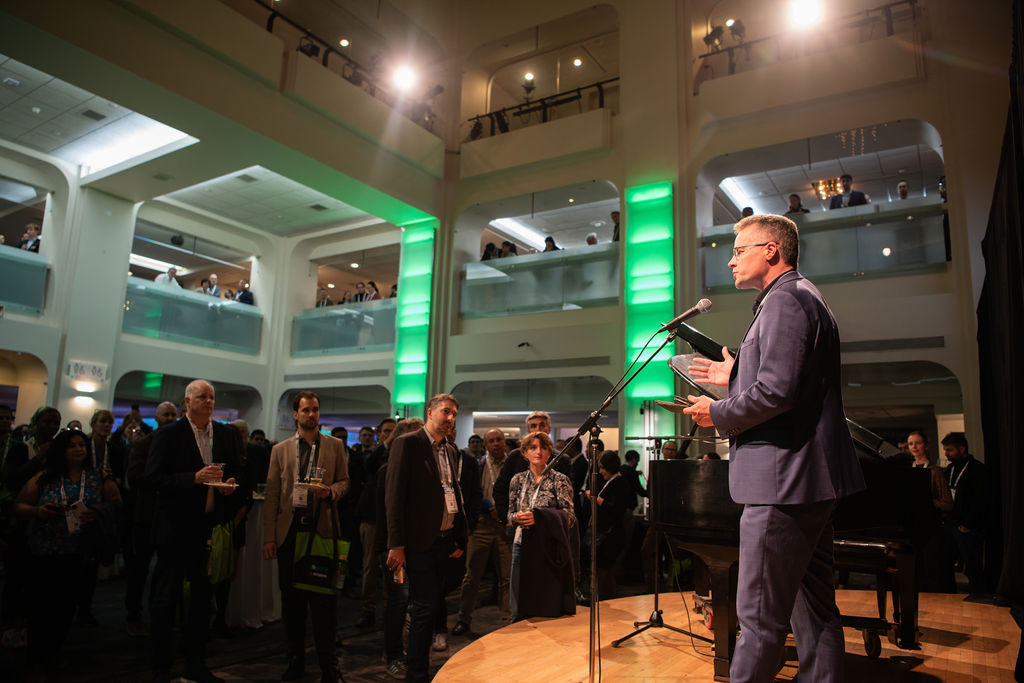
Riemer’s position brings him into contact with entrepreneurs and established operators, as well as government and other funders. Their interests overlap, but their clocks do not always run together. An inventor may need the next demonstration promptly. A host facility has operating obligations. A funder needs evidence. A useful partnership gives those different clocks a shared appointment.
A pilot needs somewhere to land
The Tailings Technology Challenge makes that coordination unusually concrete. Announced in June 2025 with up to C$50 million available, it sought technologies to reduce and manage oil sands mine water and tailings. Technology providers needed a confirmed host relationship with an oil sands operator. ERA would cover no more than half a project’s eligible expenses. A proposal therefore needed both a place to work and partners prepared to contribute.
By March 2026, the challenge had selected nine projects for C$46 million in funding, with a combined value of approximately C$133 million. The work included membrane technologies, improved tailings treatment and evaluation methods. These are specific operating questions: how to recover water, manage stored material and make eventual reclamation more achievable. They also require testing under conditions that a laboratory cannot fully reproduce.
One selected project led by the Northern Alberta Institute of Technology concerns a framework for evaluating treatment technologies and chemical additives, developed with industry and Indigenous communities. That is a revealing inclusion. Sometimes progress depends on agreeing how to judge a result. A new measurement standard can be less photogenic than a new machine, while making it easier to decide which machine deserves a larger trial.
The challenge’s review process also puts limits around the executive’s authority. Experts assess proposals, a Fairness Monitor oversees the process, and ERA’s board makes the final funding decisions. Riemer leads within that structure. Connecting people to a program and producing a fundable project are related tasks, but neither removes the need for scrutiny.
Funding commitments and project budgets. Environmental benefits depend on project results.
The second product is what everyone learns
For Riemer, the value of a funded project extends beyond its own equipment. ERA requires recipients to report outcomes and lessons publicly. A demonstration can leave behind evidence that helps another operator make a better decision. It can also reveal a difficulty that the next developer would otherwise have to discover at considerable expense. The report has a useful life after the ribbon has been packed away.
His 2023-24 message emphasized sharing lessons from projects that succeed and from those that fall short. He also described an open data portal intended to make the portfolio easier to explore. The same message offered a succinct statement of his preferred working method: “Collaboration is critical; more hands make lighter work.” It is an unshowy sentence for a job built around persuading separate organizations to attempt something together.
The following annual report described ERA as a convenor as well as a funder. It had co-hosted the GHGT-17 carbon-capture conference in Calgary with IEAGHG, drawing 1,500 attendees from 47 countries, and brought together more than 100 leaders at a bioenergy and carbon-capture summit in Banff. Those gatherings gave technical work a wider audience and created places for people with different parts of a project to meet.
Riemer’s public argument about methane follows a similar logic. In his 2026 writing, he connects predictable rules and targeted capital with field validation, early adopters and commercial uptake. His examples span detecting emissions and preventing them. The implication is practical: identifying a leak, proving a remedy and persuading an operator to adopt it are connected steps, each with its own requirements.
“Alberta’s clean technology has global potential.”
Justin Riemer · September 2026
Where the money goes when the conversation changes
There is another view of Riemer in his Carbon Copy conversation with energy economist Peter Tertzakian. Their subject is the clean technology investment climate. The discussion considers how artificial intelligence and electrification are changing where money flows, and how Canadian businesses operate between larger economic powers. It is a useful subject for someone whose mandate depends on technologies becoming commercially attractive.
The conversation broadens the setting for his work. A good project still has to compete for attention and capital as markets change. Interest in a technology does not automatically translate into a buyer or an installation. Asking where investment is moving helps bring that commercial reality into a discussion often occupied by technical possibility.
ERA’s August 2026 announcement shows how varied the work has become: nearly C$51 million for 16 projects worth nearly C$180 million. Among them were continuous emissions monitoring, hydrogen infrastructure and lower-emissions materials. The range runs across several industries and locations. These are funding commitments and development projects; their expected benefits depend on successful execution.
That distinction keeps the story honest. The important questions arrive after selection: what gets built, what performs as intended, and what another customer is willing to adopt. Riemer’s work repeatedly returns to that passage from a promising proposal to an operating decision. A funding announcement opens the door. The project still has to walk through it.
- 01Find a hostA setting for a real operating trial.
- 02Share the riskPartners and funding for the attempt.
- 03Report the resultEvidence for the next decision.
Alberta as a starting point
Riemer’s professional attachments remain close to Alberta. His public biography describes a career dedicated to the province, and his education connects him to Edmonton. Alongside his executive work, he contributes through board and advisory roles, including Edmonton Unlimited. His conference biography also offers a modest personal detail: he is married, with two grown sons and a daughter-in-law.
The province is a starting point for his ambitions, rather than the outer boundary. In September 2026, ERA committed up to C$3.2 million to the Clean Energy Transition Partnership’s international funding call. The initiative brings together funding organizations across 30 countries; proposals require participants from at least three countries or regions. It gives Alberta organizations another route to expertise, partners and markets.
His stated aspiration is to help provincial innovation reach commercial use and compete beyond Alberta. It is a fitting continuation of a career spent connecting institutions. Local industrial problems can provide the first testing ground. A wider network can help a solution find its next application.
The through-line is less dramatic than an invention story, and more revealing about how inventions reach the world. Someone must arrange the first host, the shared contribution, the fair assessment and the exchange of lessons. Riemer has built his working life around those arrangements. The interesting moment comes when a technology earns a place in ordinary operations, and people have enough evidence to try it again.
Follow the work
- Justin Riemer on LinkedIn
- ERA’s executive biography
- Watch: Riemer with Peter Tertzakian
- University of Alberta teaching profile
- Riemer’s writing on methane deployment
- ERA’s 2026-29 business plan
- 2026 tailings project details
- August 2026 project announcements
- International funding announcement
- Read the 2023-24 annual report
- Read the 2024-25 annual report
- ERA on YouTube
- ERA on Instagram
- ERA on X