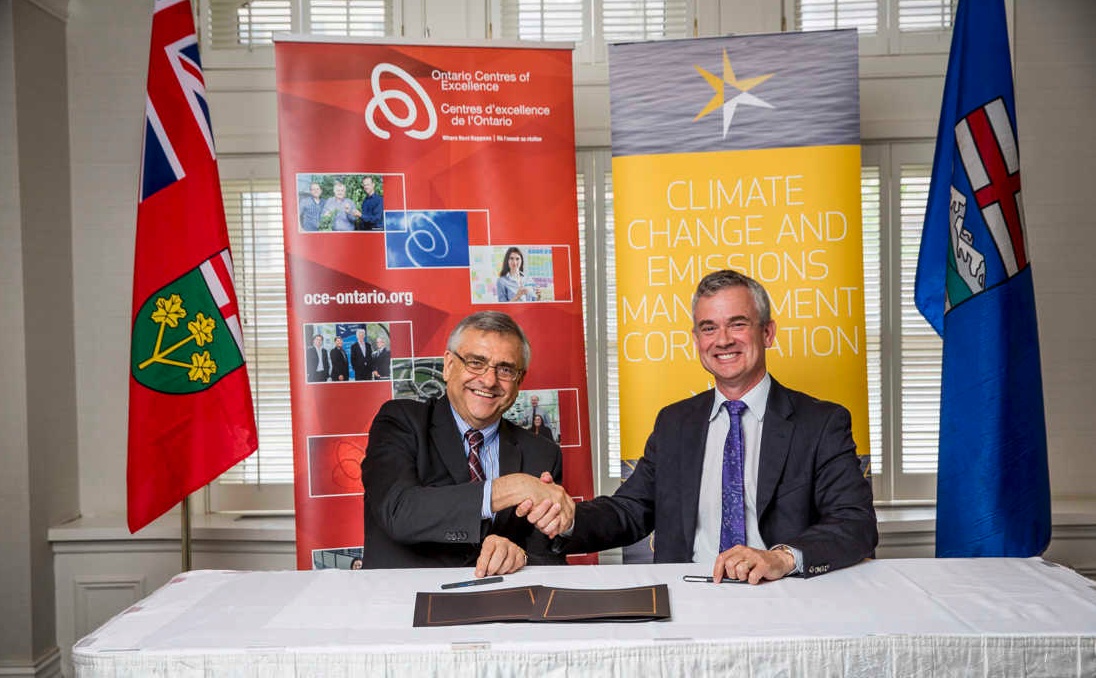
The photograph has all the ingredients of an official occasion: two provincial flags, two banners, a document on a table and a handshake held long enough for the camera. Steve MacDonald is on the right, smiling beside Ontario Centres of Excellence chief executive Tom Corr. They are signing a memorandum of understanding in 2016. A photograph of paperwork might seem an unlikely place to begin a story about climate technology. In MacDonald’s career, the paperwork is often where the interesting part begins.
Two years later, Ontario announced $3.5 million for Alberta projects also supported by Emissions Reduction Alberta, Alberta Innovates and Canada’s Natural Sciences and Engineering Research Council. The subjects included lower-carbon cement fuels, atmospheric modelling and methane detection using satellites and aircraft. The handshake had acquired a practical afterlife. MacDonald described the purpose neatly: “turn ideas into products and products into companies.”
A career on both sides of the policy desk
MacDonald came to ERA with a career in Alberta’s public service behind him. His executive assignments spanned Treasury Board, Energy, Innovation and Advanced Education, and Executive Council. He had also helped develop the province’s climate-change policy framework. That experience put him close to the difficult junction where environmental ambitions meet budgets, industrial operations and the machinery of government.
He became interim chief executive of the organization then known as the Climate Change and Emissions Management Corporation. In October 2016, it adopted the public name Emissions Reduction Alberta. The permanent appointment was announced on April 13, 2017, after a national recruitment process. By then, he had occupied the interim post for just over a year.
Chair Kathleen Sendall highlighted his relationships with government, industry and Alberta’s innovation community. The appointment carried a particular logic: someone who had helped shape policy would now lead an organization charged with helping technology catch up with it. Rules can change a company’s incentives. They cannot, by themselves, design its next piece of equipment.
The carbon-price money gets a job
ERA was established in 2009, years before MacDonald arrived. Its model directed money collected through Alberta’s industrial carbon-pricing system into clean-technology development and deployment. By his permanent appointment in 2017, the organization had committed more than $330 million to over 100 projects, with a combined value exceeding $2.2 billion. He inherited an operating institution, with a history and obligations of its own.
The range of work resisted a tidy label. Early in his tenure, the portfolio included rooftop solar at Leduc’s recreation centre, methane-reduction projects and plant-oil-based spray foam developed through a University of Alberta partnership. A cleaner economy could involve a roof, a gas facility or the material inside a wall. Some of the most consequential changes would be quite difficult to photograph.
That variety also complicates the job of a chief executive. Different technologies mature at different speeds. Some projects aim for near-term reductions; others explore equipment or processes with a longer route to use. In his 2016 annual-report message, MacDonald emphasized working across those timescales and strengthening collaboration. The organization had to keep an eye on immediate industrial needs while leaving room for unfamiliar approaches.
“We need to cut costs and we need to cut carbon.”Steve MacDonald, 2018 interview
A methane challenge with 118 answers
The Methane Challenge opened in October 2016. By July 2017, ERA had approved up to $29.5 million for 12 projects drawn from 118 submissions. They addressed monitoring, detection and reduction across oil and gas, electricity generation, agriculture and forestry. The competition gave a broad policy objective a set of specific technical assignments.
Its development brought together the provincial government, the Alberta Energy Regulator, industry associations, Canada’s Oil Sands Innovation Alliance and the Pembina Institute, among others. Their participation illustrates the kind of coordination that kept recurring during MacDonald’s tenure. A regulator, a producer and an environmental organization bring different concerns to the same table. A useful funding program has to understand the work each will need to do.
The announcement projected emissions benefits into the future. Those estimates described what the funded projects were expected to achieve; they were not a receipt for reductions already delivered. The distinction matters in a career built around technology funding. Selecting a project begins a period of testing, measurement and implementation. The announcement is the starting gun, however satisfying the photographs may be.
Nine projects, two tests
In 2018, the Oil Sands Innovation Challenge committed more than $70 million to nine projects valued at over $720 million. The target was a sector central to Alberta’s economy and central to its emissions problem. The technologies addressed both mined and in-situ operations, including opportunities to retrofit existing facilities.
MacDonald’s description of the competition joined carbon reductions with lower costs. He spoke about possibilities such as changing the use of steam in extraction and reducing the need for tailings ponds. These were ambitions attached to technology development, rather than announcements that the industry had already solved those problems. His framing put operating economics inside the environmental question.
There is an everyday discipline in that pairing. Industrial equipment has to perform in an actual facility, inside an actual business. A promising process must earn its place alongside existing machinery and meet the demands of the people running it. MacDonald’s public argument asked whether climate technology could improve that business while changing its environmental footprint. The funding competitions made the question concrete enough to test.
The room is part of the machinery
MacDonald’s ERA years also included building places for those conversations. ERA and Alberta Innovates co-hosted SPARK 2017, bringing together more than 400 attendees. SPARK 2019: Carbon Positive later gathered more than 600 speakers, presenters and participants to consider carbon’s uses and possibilities. Conferences have no shortage of optimistic vocabulary; the useful question is what participants can do with one another afterward.
The 2019 event carried its own operational experiment. Edmonton Convention Centre announced it would host the city’s first carbon-neutral conference, with carbon accounting and reporting arrangements. MacDonald connected the event’s practices to its larger purpose of reducing environmental impact while supporting economic activity. Even the gathering was being asked to take its own subject seriously.
His work travelled beyond Alberta. He spoke at the European Commission’s carbon-market workshop in Florence, sharing examples from ERA’s funding model. In 2021, he attended COP26 in Glasgow as part of the Canadian delegation and on Alberta’s behalf. There, discussions included carbon pricing, investment and market trends. The provincial portfolio had become material for an international conversation.
- IdeasResearch and technical proposals
- ProductsDevelopment and demonstration
- CompaniesCommercial use and wider markets
A conceptual illustration of his stated aim, rather than a measured conversion rate.
A wider definition of waste
In March 2022, near the end of his ERA tenure, the organization launched a $50 million Circular Economy Challenge. It invited projects involving resource recovery, recycling, reuse and other ways to keep materials valuable for longer. The eligible stages were field pilots, demonstrations and first commercial implementations of new technologies.
The program offered successful applicants up to $10 million, covering up to half of eligible project expenses. Its potential subjects included agricultural waste, metals recycling, advanced plastics technologies and carbon-dioxide conversion. MacDonald characterized circular thinking as a way to turn resource and waste problems into opportunities. The scope extended well beyond a single fuel or industrial sector.
The rules provide a useful glimpse of the job behind the title. A funder has to decide which stage of development to support, how much risk to share and where work should happen. For this competition, demonstration and deployment had to take place in Alberta. Partnerships were encouraged. The policy ambition arrived with a budget, eligibility conditions and a deadline: the less glamorous accessories that make an idea actionable.
Leaving the chair, keeping the work
In May 2022, ERA announced that Justin Riemer would take over as chief executive on June 6. MacDonald was stepping down after more than six years leading the organization. Board chair Dave Collyer credited him with improving coordination across government and industry, as well as strengthening ERA’s direct impact. His departure was also the subject of the Carbon Copy podcast episode “All About the People.”
MacDonald’s own farewell thanked the team and stakeholders for their creativity and collaboration. It fit the career’s recurring emphasis on work shared across institutions. The projects belonged to developers, researchers, operators and funders; leadership involved helping those contributions meet.
The next chapter included +SM Advisory Services, where he became principal, and AltaLink, whose board he joined on May 9, 2023. His qualifications include a University of Alberta Bachelor of Commerce, the Canadian Securities Program and the ICD.D director designation. The Canada West Foundation lists him in Edmonton and identifies innovation, change management and the energy transition as his current focus. Its biography also records his membership in the Kainai Chieftainship.
The next handshake crosses a border
On November 30, 2023, MacDonald joined Katie Sullivan and Lisa DeMarco as co-author of “The Missing Article: How to get Canada back in the game on Article 6.” The paper examined cooperation under the Paris Agreement, including the international transfer of emissions reductions. It argued that Canada could use these arrangements to expand markets for its expertise and technologies while pursuing climate goals.
The authors also emphasized federal-provincial cooperation. That requirement brings the story back to the table in the photograph. Different governments need a workable arrangement; different organizations need a reason to participate. The scale has changed, but the task remains recognizable.
Across public service, ERA, advisory work and board responsibilities, MacDonald’s career keeps returning to what happens between a policy decision and a functioning project. A memorandum is a modest object. So is a funding application. Both can be the beginning of something consequential, provided the people signing them follow through.