In 2016, Roger Noël prepared to give Ghyslain Goulet the keys to ACET. Noël had led the Sherbrooke technology accelerator since its creation five years earlier. Goulet was already inside the organization, working on financial affairs after several years of coaching its entrepreneurs. The transition had an appealingly practical arrangement: Noël would spend more time on ACET Capital, while Goulet took responsibility for the accelerator. Ten years later, the names have changed places. Goulet has handed the CEO role to Eric Gaudreau. He will keep working with the funds.
There is a certain symmetry to this. Organizations devoted to helping founders grow must eventually demonstrate that they can manage change themselves. Goulet’s next chapter offers a particularly clear example: the executive leaves the chair, while the investor remains involved. The relationships built over years need not pack their bags on the same afternoon as the job title.
A handover with a memory
Gaudreau’s appointment was announced in August 2026, with a September 21 start date. By then, ACET was marking its fifteenth year and supporting roughly 60 companies annually. Goulet had been CEO since January 2017. His farewell message credited the board, Université de Sherbrooke, the business community and the team. He described succession as a healthy step and said he would continue managing the ACET fund family and Quantacet.
“It is natural and healthy to make room for successors,” he wrote, in translation. The sentiment has some history behind it. When Goulet was preparing to succeed Noël, the two worked alongside each other so that Goulet could learn the organization and become known within the university community. ACET’s leadership was being transferred through shared work, with time allowed for introductions and familiarity.
That earlier handover happened in an organization with 52 companies accompanied over its first five years. Its public accounting included companies sold or merged and companies that had closed. It was a useful reminder of what an accelerator actually handles: developing businesses, uncertain outcomes and people trying to make decisions before the evidence is complete. Goulet inherited that responsibility before becoming the person who would eventually pass it on.
Two changes of CEO. Continued involvement on the investment side.
Before the quantum fund, a regional map
Goulet studied finance at Université de Sherbrooke, with his public professional profile listing 1989 to 1992. He began his career in manufacturing, then directed economic development in the Memphrémagog region from 1992 to 2009. During that period, he also served as president of Quebec’s association of economic development professionals, from 2003 to 2005. His working world included established businesses and the institutions surrounding them.
He later founded A+ Stratégies, a consulting firm that helped foreign companies with investment projects in Quebec. Before his name appeared beside a quantum investment fund, it appeared beside the less glamorous business of development strategies, expansion projects and corporate advice. Those activities put questions of financing and growth into a regional setting. A company’s plans had to meet the resources available to carry them out.
His move into ACET brought that background into contact with earlier-stage businesses. A researcher preparing to start a company faces a different calendar from an established manufacturer considering an investment. Both still need decisions about money, customers and the next stage of development. Goulet’s career crossed those settings, giving his later incubation work a business history that stretched beyond the startup vocabulary.
The customer is allowed to be unimpressed
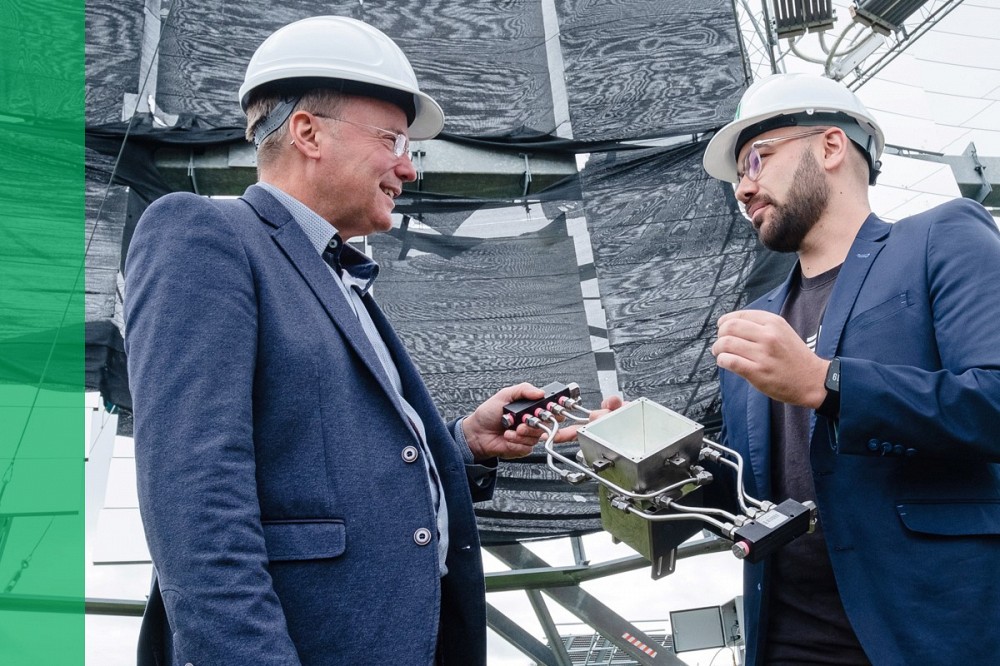
In a 2019 photograph, Goulet stands with doctoral researcher and C-SAR founding member Jean-François Dufault. Both wear hard hats. Between them sits an assembly of components, cables and tubing. Goulet is looking toward Dufault as the younger entrepreneur gestures. The picture provides a welcome interruption to the usual language of innovation: here are two people, a piece of equipment and something to discuss.
Goulet’s description of ACET’s work was similarly concrete. In discussing its 2017 activity, he singled out two fundamental needs: commercialization and financing. Young companies had to sell, and Quebec’s market meant they should look toward the United States and Europe. Technology’s promise could attract attention; the business still required customers and capital willing to accept risk.
ACET’s support paired coaching with market intelligence and investment. In 2019, Goulet described a model in which projects received 250 to 500 hours of personalized coaching. The purpose was to bring business experience into a founder’s decisions. Market analysis addressed another awkward possibility: the people who might buy a product could want something different from the people who invented it. A prospective customer has no obligation to admire the engineering.
“Notre rôle est de répondre aux besoins de nos entreprises.”
Ghyslain Goulet, discussing ACET’s 2017 activity
On meeting the needs of ACET companies.
Twenty-one investors walk into a fund
In 2018, ACET Capital 2 arrived with C$7.6 million. Quebec’s government contributed C$2 million, National Bank C$1.4 million, and 21 private investors C$4.2 million. Goulet became the fund’s president that year. The breakdown deserves attention because it shows the institutional and individual commitments behind a sum that can otherwise disappear into a headline.
The fund’s launch plan was to invest in 20 to 25 ACET technology companies over four years. That was an intention, rather than a tally of completed investments. It joined the accelerator’s earlier capital vehicle and gave selected founders another potential source of equity financing. The money belonged to a fund with a defined purpose. It should not be confused with Goulet’s personal wealth, an accelerator’s revenue or every dollar raised by its companies.
- C$4.2m · 21 private investors
- C$2m · Quebec government
- C$1.4m · National Bank
That same year, an Espace CDPQ investor clinic at ACET put Goulet on a panel with Brightspark’s Éléonore Jarry. The announced questions were usefully direct: which entrepreneurs attract investors, when should a company seek venture capital, and what should a founder consider before accepting it? Financing has its own courtship rituals. A clinic can at least let both sides ask questions before anyone starts celebrating.
A small city, an overseas address book
For Goulet, the need to reach other markets became a partnership question. On May 27, 2021, ACET and MonacoTech signed a collaboration agreement aimed at helping their startups commercialize overseas. Monaco’s incubator and Sherbrooke’s accelerator offered access to each other’s networks, with support for validating business propositions and testing products in unfamiliar markets.
Goulet highlighted the European business connections available to ACET companies. The partnership also offered MonacoTech’s startups a connection to Quebec and North America. It was a reciprocal arrangement, shaped around the practical difficulty of entering a market where a founder’s existing contacts may be few. A good introduction cannot guarantee a sale. It can make the next conversation possible.
The agreement fits the geography of his career. Earlier consulting work dealt with foreign companies investing in Quebec. At ACET, part of the task involved helping Quebec companies look outward. Sherbrooke remained the base, while the commercial map extended beyond it. Regional development and international business could meet in the same founder’s plans, provided someone helped translate ambition into contacts and tests.
Physics meets the investment committee
In November 2023, Quantacet announced a C$20 million first close for a venture capital fund dedicated to quantum technology startups. Goulet was one of its three co-managers, alongside Martin Laforest and Chloé Archambault. The fund’s stated aim was to invest in about 20 companies over five years. Again, the announcement described a plan at a particular moment.
The team combined different kinds of experience. Goulet brought finance, business strategy and the management of ACET’s earlier funds. Laforest’s background included quantum research and industry work. Archambault had worked in technology transfer and at quantum computing company Anyon Systems. Their responsibilities brought commercial judgment into contact with specialized technical knowledge.
Goulet described Quantacet as bringing together private investors from Quebec and Estrie to support young quantum companies, including businesses active in Sherbrooke and incubated at ACET. Quantacet also became a co-founding partner of QV Studio, a venture studio intended to create and develop quantum businesses. The links between researchers, incubators and investors were being given specific organizational forms. Each had a different job; the shared challenge was getting young companies further along.
Leaving the chair, keeping the work
A government profile published in January 2026 counted more than 200 startups mentored by ACET since its founding. It also described businesses moving from incubation toward subsequent public financing, including Nord Quantique, Boréas Technologies, Synode and Calogy Solutions. That cumulative activity belongs to the organization and the people involved across its history. Goulet’s tenure occupies a substantial stretch of that history.
His own emphasis, as succession approached, was on remaining useful. In a public reflection ahead of InnovAcet, he wrote about what an entrepreneurial support organization learns from its entrepreneurs, how it works and whether it keeps questioning itself. The October 7 program scheduled a conversation with Gaudreau, moderated by Catherine Mathys, around ACET’s inheritance and future ambitions.
There is an apt final turn in this career. Goulet once worked beside an outgoing CEO, learning the organization before taking charge. Now another executive has taken charge, while Goulet continues with its investment funds. The succession changes who leads ACET day to day. The work of weighing young companies, finding capital and connecting people continues. The keys have moved to another pocket. Goulet still has a reason to come through the door.
Continue the conversation
Ghyslain Goulet on LinkedIn ↗
ACET’s website ↗
Meet the Quantacet team ↗
The September 2026 leadership handover ↗
A closer look at ACET’s coaching model ↗
The 2018 launch of ACET Capital 2 ↗
Quantacet’s C$20 million first close ↗
InnovAcet’s 2026 program ↗
Goulet’s professional biography ↗
Goulet on commercialization and financing ↗
ACET’s first leadership handover ↗
The MonacoTech partnership (PDF) ↗